
 Image 1 of 1
The Jungle — Upton Sinclair
Upton Sinclair
Doubleday, Page & Company · New York · 1906
First Edition · First Printing
The Book:
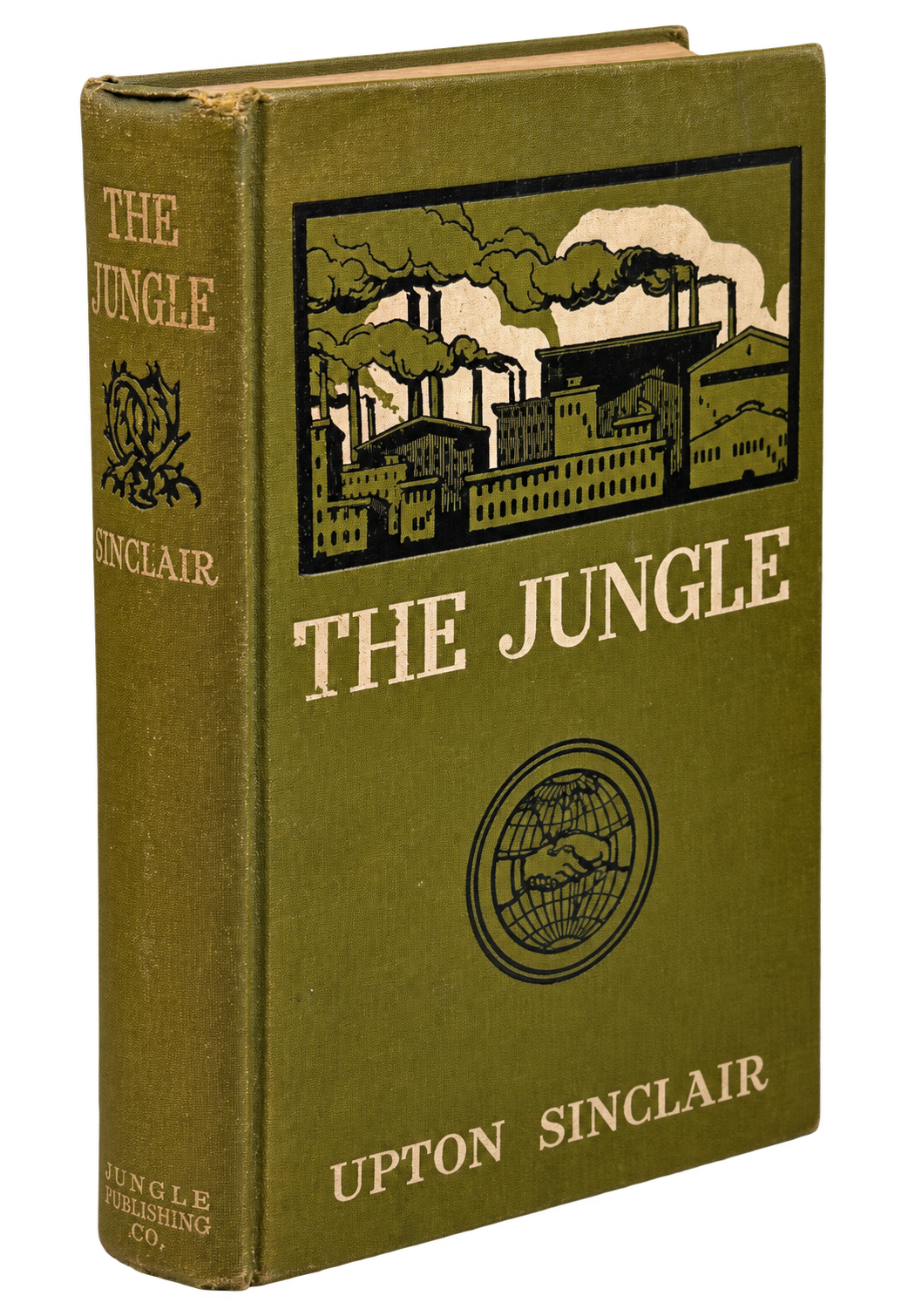
The first trade edition, first printing of Upton Sinclair’s The Jungle, published by Doubleday, Page & Company in February 1906. This copy retains the earliest textual points: the unbroken numeral “1” in the copyright-page date, “brass buttons” on page 42, “eight dollars” on page 82, and the undamaged numeral “3” in the page number on page 385. Original olive-green pictorial publisher’s cloth stamped in black, gray, and white. The original dust jacket is not present.
Condition:
Very Good. The original pictorial cloth remains complete and the binding sound, with light rubbing to the boards and moderate wear at the spine ends and corners. The text block remains clean and bright. A small pencil notation is present on the front pastedown. No restoration or structural defects are observed. The original dust jacket is not present.
Story Of The Book
Upton Sinclair went into Chicago’s stockyards intending to expose what industrial capitalism was doing to workers. America became horrified by what the stockyards might be doing to its dinner.
Sinclair spent weeks investigating the meatpacking district and built The Jungle around Jurgis Rudkus, a Lithuanian immigrant who arrives in Chicago believing hard work will secure a better life. Instead, Jurgis and his family encounter dangerous labor, poverty, exploitation, injury, corruption, and an economic system capable of consuming people almost as efficiently as the factories process animals.
Sinclair intended the novel as an indictment of that system. But readers seized upon something else.
His descriptions of filthy slaughterhouses and contaminated meat created a national sensation. Meat sales fell, President Theodore Roosevelt ordered an investigation, and Sinclair corresponded directly with the president about conditions in the packing industry. The resulting public pressure helped break a political stalemate that had frustrated federal food regulation for decades. In June 1906—only four months after the novel appeared—Roosevelt signed both the Pure Food and Drug Act and the Federal Meat Inspection Act.
Sinclair wanted readers to see exploited workers. Instead, millions of Americans imagined what might be inside their food—and Congress moved.
The irony became inseparable from the book’s history. Sinclair’s socialist novel did not transform American capitalism as he hoped. It did something far more immediate and measurable: it helped force the federal government to regulate what Americans ate.
Why It’s In The Collection
The Jungle belongs in Consigned to Darkness because few books demonstrate more dramatically what can happen when writing exposes a system powerful institutions have tolerated.
Sinclair investigated an industry whose workers—many of them immigrants—possessed little political or economic power compared with the corporations employing them. Fiction allowed him to make their conditions visible to readers far beyond Chicago.
What happened next demonstrates both the power and unpredictability of publication. The reform movement for federal food regulation already existed, and Congress had considered legislation repeatedly. But The Jungle transformed an established political struggle into a public emergency. FDA's own institutional history identifies the conditions Sinclair exposed as the final precipitating force behind the legislation that followed.
This copy preserves that intervention in its original 1906 trade publication, with the earliest textual points intact—the book as it entered American homes while the controversy it generated was still becoming national policy.
Lots of books change minds. The Jungle helped change federal law.
Collection Categories: Literature · Labor & Economic Justice · Political Dissent · Investigative Journalism · Political Movements · Publication-Event Object
———
Authentication Evidence
Title page identifies The Jungle by Upton Sinclair and bears the Doubleday, Page & Company, New York publisher imprint.
Copyright page states “Published February, 1906,” consistent with the original trade publication.
Copyright-page date retains the unbroken numeral “1” in “1906,” an established first-printing textual point.
Page 42 contains the first-printing reading “blue uniform, with brass buttons.”
Page 82 contains the first-printing “eight dollars” reading.
Page 385 retains the undamaged numeral “3” in the page number.
These four textual points correspond to independently documented first-printing points for The Jungle.
Standard Sinclair bibliography distinguishes the privately financed Jungle Publishing Company Sustainers’ issue as Ahouse A7(b); documented Sustainers’ copies contain three pages of publisher’s advertisements and a Socialist Party emblem in the binding. This copy instead bears the Doubleday, Page & Company imprint and contains no publisher advertisements following the text, supporting identification as the trade issue.
Original olive-green pictorial publisher’s cloth stamped in black, gray, and white is present.
No publisher advertisements follow the text, consistent with the Doubleday trade issue rather than the Sustainers’ issue.
No evidence of rebinding, substituted leaves, facsimile components, book-club manufacture, or later-edition characteristics is observed.
Taken together, the Doubleday, Page & Company imprint, February 1906 publication statement, verified first-printing textual points, original pictorial binding, and absence of the Sustainers’ issue advertisements support identification as an authentic 1906 First Edition · First Printing.