
 Image 1 of 1
The Joke — Milan Kundera
Milan Kundera
Translated from the Czech by Michael Henry Heim
New York: Harper & Row, Publishers, 1982
First U.S. Edition of a Complete Translation · First Printing
The Book:
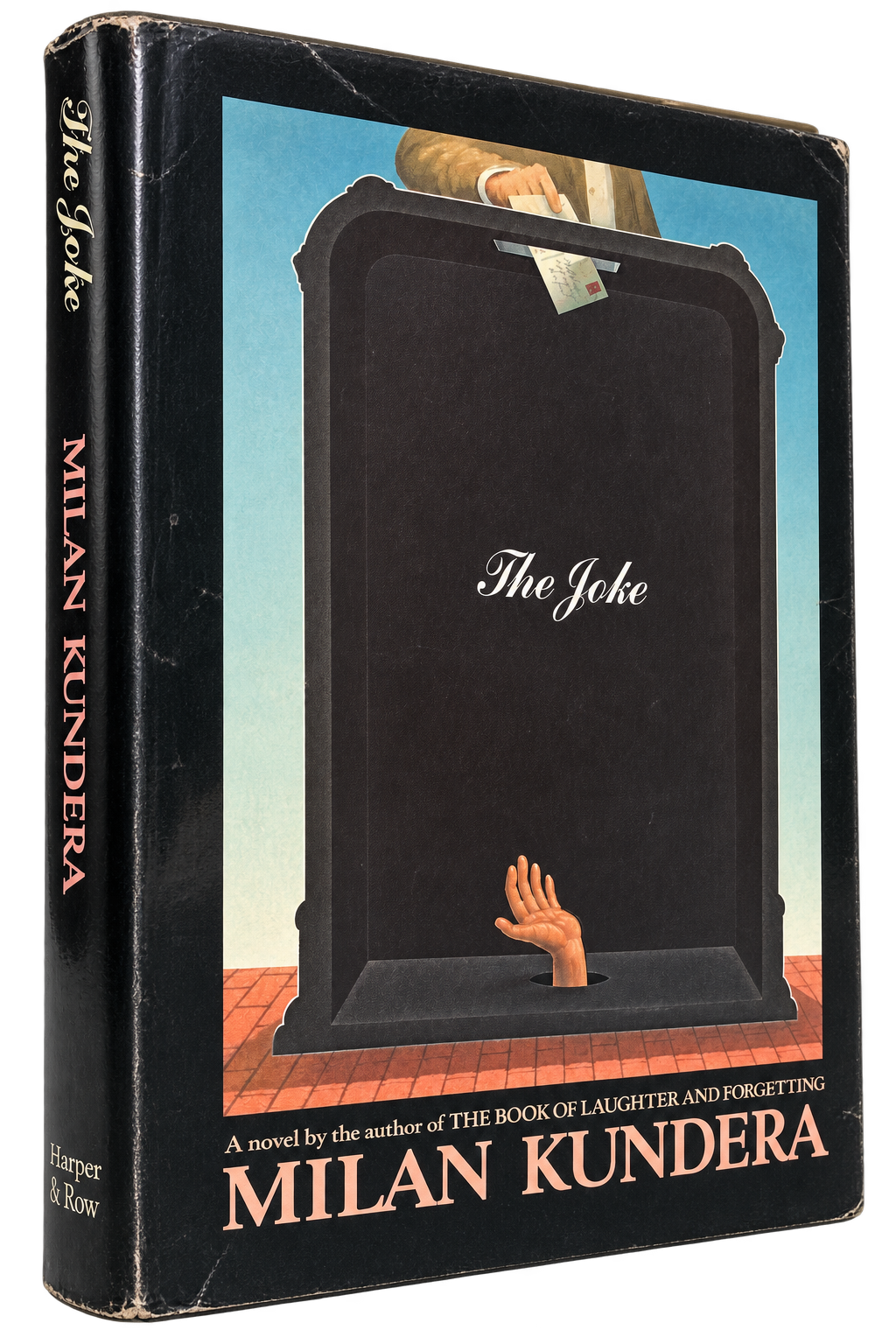
The first U.S. edition of a complete translation of Milan Kundera’s The Joke, published by Harper & Row in 1982 in Michael Henry Heim’s new translation. The distinction is important: this is not the first American edition of the novel, which appeared in 1969. Instead, the copyright page explicitly states “FIRST U.S. EDITION OF A COMPLETE TRANSLATION,” and the complete number line ending in 1 establishes first-printing status. The volume collates to xii, 267 pages and retains its original tan paper-covered boards over black cloth, with gilt spine lettering, and its original pictorial dust jacket.
Condition:
Near Fine in a Very Good+ dust jacket. The binding remains square and sound with exceptionally clean boards, bright gilt spine lettering, clean endpapers, a fresh interior, and no ownership markings or structural defects observed. The original jacket remains complete and visually strong, showing moderate surface rubbing, scattered scratches, light edge wear, and minor compression at the spine ends, with no significant tears or losses. No evidence of book-club manufacture, rebinding, substituted leaves, or facsimile components is present.
Story Of The Book
A joke destroyed Ludvik Jahn’s life. Then translation nearly distorted the novel that told his story.
Originally published in Prague in 1967 as Žert, The Joke appeared during the cultural opening that preceded the Prague Spring. Its central event is deliberately absurd: Ludvik sends a sarcastic postcard whose political slogans are interpreted literally. What should have been private foolishness becomes ideological evidence. He is expelled from the Communist Party, removed from university, and sent into a punitive military labor unit. Kundera turns that grotesque disproportion into an anatomy of totalitarian power—a system in which humor can become guilt and private language can be converted into evidence against the person who spoke it.
History then gave the novel another layer. After the Soviet-led invasion of Czechoslovakia in 1968, The Joke was banned, removed from public libraries, and effectively expelled from the country’s official literary culture. But even when the book reached American readers in 1969, it did not arrive intact. The earlier English translation omitted material and altered the carefully constructed sequence of the novel.
That is what makes this particular 1982 edition so interesting. Harper & Row did not simply publish another translation. It explicitly presented Michael Henry Heim’s version as the “First U.S. Edition of a Complete Translation.” For the first time, American readers received the complete novel with its narrative structure restored. Kundera would later supervise another revised English version in 1992, but this edition remains a distinct publication event: the first American book edition intended to recover the complete work after the compromised version through which Americans had initially encountered it.
The object therefore contains two related stories about authority over language. Inside the novel, political power refuses to allow a joke to remain a joke. Outside the novel, the physical form of the text itself became contested as it crossed political, linguistic, and editorial borders.
The regime distorted the meaning of Ludvik’s words. Years later, this edition helped restore Kundera’s.
Why It’s In The Collection
The Joke is unusually well suited to Consigned to Darkness because the collection’s interest does not end with censored books. It extends to what happens to the text itself when political and institutional forces intervene between an author and a reader.
The novel already belongs here on its substance alone. Kundera depicts a political system incapable of tolerating ambiguity, irony, privacy, or individual error because ideology has become the standard against which ordinary human behavior is judged. After 1968, the Czechoslovak state supplied the real-world counterpart by banning the book and removing it from libraries.
But the collection specifically values the 1982 edition because it adds a second publication history. The earlier American translation had itself been textually compromised. This first printing of the first U.S. complete translation represents an attempt to return the full work and its intended structure to American readers. The inventory therefore treats it not merely as a Kundera first, but as a publication-event object documenting the recovery of literary integrity.
Placed alongside The Book of Laughter and Forgetting, the relationship becomes particularly strong. One book asks what happens when political power manipulates collective memory. The Joke demonstrates something even more tangible: texts themselves can become historical battlegrounds, altered, suppressed, restored, and republished as authority changes hands.
The collection therefore values this edition for a reason that conventional first-edition collecting might initially overlook. The 1969 American edition came first. The 1982 edition is the one that documents correction.
Some publication events introduce a book. Others give the book back to its author.
Collection Categories: Censorship · Anti-Totalitarianism · Political Dissent · Anti-Authoritarianism · Exile & Émigré Literature · Publication-Event Object · Literature
———
Authentication Evidence
• The title page identifies the work as The Joke by Milan Kundera and states that it was translated from the Czech by Michael Henry Heim.
• The title page bears the Harper & Row imprint and publisher’s device, consistent with the 1982 United States edition.
• The copyright page explicitly states “FIRST U.S. EDITION OF A COMPLETE TRANSLATION.” This directly establishes the edition represented by the copy; it should not be simplified to “First American Edition,” because an earlier American edition appeared in 1969.
• The copyright page identifies the original work as Žert, records copyright ©1967 by Milan Kundera, and records the English translation copyright ©1982 by Harper & Row.
• The complete number line reads 82 83 84 85 86 10 9 8 7 6 5 4 3 2 1. The terminal “1” directly establishes first-printing status.
• The copyright page gives ISBN 0-06-014987-6, matching bibliographic records for the 1982 Harper & Row edition. Institutional cataloging describes the volume as the “1st U.S. ed. of a complete translation,” with a collation of xii, 267 pages.
• The original binding of tan paper-covered boards over black cloth, with gilt spine lettering, remains present and internally consistent with the publisher and period.
• The original jacket bears the correct title, author, Harper & Row identification, ISBN, summary text describing the new translation, review quotations, and Kundera biographical material.
• The jacket flap explicitly describes the volume as a new translation following the compromised earlier American edition, consistent with the bibliographic identity stated on the copyright page.
• No later-printing statement, book-club designation, remainder mark, rebinding, substituted title leaf, or facsimile characteristic is visible.
• Edition identification: The explicit statement “FIRST U.S. EDITION OF A COMPLETE TRANSLATION” establishes this as the first American publication of the complete text in Michael Henry Heim’s translation. It is not the first American edition of the work in an absolute sense; that distinction belongs to the 1969 edition.
• Printing identification: The complete number line ending in 1 directly establishes the first printing of this 1982 edition.