
 Image 1 of 1
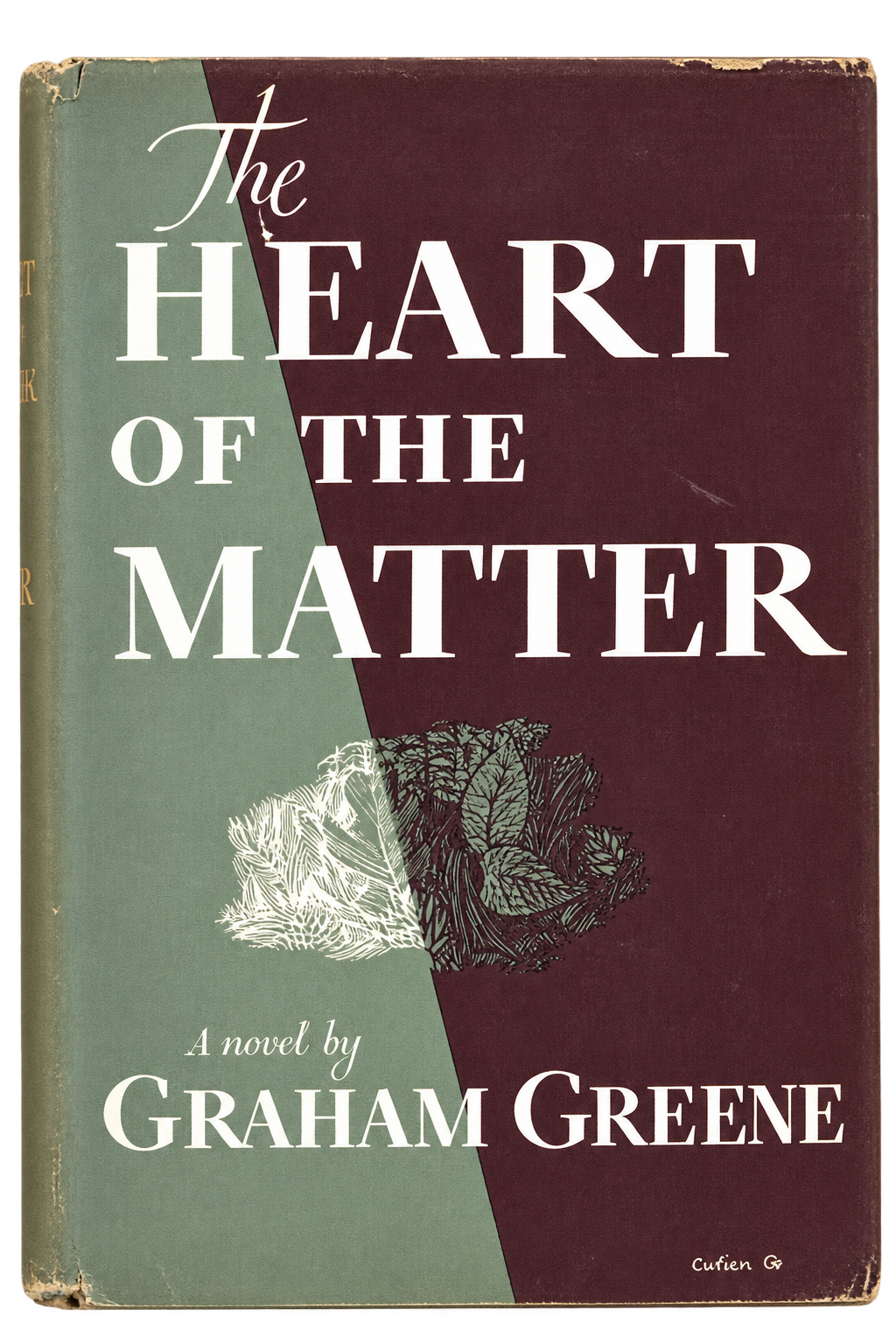
The Heart of the Matter — Graham Greene
Graham Greene
New York: The Viking Press, 1948
First American Edition · First Printing
The Book:
The first American edition, first printing of Graham Greene’s The Heart of the Matter. The copyright page states “Published by The Viking Press in July 1948,” with no later printing statement, consistent with the first printing. This copy retains its original salmon-red boards over a pale green cloth spine and its original unclipped dust jacket priced at $3.00.
Condition:
Near Fine in a Very Good+ dust jacket. The book remains square and clean, with bright original cloth, sharp spine lettering, and a clean interior apart from a former owner’s name on the front free endpaper. The jacket is complete and highly attractive, with strong front-panel presentation, light to moderate edge wear, small chips at the spine ends and corners, and expected age toning.
Story Of The Book
The Heart of the Matter is a novel about the terrifying loneliness of trying to be good.
Set in a British colony in West Africa during wartime, Greene places his central character inside a web of institutions that are supposed to give life order: empire, church, marriage, law, duty.
Instead, each makes competing demands.
The result is not a conventional story of rebellion against authority. It is a story about conscience under pressure.
Greene is interested in what happens when a person tries to behave morally but discovers that every available choice injures someone. Loyalty to one obligation becomes betrayal of another. Compassion creates new guilt. Religious belief offers moral certainty while making human weakness harder to survive.
That is the novel’s cruelty.
Its central character is not destroyed because he has no conscience. He is destroyed because he cannot reconcile all the authorities claiming it.
The colonial setting makes that conflict larger than one man's private crisis. The systems around him—imperial administration, religion, social expectation, wartime duty—each claim legitimacy. Greene refuses to let any one of them provide an easy moral refuge.
The inventory captures the point particularly well: authority does not always destroy people by making them wicked.
Sometimes it destroys them by making goodness impossible.
Why It’s In The Collection
The Heart of the Matter belongs in Consigned to Darkness because power can govern conscience as effectively as it governs behavior.
The novel contains no dramatic censorship battle, political trial, or revolutionary movement. Its authority is quieter. It operates through duty, religion, marriage, colonial hierarchy, and the expectations people internalize about what they owe to others.
That gives the book an important place within the collection.
Many objects in Consigned to Darkness show what happens when people resist obvious coercion. Greene examines the more intimate problem of what happens when several legitimate-seeming systems of authority make incompatible claims on the same human being.
The collection acquired this first American edition, first printing with its original unclipped jacket specifically for that examination of conscience under institutional pressure, moral responsibility, colonial authority, and the conflict between individual integrity and competing systems of power.
Read beside the collection’s more overtly political works, The Heart of the Matter offers a different anatomy of authority: not power demanding obedience at gunpoint, but power dividing the individual against himself.
Greene’s tragedy is not that conscience fails. It is that conscience can become unbearable when every authority insists it is the one that must be obeyed.
Collection Categories: Literature · Religious Conscience · Political History · War & Conflict · Institutional Power · Colonialism
———
Authentication Evidence
• Title page identifies Graham Greene, The Heart of the Matter, published by The Viking Press, New York.
• First Edition Evidence: Title page bears the correct The Viking Press, New York · 1948 imprint, consistent with the first American edition.
• First Printing Evidence: Copyright page states "Published by The Viking Press in July 1948" with no later printing statements, consistent with Viking's first-printing practice for this title.
• Copyright page carries the original 1948 copyright.
• Original unclipped dust jacket retains the correct $3.00 publisher's price.
• Original publisher's binding (salmon-red boards over pale green cloth spine) matches known first American issue.
• No evidence of book-club manufacture, rebinding, ex-library provenance, or facsimile dust jacket observed.
• The observed bibliographic evidence is fully consistent with an authentic First American Edition, First Printing.