
 Image 1 of 1
The Grapes of Wrath — John Steinbeck
John Steinbeck
William Heinemann Ltd., London & Toronto · 1939
First UK Edition · First Printing
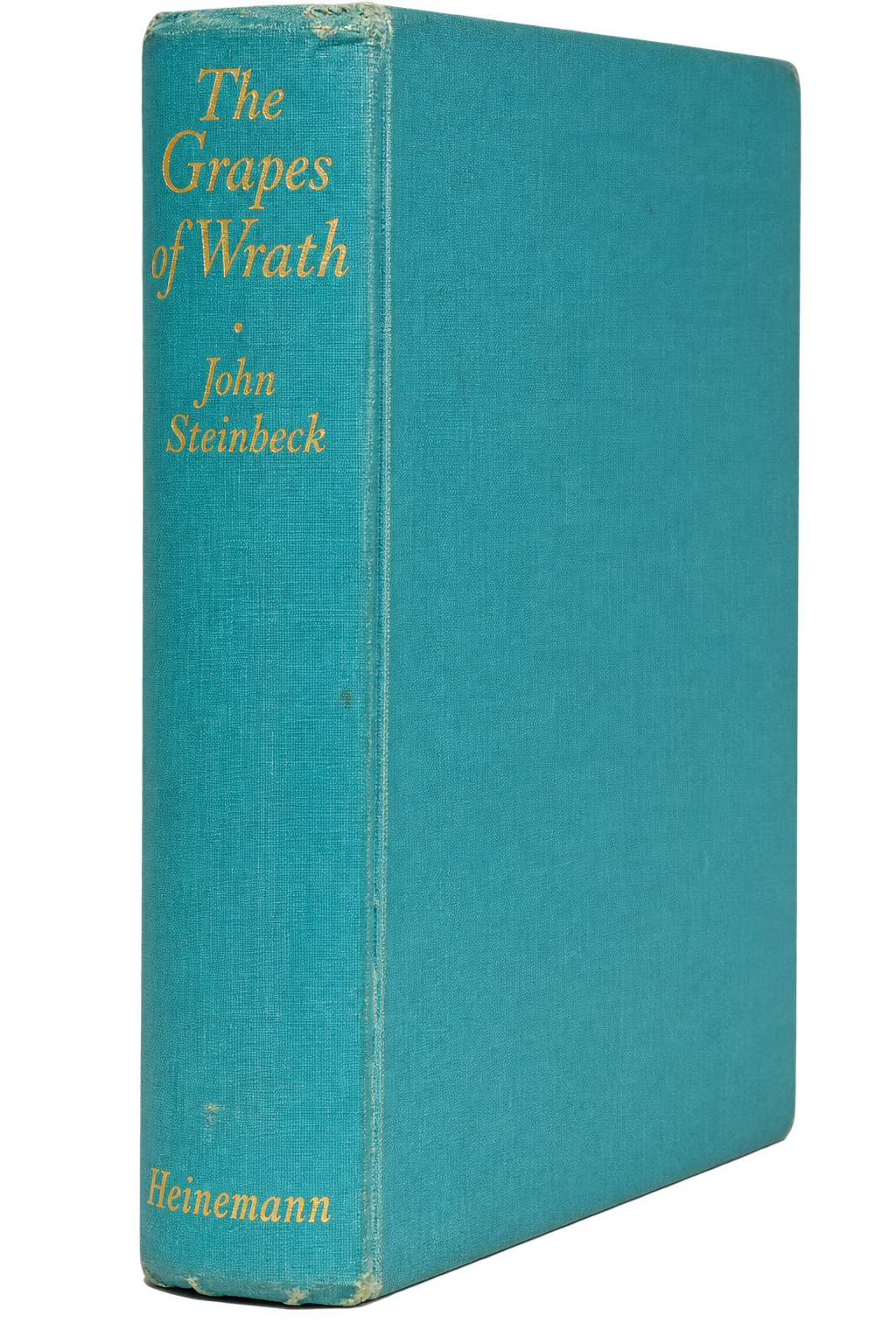
The Book: True first English edition, first printing of John Steinbeck’s The Grapes of Wrath. The title page bears the correct William Heinemann Ltd., London and Toronto imprint, while the copyright/printing page states “First Published 1939” with no subsequent reprinting statement. Documented Heinemann reprints from later in 1939 explicitly add a reprint notice; its absence here supports first-printing status. The volume was manufactured in Great Britain by The Windmill Press, Kingswood, Surrey, and retains the original turquoise-blue publisher’s cloth with gilt spine lettering. Bibliographically identified as Goldstone and Payne A12a. No evidence of book-club manufacture, institutional binding, later impression, or restoration observed. This copy is without dust jacket.
Condition: Very Good+. The original turquoise-blue cloth remains bright with strong gilt spine lettering, a square and tight binding, clean endpapers, and an unusually fresh interior. Minor rubbing is present at the spine ends and corners, with light scattered spotting to the fore-edge and a few trivial marks to the cloth consistent with careful handling. No ownership inscriptions, bookplates, institutional markings, or restoration observed.
Story Of The Book
America called them migrants, vagrants, and burdens. Steinbeck forced readers to see families.
Published in 1939 as the United States continued to struggle through the Great Depression, The Grapes of Wrath follows the Joad family after drought, foreclosure, and economic collapse drive them from Oklahoma toward California. What they find is not the promised land advertised on handbills, but an economy in which desperate workers compete for wages deliberately kept low by the abundance of people with nowhere else to go.
Steinbeck transformed that economic catastrophe into a human one. Through hunger, displacement, humiliation, family separation, and endurance, the novel challenged the idea that poverty represented individual failure. Instead, it asked readers to examine the institutions and concentrations of economic power capable of determining whether people could keep their land, earn a living, feed their children, or preserve their dignity.
The reaction demonstrated how politically dangerous that argument could appear. The Grapes of Wrath was attacked, banned, and publicly burned, particularly in communities that believed Steinbeck had distorted conditions faced by migrant agricultural workers. Yet attempts to discredit or suppress the novel only reinforced its position at the center of the national argument over poverty, labor, and economic justice.
Within months, that argument crossed the Atlantic.
Why It’s In The Collection
The Grapes of Wrath belongs in the collection because it demonstrates literature’s ability to restore individual humanity to people whom economic systems had reduced to a social problem.
The Joads matter not because they are exceptional, but because they are ordinary. They want work, food, shelter, family, and some measure of control over their own lives. Steinbeck’s achievement was to make the deprivation of those ordinary things impossible to understand solely through statistics about unemployment, migration, agricultural production, or wages.
That makes this 1939 first English edition particularly meaningful. Published by Heinemann in the same year as the American original, it records the moment Steinbeck’s account of American dispossession became an international one. The crisis described in its pages had not passed into history: migrant families were still living through it when British readers first encountered the novel.
The book therefore occupies an important place in the collection’s exploration of power without traditional authoritarianism. No dictator is required for individuals to become powerless. Institutions controlling land, employment, wages, and access to basic necessities can profoundly shape human freedom as well. The Grapes of Wrath made those relationships visible—and made the people living beneath them considerably harder to ignore.
Collection Categories: Literature · Labor & Economic Justice · Censorship · Publication-Event Object · Political Dissent · Human Rights
———
Authentication Evidence
• The title page bears the correct title, author, and William Heinemann Ltd., London and Toronto imprint, establishing that the volume belongs to the British Heinemann edition rather than the earlier Viking Press American edition.
• The copyright/printing page states “First Published 1939,” directly supporting first-edition status for the UK publication.
• No reprinting statement appears beneath the first-publication statement. Documented Heinemann reprints from the same year add an explicit statement such as “reprinted September 1939”; its absence supports identification as the first printing rather than the September 1939 reprint.
• The printing page records manufacture in Great Britain by The Windmill Press, Kingswood, Surrey, consistent with the Heinemann British issue shown in the supplied photographs.
• The original turquoise-blue cloth binding and gilt spine lettering correspond to documented first UK edition bindings.
• The typography, Heinemann windmill device, London–Toronto title-page imprint, and binding materials are internally consistent throughout.
• No book-club, export, institutional, later-edition, or later-impression designation is visible.
• Bibliographical references identify the 1939 William Heinemann publication as the first English edition, commonly designated Goldstone and Payne A12a.
• The observable publication statement distinguishes this copy from documented 1939 Heinemann reprints that explicitly identify the later impression.
• Taken together, the Heinemann title-page imprint, unamended “First Published 1939” statement, absence of a reprint notice, Windmill Press statement, and correct original cloth binding establish this copy as a first UK edition, first printing.