
 Image 1 of 1
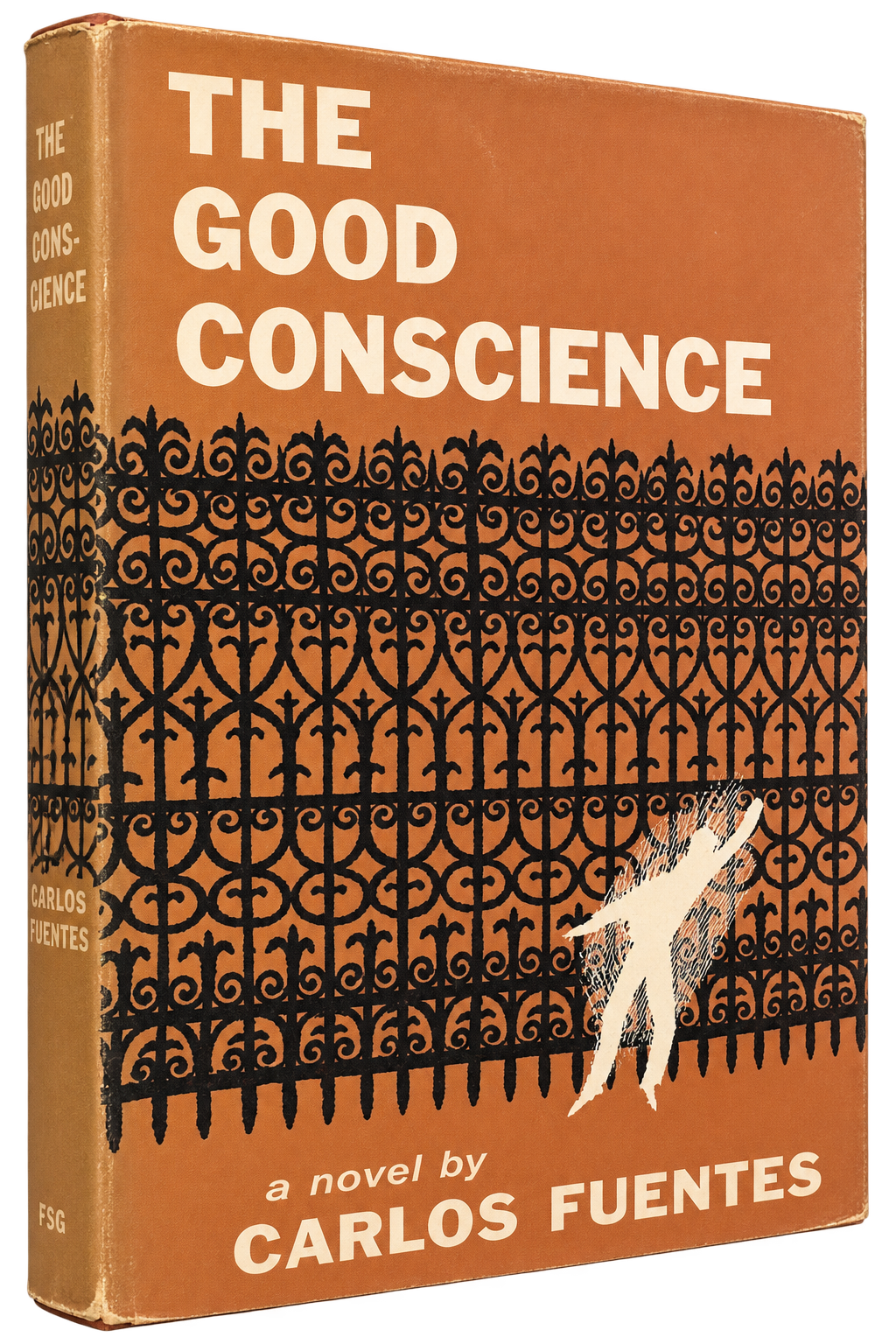
The Good Conscience — Carlos Fuentes
Carlos Fuentes
New York: Ivan Obolensky, Inc., 1961
First American Edition · First Printing
The Book:
The first American edition, first printing of Carlos Fuentes’s The Good Conscience, the first English-language publication of his 1959 novel Las buenas conciencias. The copyright page explicitly states “First Printing.” This copy retains its original brown cloth spine over mustard-yellow paper-covered boards and its original unclipped dust jacket priced at $3.95. Published early in Fuentes’s career, the novel introduced English-speaking readers to one of his first sustained examinations of class, religion, conscience, and inherited social power.
Condition:
Near Fine in a Very Good dust jacket. The book is square and tightly bound, with exceptionally clean boards, bright gilt spine lettering, and a clean interior. The jacket is complete and highly presentable, showing moderate toning to the rear panel, scattered age spotting, light edge wear, and several small chips at the head and tail of the spine.
Story Of The Book
The most powerful rules are often the ones a society teaches people to mistake for virtue.
Set within the rigid social and religious structures of post-revolutionary Mexico, The Good Conscience follows a world in which class, family, religion, reputation, and morality are so tightly intertwined that obedience can begin to look like goodness.
That distinction is what Fuentes sets out to disturb.
The novel is concerned with conscience, but not conscience in the abstract. Its characters must decide what they owe to themselves when the institutions surrounding them already claim to know what a good person should believe, how a respectable family should behave, and where everyone belongs within the social order.
Fuentes is especially interested in the distance between morality and conformity.
An institution does not always preserve its authority by threatening people. Sometimes it succeeds by teaching them that obedience is honorable, hierarchy is natural, and questioning either one is a moral failure.
That is what makes the title so important. A “good conscience” can mean the courage to recognize injustice. But it can also mean the comforting conviction that one has behaved properly according to the rules of a society whose rules have never been seriously examined.
Published in English in 1961, the novel brought this early Fuentes exploration of power, class, religion, and social hierarchy to an American readership while he was emerging as one of the major voices of Latin American literature.
Fuentes asks a difficult question: what is conscience worth if the society that formed it has already decided which injustices should feel normal?
Why It’s In The Collection
The Good Conscience belongs in Consigned to Darkness because authority does not operate only through governments.
Families possess authority. Churches possess authority. Social classes possess authority. Traditions possess authority. And each can become powerful enough that the people living inside them stop experiencing their expectations as coercion at all.
That is the form of power Fuentes examines here.
Unlike Terra Nostra, which confronts empire and historical memory on a vast scale, The Good Conscience brings the same concern with authority into intimate life. The struggle occurs inside families, religious expectations, social conventions, and individual decisions about whether to conform.
That makes the two Fuentes books particularly strong companions within the collection. Terra Nostra asks how civilizations inherit systems of power. The Good Conscience asks what those systems feel like once they have entered the individual conscience.
The collection acquired this first American edition, first printing with its original unclipped dust jacket as an early literary exploration of institutional authority and inherited political, religious, and social hierarchy. Together with Terra Nostra, it documents Fuentes’s sustained interest in the legitimacy of established power and the stories societies use to justify it.
The hardest authority to resist may be the one that has already taught you to call obedience good.
Collection Categories: Literature · Latin American Literature · Political History · Institutional Power · Religious Conscience · Social Criticism
———
Authentication Evidence
• Title page identifies Carlos Fuentes, The Good Conscience, published by Ivan Obolensky, Inc., New York.
• First Edition Evidence: This is the First American Edition, representing the first English-language publication of Las buenas conciencias.
• First Printing Evidence: Copyright page explicitly states "First Printing," confirming first-printing status.
• Copyright page bears the original 1961 copyright.
• Original unclipped dust jacket retains the correct $3.95 publisher's price.
• Original publisher's cloth-and-paper binding matches known first-printing copies.
• No evidence of book club manufacture, rebinding, ex-library provenance, or facsimile dust jacket observed.
• The observed bibliographic evidence is fully consistent with an authentic First American Edition, First Printing.