
 Image 1 of 1
The City and the Pillar — Gore Vidal
Gore Vidal
E. P. Dutton & Company, Inc. · New York · 1948
First Edition · First Printing
The Book:
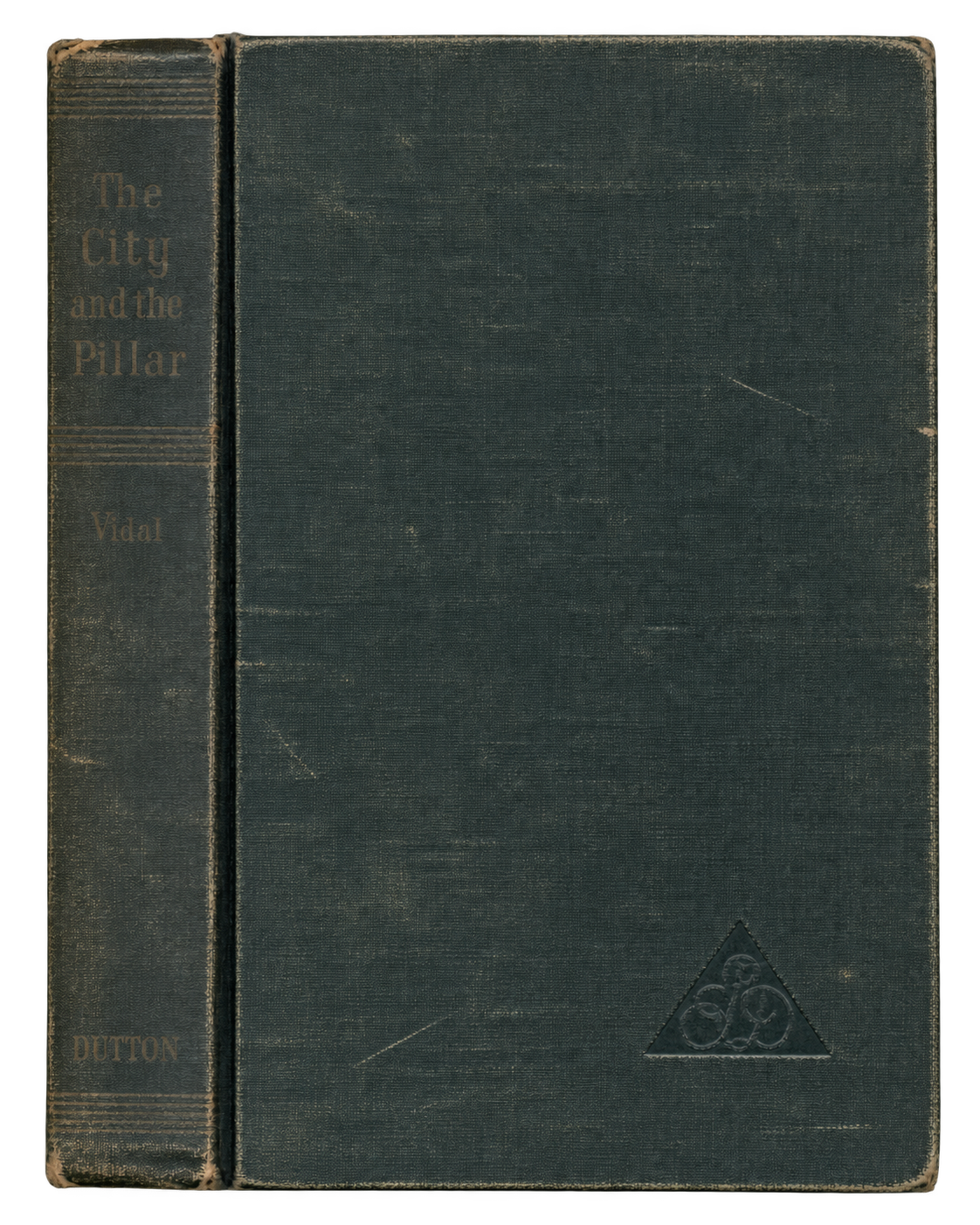
The true first edition, first printing of Gore Vidal’s The City and the Pillar, published by E. P. Dutton in 1948. Vidal’s third novel placed an ordinary young American man’s homosexuality at the center of serious mainstream fiction at a moment when gay characters were commonly confined to pathology, caricature, coded implication, or moral warning. Importantly, this first printing preserves Vidal’s original 1948 text and original ending, both substantially changed when he rewrote the novel for its 1965 revised edition. This copy retains its original black publisher’s cloth and collates to 314 pages. The original dust jacket is not present.
Condition:
Very Good. Original black publisher’s cloth with gilt spine lettering and blind-stamped Dutton device on the front board. Binding remains square and structurally sound, with moderate surface rubbing and shelf abrasion, more pronounced abrasion along the lower front-board edge, softened corners, and substantially faded gilt spine lettering. Interior remains clean with light age toning. A Paul Elder & Co., San Francisco bookseller label is affixed to the front pastedown. No ownership inscriptions, foxing, restoration, or structural defects observed. Lacking the original dust jacket.
Story Of The Book
In 1948, Gore Vidal made a choice that changed his career: he wrote about homosexuality without treating homosexuality itself as the tragedy.
Jim Willard was deliberately recognizable—a young, athletic, conventionally masculine American whose desire for another man did not make him a medical curiosity or a creature existing outside ordinary life. Vidal used him to challenge prevailing assumptions about homosexuality years before the modern gay-rights movement gave those arguments a mass political vocabulary.
The response demonstrated how radical that choice remained. The City and the Pillar became a bestseller, but its frank treatment of homosexuality produced a literary scandal. The New York Times refused advertising for the novel, and Vidal later described being effectively shut out of important reviewing outlets for years afterward.
But the book preserved here tells an additional story that later copies often cannot. In 1965, Vidal returned to The City and the Pillar and substantially rewrote it. He tightened and altered the text and radically changed its conclusion: in the original 1948 version preserved here, Jim kills Bob; in the revised version, Vidal replaced that ending with a different and still violent encounter.
This first printing therefore preserves more than the novel’s first appearance. It preserves the version that caused the original confrontation—the book as American readers actually encountered it in 1948, before Vidal reconsidered and rewrote it seventeen years later.
Why It’s In The Collection
The City and the Pillar belongs in Consigned to Darkness because representation becomes an act of dissent when a culture has decided certain lives should remain unrepresented.
Vidal placed homosexual desire inside the life of a recognizably ordinary American man and asked readers to encounter him as a protagonist rather than a diagnosis or abstraction. Published more than twenty years before Stonewall, the novel forced gay identity into mainstream literary discussion at considerable professional cost to its author.
The fact that Vidal later rewrote the book makes this particular edition especially important. Later editions can preserve Vidal’s mature reconsideration of the novel. This first printing preserves the original intervention. Its text, its original ending, and the controversy that followed belong specifically to the cultural world of 1948.
Even this copy carries a small trace of that original circulation history: its front pastedown retains the label of Paul Elder & Co., the long-running San Francisco bookseller and publisher. The label does not tell us who originally owned the book or precisely when it was sold, but it places this physical copy within San Francisco’s mid-century book trade.
The book was later rewritten. The confrontation cannot be. This is the version that caused it.
Collection Categories: LGBTQ+ History · Free Expression · Censorship · Literature · Publication-Event Object · Cultural Criticism · Sexuality & Culture
———
Authentication Evidence
Title page identifies the work as The City and the Pillar by Gore Vidal.
Title page gives the correct E. P. Dutton & Company, Inc., New York, 1948 imprint.
Copyright page states “Copyright, 1948, by E. P. Dutton & Co., Inc.”, matching the title-page date and documented original edition.
Copyright page explicitly states “FIRST EDITION.”
No subsequent-printing statement appears in the volume; the explicit “FIRST EDITION” statement and absence of later-printing identification support first-printing status.
Volume collates to 314 pages, consistent with the documented 1948 Dutton edition.
Original black publisher’s cloth remains present, with gilt spine lettering and the blind-stamped Dutton device near the lower front board.
Contents divide the novel into “Part I — The City” and “Part II — The Pillar of Salt,” beginning on pages 11 and 209 respectively, consistent with the original edition.
This copy preserves Vidal’s original 1948 text and original ending, predating the substantial rewriting published by Dutton as The City and the Pillar Revised in 1965.
The 1965 edition was explicitly published as a revised edition and substantially altered the text and conclusion, distinguishing this 1948 publication bibliographically and textually from the version underlying most later editions.
Original Paul Elder & Co., San Francisco bookseller label remains affixed to the front pastedown, providing evidence of this copy’s historical circulation through the San Francisco book trade.
Typography, paper, title-page border, copyright-page design, cloth construction, and natural age characteristics are internally consistent with the original 1948 publication.
No evidence of later publisher attribution, revised-edition language, modern reproduction, facsimile leaves, book-club manufacture, or rebinding is observed.
Original dust jacket is not present.
Observable bibliographic evidence supports identification as the 1948 First Edition · First Printing, preserving the original unrevised text.