
 Image 1 of 1
The Brass Check — Upton Sinclair
Full Title: The Brass Check: A Study of American Journalism
Upton Sinclair
Published by the Author · Pasadena, California · 1920
Early Self-Published Edition · First Cloth Edition
The Book:
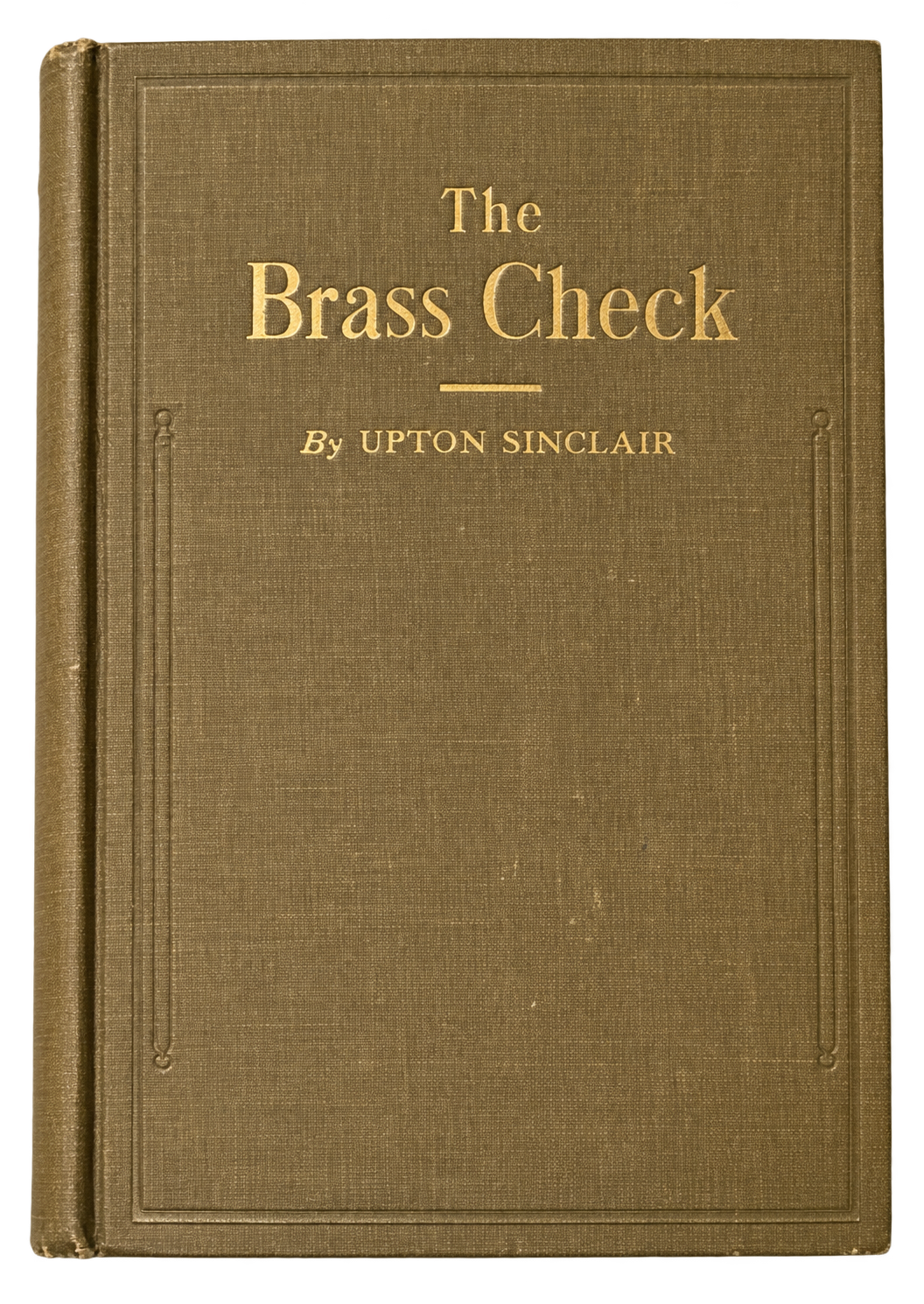
An early self-published edition and first cloth edition of Upton Sinclair’s The Brass Check: A Study of American Journalism, issued by Sinclair himself in Pasadena, California, in 1920. One of Sinclair’s major works of investigative criticism, the book turned his attention toward the institution responsible for investigating everyone else: the American press. 445 pp., followed by publisher advertisements. Original brown publisher’s cloth, front board and spine lettered in gilt. The original dust jacket is not present.
Condition:
Very Good+. The original brown cloth remains attractive, with gilt lettering still clearly visible to the front board and spine, moderate rubbing and handling wear, and minor wear at the spine ends and corners. The binding remains square and tight and the interior remarkably clean and well preserved. A small contemporary pencil price notation appears in the preliminary matter. No ownership inscriptions, bookplates, foxing, restoration, or structural defects are observed. The original dust jacket is not present.
Story Of The Book
After exposing the meatpacking industry, Upton Sinclair turned his attention to the institution Americans depended upon to expose everyone else.
Sinclair believed the problem with American journalism was larger than dishonest reporters or sensational headlines. The deeper problem was structural: newspapers were businesses, and the people who owned them, financed them, and purchased their advertising possessed interests of their own.
In The Brass Check, Sinclair assembled hundreds of examples involving newspapers, magazines, wire services, advertisers, publishers, politicians, workers, and reform movements to argue that supposedly independent journalism could be distorted by the economic system supporting it.
The title itself was deliberately insulting. A “brass check” was associated with the transaction between a customer and a prostitute; Sinclair used the metaphor to accuse journalists and newspapers of selling their independence to the interests that financed them.
His accusation was more dangerous than saying journalists sometimes lie. Sinclair argued that an institution could sincerely call itself a free press while economic power quietly determined whose version of reality reached the public.
The method of publication reinforced the argument. Sinclair bypassed the traditional publishing establishment and issued The Brass Check himself from Pasadena. The book ultimately circulated through numerous editions and became an important early American critique of the economic structures underlying mass media.
Why It’s In The Collection
The Brass Check belongs in Consigned to Darkness because freedom of the press means little if we never ask who possesses the power to operate the press.
The First Amendment can prevent government from controlling newspapers. It cannot, by itself, prevent owners, advertisers, financial incentives, professional interests, or concentrated economic power from influencing what newspapers choose to publish.
Sinclair understood that distinction more than a century ago.
That makes The Brass Check an unusually important object for a collection concerned with free expression and power. It challenges the comforting assumption that threats to the circulation of ideas must originate with government. A formally free press can still reproduce powerful interests, exclude inconvenient voices, and fail the people who depend upon it for information.
This copy carries an additional publication-event significance because Sinclair did not merely criticize the gatekeepers of American information—he circumvented them. Self-publishing allowed him to put his argument directly before readers without depending upon the institutions his book accused of corruption and self-interest.
More than a century later, the technologies and institutions governing information have changed enormously. The underlying question has not:
Who controls the institutions that decide what everyone else gets to know?
Collection Categories: Investigative Journalism · Free Expression · Political Dissent · Anti-Authoritarianism · Media & Propaganda
———
Authentication Evidence
Title page identifies The Brass Check: A Study of American Journalism by Upton Sinclair and states “Published by the Author · Pasadena, California.”
Complete through page 445, including Sinclair’s terminal “Publisher’s Note” and original advertisements for his other works.
Preliminary matter includes Romain Rolland’s “A Letter for the Time,” dated October 6, 1919; this date belongs to the letter and does not represent the book’s publication date.
Sinclair’s documented publication chronology records two paper editions in February 1920 followed by a 16,500-copy cloth edition in April 1920, subsequently described by Sinclair as the “first cloth edition.”
Original brown publisher’s cloth is present, with title and author lettered in gilt to the front board and spine.
Self-published Pasadena imprint, pagination, typography, binding, and terminal matter are consistent with Sinclair’s early 1920 self-published production.
No evidence of rebinding, facsimile components, book-club manufacture, or later commercial reissue is observed.
No definitive physical point distinguishing the first cloth edition from subsequent 1920 cloth issues has yet been located; identification as the First Cloth Edition is therefore supported by the available bibliographic and physical evidence but remains provisional.
Taken together, the physical and bibliographic evidence supports identification as a 1920 Early Self-Published Edition · First Cloth Edition.