
 Image 1 of 2
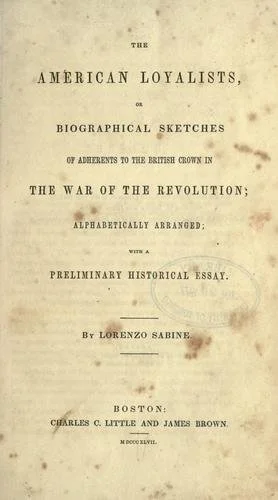 Image 2 of 2
The American Loyalists — Lorenzo Sabine
Full Title: The American Loyalists; or, Biographical Sketches of Adherents to the British Crown in the War of the Revolution; Alphabetically Arranged; with a Preliminary Historical Essay
Lorenzo Sabine
Charles C. Little and James Brown · Boston · 1847
First Edition · First Printing
The Book:
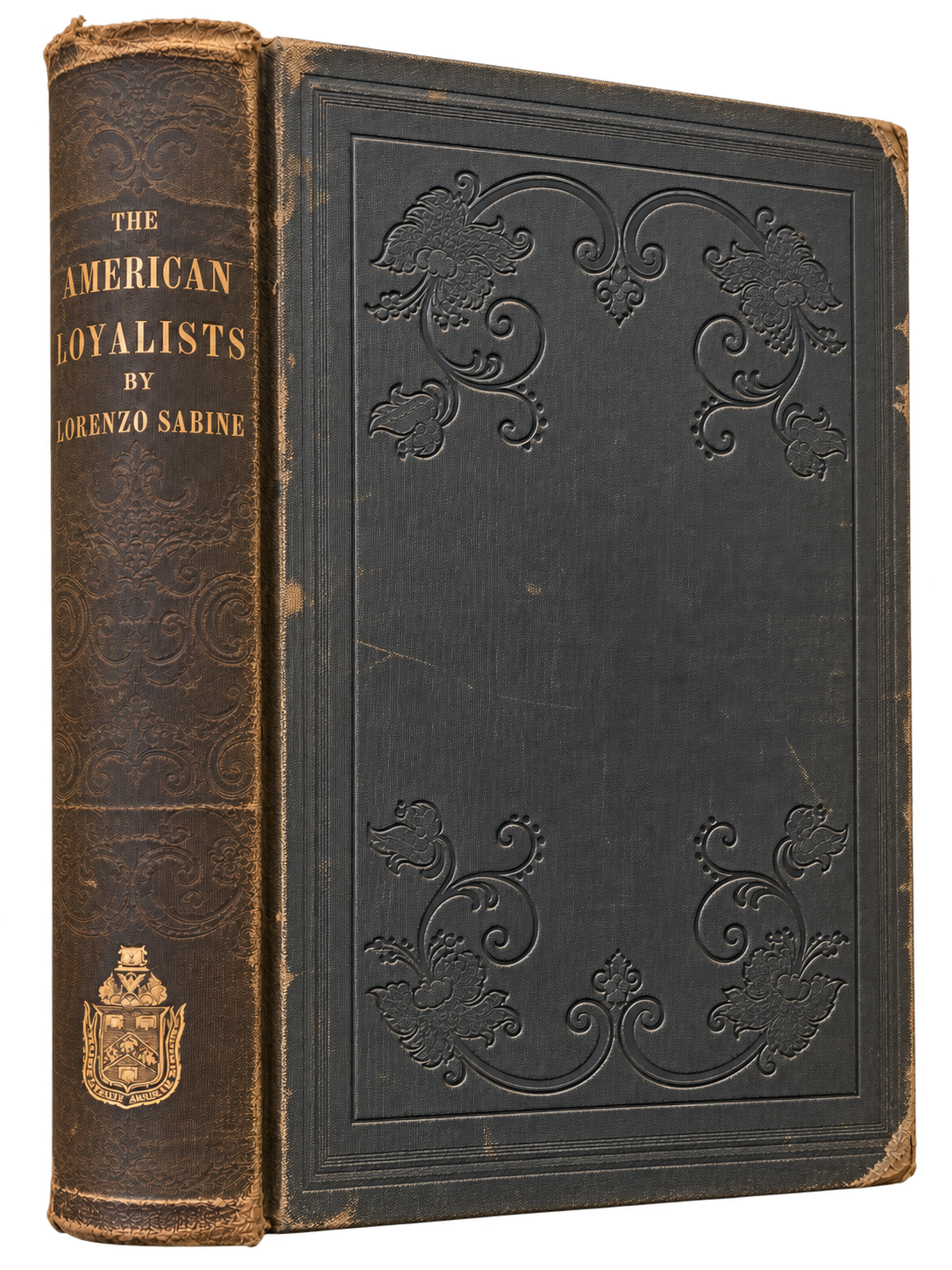
The First Edition · First Printing of Lorenzo Sabine’s pioneering attempt to recover the lives of Americans who remained loyal to the British Crown during the Revolution. Rather than treating Loyalists simply as traitors, Sabine assembled hundreds of biographical sketches documenting confiscation, exile, military service, displacement, and the social consequences of choosing the losing side of the American founding. The volume opens with a substantial historical essay and extends to 733 pages. Original dark publisher’s cloth with elaborate blind-stamped decoration and gilt spine lettering retained.
Condition:
Very Good. Original dark publisher’s cloth remains sound, with moderate rubbing and extremity wear, localized cloth loss and fraying at the spine ends and corners, and scattered foxing and spotting internally. Gilt spine lettering and blind-stamped board decoration remain well preserved. The volume is complete through page 733. A handwritten provenance note attributes former ownership to Ogden Codman Jr., while separate manuscript material records a 1978 purchase from Harold Webster of Waldwick, New Jersey; the Codman attribution remains unverified.
Story Of The Book
Every revolution writes a story about its heroes. Sabine went looking for the people that story had turned into villains.
Published in 1847, The American Loyalists was one of the earliest substantial attempts to reconstruct the lives of Americans who remained loyal to Britain during the Revolution.
Sabine’s subjects had lost homes, property, political standing, communities, and sometimes their country. Many became refugees or exiles. Others served in Loyalist regiments or simply found themselves on the wrong side of a new national mythology.
Instead of reducing them to “Tories,” Sabine restored names, biographies, motives, and consequences.
That reversal of perspective was the book’s real intervention. Seventy-one years after independence, Sabine asked Americans to look beyond the triumphal story of national birth and consider the lives of those history had pushed outside it.
The Revolution created a nation. Sabine asked what happened to the people it left behind.
Why It’s In The Collection
The American Loyalists belongs in Consigned to Darkness because power shapes memory as surely as it shapes law.
The winners of revolutions usually control the story afterward. Sabine challenged that simplicity by recovering the people whose political choices placed them on the defeated side of American independence.
The book does not ask readers to agree with the Loyalists. It asks them to see them as human beings rather than abstractions.
That makes it especially valuable within this collection. It preserves an early American attempt to complicate a victorious national narrative by restoring the voices, losses, and lives of people whom that narrative had largely flattened into a single word: traitor.
History remembered who won. Sabine chose to remember who lost.
Collection Categories: Political Dissent · Political Movements · Political History · Revolutionary History · Exile & Displacement · Human Rights · Anti-Authoritarianism · Witness Literature · Literature
———
Authentication Evidence
Title page identifies the work as The American Loyalists; or, Biographical Sketches of Adherents to the British Crown in the War of the Revolution; Alphabetically Arranged; with a Preliminary Historical Essay by Lorenzo Sabine.
Title page bears the Boston imprint of Charles C. Little and James Brown.
Title page is dated MDCCCXLVII [1847].
Contemporary copyright leaf records entry according to Act of Congress in 1847 by Charles C. Little and James Brown.
Copyright leaf identifies Thurston, Torry and Co., 31 Devonshire Street, Boston, as printer.
Institutional bibliographic records identify the 1847 Charles C. Little and James Brown issue as the original edition; Sabine’s substantially enlarged two-volume edition followed in 1864.
No later-edition statement, later-printing designation, or subsequent publisher appears in the volume.
Collation corresponds to institutional descriptions of the 1847 issue: v, [1], 733 pages.
Final numbered page is 733, followed by “THE END.”
Original nineteenth-century dark cloth binding with elaborate blind-stamped board decoration and gilt spine lettering remains present.
Physical construction, typography, imprint, pagination, and binding are consistent with the original 1847 issue.
No evidence of modern facsimile production, rebinding, supplied leaves, or later-edition substitution is observed.
The handwritten provenance note attributes former ownership to Ogden Codman Jr. (1863–1951), but this remains attributed rather than independently authenticated provenance.
A separate notation records purchase from Harold Webster of Waldwick, New Jersey, on October 22, 1978.
Additional laid-in manuscript research concerning Loyalists is signed “E. A. Smyk.”
Observable physical and bibliographic evidence supports identification as the 1847 First Edition · First Printing.