
 Image 1 of 1
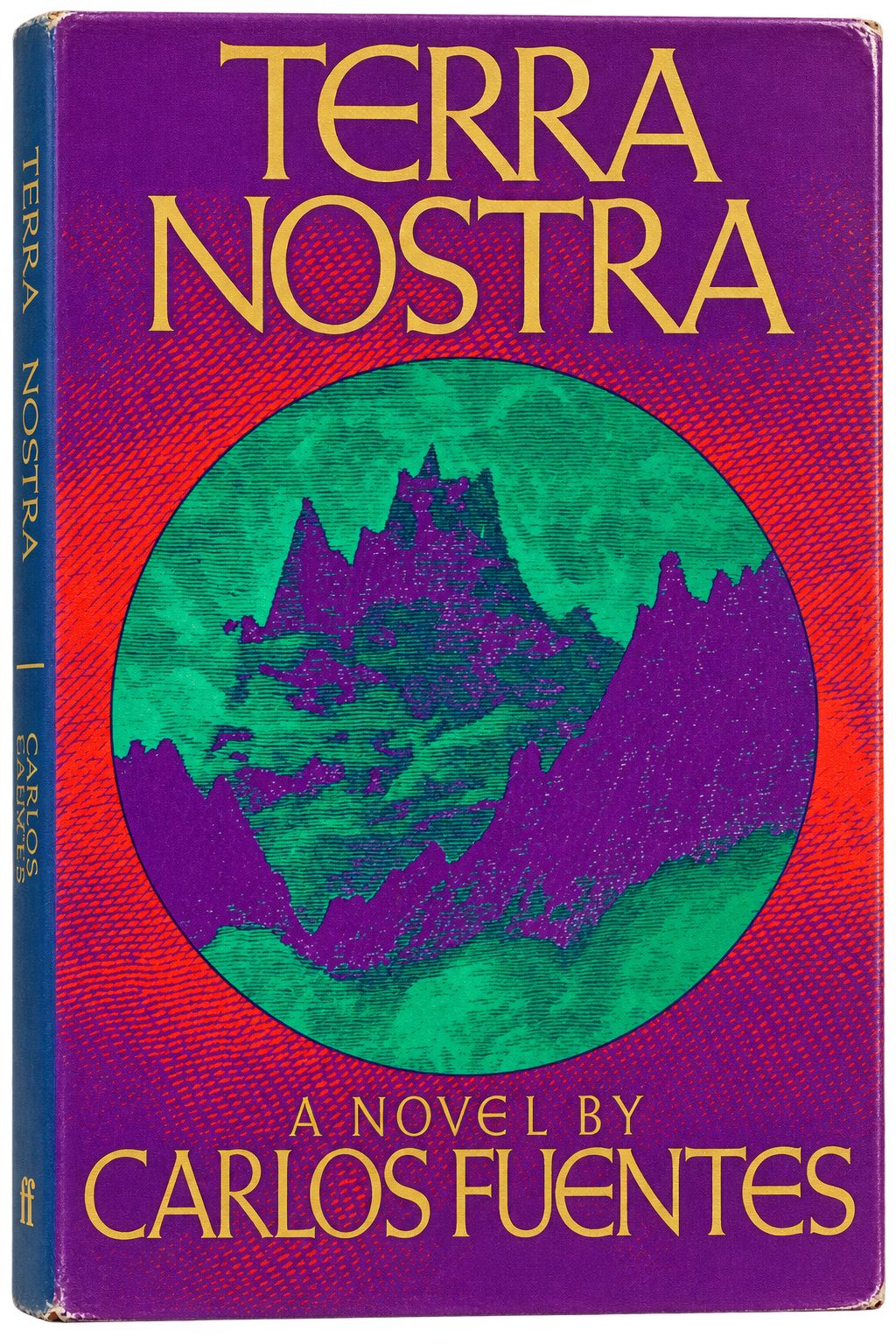
Terra Nostra — Carlos Fuentes
Carlos Fuentes
New York: Farrar, Straus and Giroux, 1976
First American Edition · First Printing
The Book:
The first American edition, first printing of Carlos Fuentes’s monumental historical novel Terra Nostra, translated into English by Margaret Sayers Peden. The copyright page explicitly states “First printing, 1976.” This copy retains its original two-tone red and purple cloth binding and original unclipped dust jacket priced at $15.00. It represents the novel’s first English-language appearance and preserves the moment one of the major works of the Latin American literary boom entered the English-speaking world.
Condition:
Near Fine in a Very Good dust jacket. The book is exceptionally clean, with bright gilt lettering, a tight binding, and a clean interior. A previous owner’s name, “Martin Prieto,” appears on the front free endpaper. The jacket is complete and highly presentable, showing moderate edge wear, several small chips at the head of the spine and upper corners, and light age toning.
Story Of The Book
Empires do not only conquer territory. They also decide which version of history survives.
Terra Nostra is Carlos Fuentes’s vast imaginative reconstruction of the Hispanic world across centuries of empire, religion, conquest, memory, and political authority. Moving between Spain and the Americas, past and future, history and myth, Fuentes refuses the idea that the past can be reduced to a single official narrative.
That refusal is the heart of the book.
Rather than treating imperial history as settled fact, Fuentes repeatedly asks who created the stories through which nations understand themselves—and whose experiences had to be excluded for those stories to remain coherent. Kings, religious institutions, conquerors, rebels, and ordinary people all compete for control of memory.
The result is less a conventional historical novel than an argument with history itself.
Fuentes uses fiction to expose the recurring relationship between authority and memory: political and religious institutions do not merely exercise power in the present. They also shape how the past is remembered, which identities are legitimized, and which alternatives are made to seem impossible. The inventory describes the novel as a sustained examination of how imperial, political, and religious power construct official versions of history while marginalizing competing voices and identities.
The question running beneath Terra Nostra is not simply what happened. It is who acquired the power to tell everyone else what happened.
Why It’s In The Collection
Terra Nostra belongs in Consigned to Darkness because authority depends partly on controlling the stories societies tell about themselves.
The collection contains many objects documenting direct exercises of power: censorship, imprisonment, propaganda, colonial rule, political violence. Fuentes approaches the same problem from another direction. He examines what happens after power becomes history—when conquest turns into tradition, institutions become inherited authority, and official narratives begin to disguise the violence that created them.
That makes the novel especially valuable within the collection’s literary holdings. It does not simply condemn empire from a distance. It dismantles the myths through which empire legitimizes itself, using memory, myth, historical revision, and literary invention to reopen possibilities that official history attempts to close.
This first American edition is particularly relevant because it preserves the work’s original entry into English-language culture through Margaret Sayers Peden’s translation. The collection acquired it not only as a major literary first, but as a foundational work examining empire, historical memory, religious authority, and political power.
Power can conquer a country once. Control the memory of that conquest, and it can keep winning for centuries.
Collection Categories: Literature · Latin American Literature · Political History · Anti-Colonialism · Institutional Power · Historical Memory
———
Authentication Evidence
• Title page identifies Carlos Fuentes, Terra Nostra, published by Farrar, Straus and Giroux, New York.
• First Edition Evidence: Published as the First American Edition, representing the first English-language appearance of Terra Nostra in Margaret Sayers Peden's translation.
• First Printing Evidence: Copyright page explicitly states "First printing, 1976," confirming first-printing status.
• Library of Congress Catalog Number 76-18238 appears on the copyright page, consistent with the original publication.
• Original unclipped dust jacket retains the $15.00 publisher's price.
• Original publisher's cloth binding matches known first-printing copies.
• Previous owner's name ("Martin Prieto") is present on the front free endpaper; no author signature or inscription observed.
• No evidence of book club manufacture, rebinding, ex-library provenance, or facsimile dust jacket observed.
• The observed bibliographic evidence is fully consistent with an authentic First American Edition, First Printing.