
 Image 1 of 1
Tales from a Troubled Land — Alan Paton
Alan Paton
Charles Scribner's Sons · New York · 1961
First American Edition · First Printing
The Book:
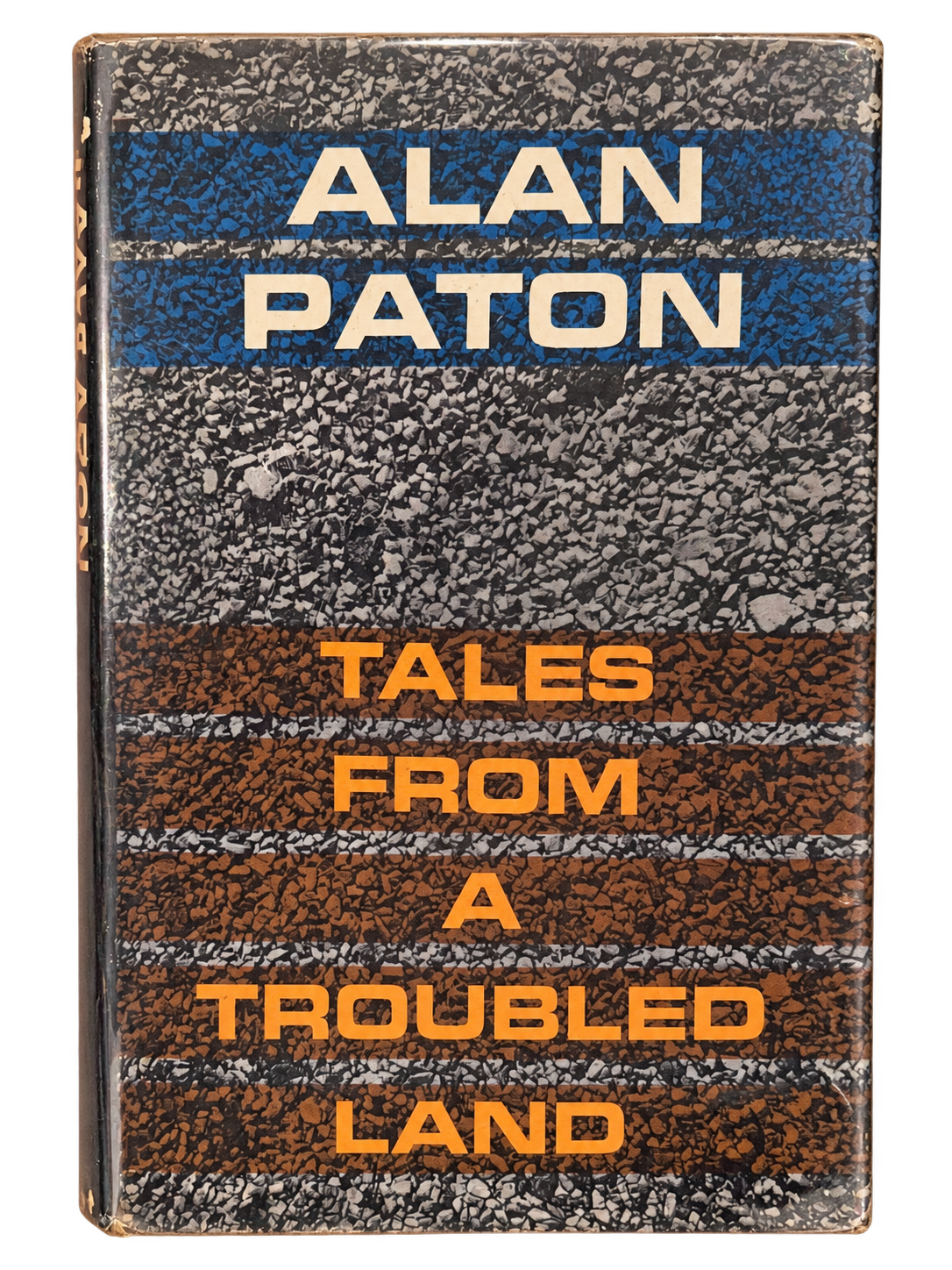
The first American edition, first printing of Alan Paton's Tales from a Troubled Land, published by Charles Scribner's Sons in 1961. This collection of ten short stories examines racial injustice, violence, conscience, and human relationships in apartheid South Africa. Original publisher's brown cloth binding with gilt spine lettering, retaining its original unclipped $3.50 pictorial dust jacket. The copyright page bears Scribner's capital “A” first-printing identifier above the printer's code “2-61 [H].”
Condition:
Near Fine in a Near Fine original dust jacket. Brown cloth remains clean and well preserved, with minor handling wear, faint surface marks, and slight dulling to the gilt spine lettering. Interior pages remain clean and legible, without visible annotations or significant staining. The original unclipped $3.50 jacket retains its pictorial design, blue-and-orange typography, and photographic portrait of Paton on the rear panel, with light toning and minimal extremity wear. No significant tears, chips, structural defects, or restoration observed.
Story Of The Book
In apartheid South Africa, the color of your skin could determine where you lived, whom you loved, and whether the law would protect you or persecute you.
Alan Paton understood that apartheid's cruelty wasn't confined to legislation. It lived in the ordinary encounters between people — in their fears, prejudices, compromises, and the terrible choices an unjust society forced them to make.
In Tales from a Troubled Land, the author of Cry, the Beloved Country returned to the country whose racial divisions had made him an international literary voice. Through ten stories of violence, compassion, injustice, and moral courage, Paton confronted a society that had made racial discrimination an organizing principle of everyday life.
Published in 1961, one year after the Sharpeville massacre, these stories reached American readers as South Africa's apartheid government intensified its repression of political dissent.
Apartheid divided people by race. Paton reminded readers that suffering, conscience, and humanity recognized no such boundaries.
Why It's In The Collection
Tales from a Troubled Land belongs in Consigned to Darkness because the power of an oppressive system extends far beyond the laws that establish it. It reaches into the relationships, choices, and moral lives of the people forced to live within it.
Paton's stories are especially important because they explore apartheid not simply as a political institution, but as a human experience. His characters confront the consequences of a society that assigns people different rights, opportunities, and degrees of dignity according to race.
This particular 1961 first American printing preserves Paton's literary response while apartheid was actively tightening its grip on South Africa. Published in the aftermath of Sharpeville and the banning of major Black liberation organizations, it brought these stories into American book culture at a moment when the struggle against apartheid was becoming increasingly urgent.
The collection preserves this edition because it represents literature confronting racial oppression while that oppression was still being exercised, defended, and enforced.
Apartheid demanded that people see one another through the categories imposed by the state. Paton insisted they see one another as human beings.
Collection Categories: Anti-Authoritarianism · Political History · Civil Rights · Human Rights · Literature · Political Dissent · Anti-Apartheid · Publication-Event Object
Authentication Evidence
Original title page identifies Tales from a Troubled Land by Alan Paton.
Title page identifies Charles Scribner's Sons, New York, as publisher.
Copyright page records “Copyright © 1961 Alan Paton,” consistent with the original American publication.
Capital “A” appears on the copyright page, corresponding to Scribner's established first-printing identification practice during this period.
Printer's code “2-61 [H]” appears beneath the capital “A,” consistent with the original production period.
Copyright page identifies the original periodical appearances of several stories, including publications in Esquire and The New Yorker.
Library of Congress catalog card number 61-1709 appears on the copyright page.
Original publisher's brown cloth binding with gilt spine lettering retained.
Original Charles Scribner's Sons dust jacket present.
Front jacket flap retains the original unclipped $3.50 publisher's price.
Original jacket features blue-and-orange typography and a photographic portrait of Alan Paton on the rear panel.
Jacket retains its original publisher's descriptive text and design.
Table of contents identifies ten stories, beginning with “Life for a Life” and concluding with “A Drink in the Passage.”
Publisher's imprint, copyright information, binding, and jacket characteristics are consistent with the documented 1961 American edition.
No later-printing statement, revised publisher imprint, book-club designation, or facsimile characteristics observed.
The Scribner's capital “A,” original publication information, publisher's binding, and correctly priced dust jacket collectively establish the First American Edition · First Printing.