
 Image 1 of 1
Slaughterhouse-Five — Kurt Vonnegut, Jr.
Full Title: Slaughterhouse-Five, or The Children’s Crusade: A Duty-Dance with Death
Kurt Vonnegut, Jr.
Delacorte Press / Seymour Lawrence · New York · 1969
First Edition · Fifth Printing · June 1969
The Book:
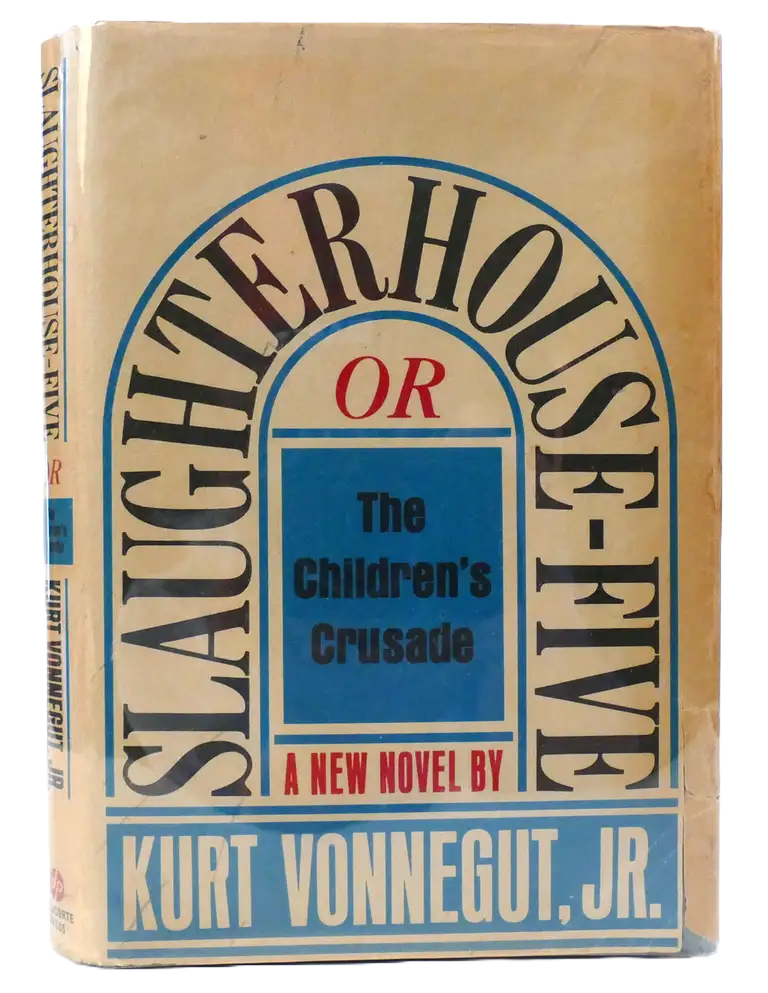
An exceptionally well-preserved fifth printing from June 1969, still within the first edition and issued only months after the original publication of Kurt Vonnegut’s Slaughterhouse-Five. Drawing directly upon Vonnegut’s experience as an American prisoner of war who survived the Allied firebombing of Dresden, the novel fused autobiography, fiction, science fiction, satire, and historical witness into one of the defining anti-war works of the twentieth century. Octavo; 186 pp. This copy retains its original blue publisher’s cloth, gilt facsimile Vonnegut signature on the front board, black endpapers, and original unclipped $5.95 Paul Bacon dust jacket, with a rear-panel photograph of Vonnegut by Bossi.
Condition:
Near Fine+ book in a Near Fine original dust jacket. The blue cloth remains bright, with the gilt facsimile signature and gilt-and-red spine decoration well preserved. Binding is square and sound and the interior exceptionally clean, with no ownership markings, foxing, or restoration observed. The original unclipped jacket remains structurally complete and highly attractive, showing only mild age toning, light rubbing, and trivial edge wear.
Story Of The Book
Kurt Vonnegut survived Dresden in 1945. It took him more than twenty years to find a way to write about it.
As an American prisoner of war, Vonnegut was being held in Dresden when Allied bombers devastated the city in February 1945. He and other prisoners survived underground in the meat locker of the slaughterhouse that gave the novel its name. When they emerged, they encountered a destroyed city and were put to work recovering bodies from the ruins.
A conventional war novel could not contain what Vonnegut wanted to say about that experience. So Slaughterhouse-Five refuses conventional time itself. Billy Pilgrim becomes “unstuck in time,” moving helplessly among childhood, war, Dresden, suburban America, death, and the alien world of Tralfamadore. The fragmentation turns trauma into form: Billy cannot leave the past behind because, for him, the past never actually ends.
Published in March 1969 as the Vietnam War divided the United States, the novel arrived while another generation was confronting the language of military necessity, civilian casualties, patriotism, and obedience. Vonnegut offered no heroic counter-myth. His soldiers are frightened, confused, young, absurd, and largely powerless before forces they cannot control.
That is why the subtitle matters. This is a children’s crusade. The mythology of glorious warfare collapses when the people sent to fight it are seen not as warriors in an epic, but as human beings caught inside machinery larger than themselves.
Vonnegut survived the bombing. The novel records what survival could not make comprehensible.
Why It’s In The Collection
Slaughterhouse-Five belongs in Consigned to Darkness because witness does not always look like testimony. Sometimes memory becomes so difficult that fiction is the only form capable of carrying it.
Vonnegut was there. Dresden is not historical scenery borrowed for a novel; it is an event he survived and spent decades trying to understand. By refusing chronology, heroism, and conventional realism, he found a literary form capable of expressing something ordinary historical narrative could not: the persistence of traumatic memory and the absurdity of industrialized killing.
Published during the Vietnam War, the novel also became a major literary expression of dissent against the narratives that make warfare appear orderly, heroic, or inevitable. Its later history extended that confrontation into another arena. Slaughterhouse-Five has repeatedly been challenged and removed from American schools and libraries, making arguments over who should be permitted to read Vonnegut’s account of war part of the history of the book itself.
This copy is a fifth printing rather than the scarce first. But June 1969 places it inside the novel’s original publication moment, only months after its March appearance, while its anti-war argument was entering American culture during the Vietnam War itself. Its exceptional condition and original jacket preserve that moment remarkably well.
Vonnegut wrote about what happens when human beings become expendable. The book’s later history asks a related question: who gets to decide whether the next generation is allowed to read about it?
Collection Categories: Literature · Witness Literature · Anti-Authoritarianism · Political Dissent · Free Expression · Censorship
———
Authentication Evidence
Title page identifies the work as Slaughterhouse-Five, or The Children’s Crusade: A Duty-Dance with Death by Kurt Vonnegut, Jr.
Publisher is correctly identified as A Seymour Lawrence Book / Delacorte Press.
Copyright page carries the original 1969 copyright.
Copyright page explicitly states “Fifth printing, June 1969,” directly establishing the printing and date.
The volume therefore belongs to the original 1969 first edition but is not represented as a first printing.
Volume collates to 186 pages, consistent with documented 1969 Delacorte copies.
Original blue/turquoise publisher’s cloth remains present.
Front board carries the original gilt facsimile signature of Kurt Vonnegut, a documented feature of the 1969 Delacorte binding.
Spine retains the original gilt-and-red titling and decoration, consistent with documented early Delacorte copies.
Original black endpapers remain present.
Original dust jacket designed by Paul Bacon remains present.
Rear jacket panel carries the original author photograph credited to Bossi.
Original dust jacket is unclipped and retains the $5.95 publisher’s price.
Jacket retains publisher’s code 8021 on the front flap and 0369 on the rear flap, consistent with the original 1969 issue jacket.
Independently documented June 1969 fifth-printing copies exhibit the same binding, gilt-and-red spine treatment, gilt facsimile front-board signature, $5.95 price, and 8021/0369 jacket codes observed on this copy.
Publisher imprint, binding, typography, jacket configuration, and production characteristics are internally consistent with documented early 1969 Delacorte trade copies.
No evidence of book-club manufacture, remainder marking, rebinding, facsimile dust jacket, or replacement components is observed.
Observable bibliographic evidence supports identification as the 1969 First Edition · Fifth Printing (June 1969), in the original unclipped $5.95 dust jacket.