
 Image 1 of 1
Sexual Politics — Kate Millett
Kate Millett
Doubleday & Company, Inc. · Garden City, New York · 1970
First Edition · First Printing
The Book:
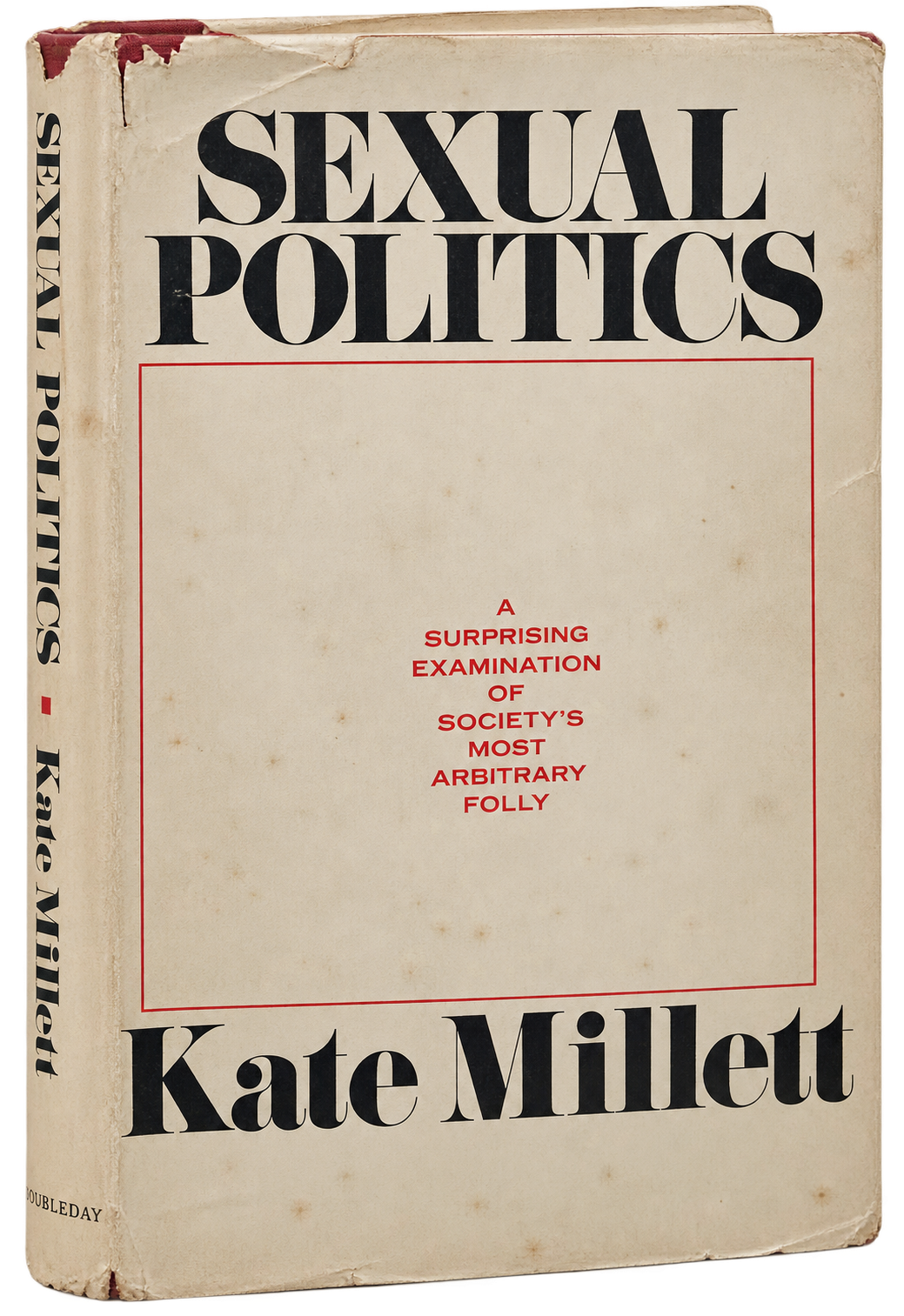
The first edition, first printing of Kate Millett’s Sexual Politics, published by Doubleday in 1970. The copyright page states “FIRST EDITION IN THE UNITED STATES OF AMERICA,” with no later-printing statement present. Developed from Millett’s doctoral dissertation at Columbia University, the book appeared at a pivotal moment in second-wave feminism and quickly became one of the movement’s defining intellectual texts.
Condition:
Near Fine in a Very Good+ original dust jacket. The book remains square and tight with a clean interior and only minor handling wear. The original jacket remains bright and complete, showing light rubbing and modest edge wear. No restoration, rebinding, or replacement components are observed.
Story Of The Book
Kate Millett argued that politics did not stop at the doors of Congress, the courthouse, or the voting booth. It followed people home.
Published in 1970, Sexual Politics challenged the idea that relationships between men and women belonged primarily to the private sphere. Millett argued instead that patriarchy constituted a political system—one reproduced through family life, sexuality, education, culture, and literature as surely as other forms of authority operated through formal institutions.
Her method was deliberately provocative. Millett subjected celebrated male writers including D. H. Lawrence, Henry Miller, Norman Mailer, and Jean Genet to political analysis, asking what their depictions of sex and gender revealed about assumptions concerning domination and submission. Literature, in her account, was not isolated from power; it could help normalize it.
The book appeared as the women’s liberation movement was rapidly expanding and carried ideas developing within feminist organizing into mainstream American intellectual life. Millett’s radical proposition was that some of society’s most powerful hierarchies were precisely the ones it had learned to call private.
Why It’s In The Collection
Sexual Politics belongs in Consigned to Darkness because it expanded the territory on which power could be recognized and challenged.
Where many objects in the collection document visible authority—governments, police, censors, or political institutions—Millett examined power operating through intimate relationships, cultural expectations, sexual norms, and assumptions about whose dominance should be considered natural.
This first printing matters because it captures that argument at the moment it entered the culture. Sexual Politics did not retrospectively explain second-wave feminism; it became one of the books through which the movement articulated itself to a mass audience.
Collection Categories: Feminist Classics · Literature · Social Criticism · Gender & Sexuality · Political Movements · Publication-Event Object · Women's History & Feminism
———
Authentication Evidence
Copyright page states “FIRST EDITION IN THE UNITED STATES OF AMERICA,” consistent with the first edition.
No later-printing statement is present, consistent with first-printing status.
Title page identifies Doubleday & Company, Inc., Garden City, New York, consistent with the 1970 first edition.
Title page is dated 1970, consistent with the original publication.
Original publisher’s binding is present.
Original dust jacket is retained.
Jacket design, typography, publisher information, and flap text are consistent with documented first-edition jackets.
No book-club indicators are observed.
No evidence of rebinding, facsimile jacket, or replacement components is observed.
Observable bibliographic evidence supports identification as the 1970 Doubleday first edition, first printing.