
 Image 1 of 1
Psychopathia Sexualis — Richard von Krafft-Ebing
Full Title: Psychopathia Sexualis: With Especial Reference to the Antipathic Sexual Instinct: A Medico-Forensic Study
Richard von Krafft-Ebing
Translated from the Twelfth German Edition by Franklin S. Klaf
Foreword by Daniel Blain
Stein and Day · New York · 1965
First Complete English-Language Edition · First Printing
The Book:
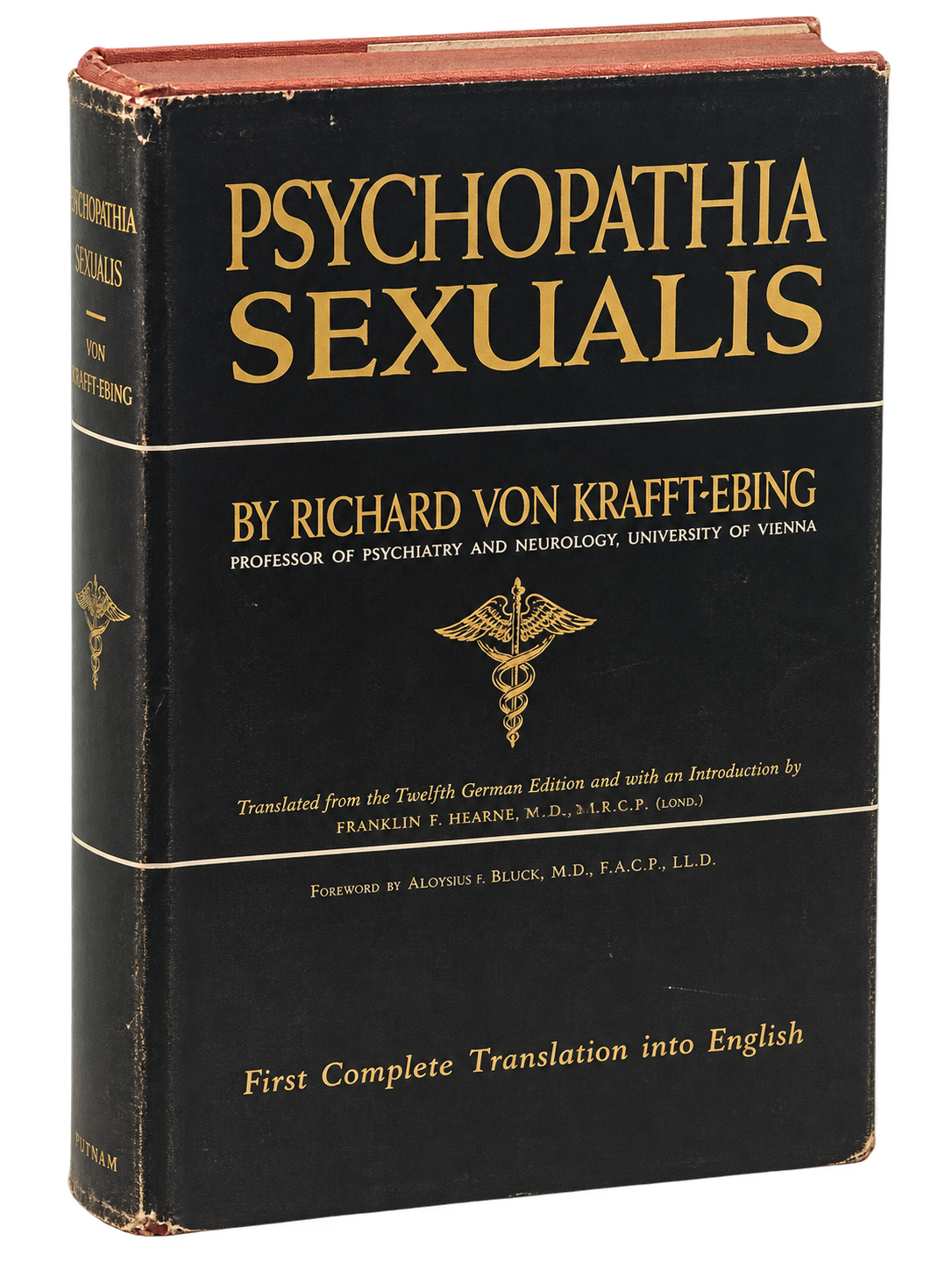
The First Complete English-Language Edition · First Printing of Richard von Krafft-Ebing’s Psychopathia Sexualis, one of the foundational texts of modern sexology. First published in German in 1886, the work helped give lasting currency to categories including sadism, masochism, fetishism, and homosexuality. Earlier English editions left portions untranslated, while Krafft-Ebing himself placed especially explicit material in Latin. Franklin S. Klaf’s 1965 translation of the twelfth German edition was explicitly issued as the “First Complete Translation into English.” xviii, 434 pp. Original red publisher’s cloth, red topstain, and original unclipped $10.00 dust jacket retained.
Condition:
Fine book in a Very Good original dust jacket. Original red cloth remains clean and tight, with gilt spine lettering, decorative rules, publisher device, and red topstain intact. Interior is exceptionally well preserved, with only a small pencil price notation to the rear free endpaper. The original unclipped $10.00 jacket shows localized chipping and paper loss at the spine ends and corners, several short edge tears, and moderate surface rubbing, but remains substantially complete and presents strongly.
Story Of The Book
Krafft-Ebing helped give medicine a vocabulary for talking about sexuality. He also helped establish the idea that homosexuality and other forms of sexual difference were diseases.
First published in 1886, Psychopathia Sexualis became one of the most influential books in the history of sexology. It organized sexual behavior into medico-forensic categories and gave medicine, psychiatry, and law a vocabulary for subjects long treated primarily as sin, crime, or scandal.
That visibility was profoundly double-edged. Krafft-Ebing brought same-sex desire into sustained scientific discussion, but framed it through theories of abnormality and degeneration. The result was a language that helped make sexuality legible to modern institutions while also giving those institutions new authority to classify, diagnose, and judge it.
Access to the book itself was restricted too. Explicit passages were placed in Latin, and earlier English translations remained incomplete. This 1965 Stein and Day edition finally translated the complete twelfth German edition into English.
Krafft-Ebing deliberately put some of the book’s most explicit material in Latin to keep provocative information about sex out of the hands of ordinary readers. This 1965 edition finally made the complete text available in English.
Why It’s In The Collection
Psychopathia Sexualis belongs in Consigned to Darkness because power does not only decide what may be said. It also decides what people are called.
Krafft-Ebing’s categories shaped medicine, psychiatry, law, and public culture for generations. For LGBTQ+ people, that legacy was both emancipatory and damaging: scientific recognition could replace silence, but recognition arrived through a framework that often treated identity as pathology.
This 1965 edition matters because it finally removed a linguistic barrier that had limited English access to the complete text—just as psychiatry was beginning to reconsider some of the assumptions the book had helped institutionalize.
It preserves a moment when the language of authority became fully visible to the people it had helped define.
Collection Categories: Free Expression · Censorship · Publication-Event Object · Human Rights · LGBTQ+ History · Sexuality & Culture · Sexology · History of Medicine · History of Psychiatry
———
Authentication Evidence
Title page identifies the work as Psychopathia Sexualis: With Especial Reference to the Antipathic Sexual Instinct: A Medico-Forensic Study by Richard von Krafft-Ebing.
Title page identifies Franklin S. Klaf, M.D., M.P.H., as translator and author of the introduction.
Title page identifies Daniel Blain, M.D., F.A.C.P., F.A.P.A., as author of the foreword.
Title page explicitly states “Translated from the Twelfth German Edition.”
Title page explicitly states “First Complete Translation into English.”
Title page identifies Stein and Day · New York as publisher.
Copyright page states “Translation and Introduction copyright © 1965 by Franklin S. Klaf.”
Copyright page states “Foreword copyright © 1965 by Stein and Day, Incorporated.”
Copyright page gives Library of Congress Catalog Card No. 65-16706.
Copyright page states that the volume was manufactured in the United States.
Contemporary scholarly review literature independently identifies the Stein and Day/Klaf edition as the “First complete translation into English.”
Physical collation is xviii + 434 pages, consistent with independently recorded copies of the Stein and Day edition.
A distinct 1965 G. P. Putnam’s Sons edition, translated by Harry E. Wedeck, was separately advertised as the “First unexpurgated edition in English.”
The Putnam/Wedeck and Stein and Day/Klaf editions are therefore bibliographically distinct 1965 English-language editions.
Original red Stein and Day publisher’s cloth remains present.
Binding retains gilt spine title, author name, decorative rules, and publisher device.
Original red topstain remains present.
Original Stein and Day dust jacket remains present.
Dust jacket is unclipped and retains the original $10.00 publisher’s price.
Dust jacket prominently identifies the work as the “First Complete Translation into English.”
No later-printing or reissue statement is present.
No evidence of book-club manufacture, later publisher issue, facsimile jacket, rebinding, or restoration is observed.
Observable physical and bibliographic evidence supports identification as the 1965 First Complete English-Language Edition · First Printing.