
 Image 1 of 1
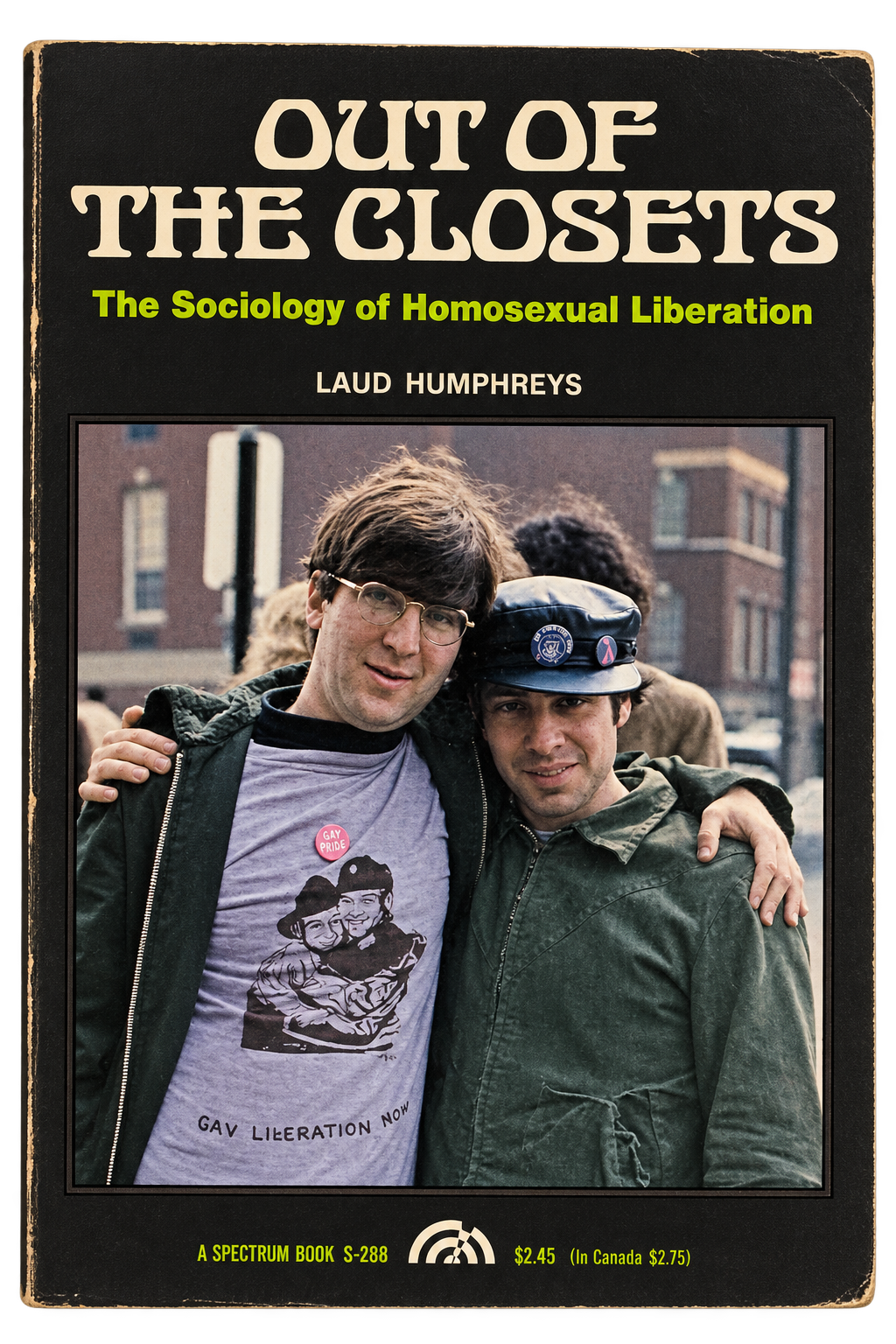
Out of the Closets — Laud Humphreys
Out of the Closets
Full Title:Out of the Closets: The Sociology of Homosexual Liberation
Laud Humphreys
Englewood Cliffs, New Jersey: Prentice-Hall, Inc., 1972
First Edition · First Printing · Hardcover
The Book:
The true first edition, first printing of Laud Humphreys’s Out of the Closets: The Sociology of Homosexual Liberation, published by Prentice-Hall in 1972, only three years after the Stonewall uprising. The copyright page carries the complete number line 10 9 8 7 6 5 4 3 2 1, confirming the first printing. This copy retains its original black cloth binding with gilt spine lettering and its original unclipped dust jacket priced at $5.95. No evidence of book-club manufacture, rebinding, ex-library provenance, or facsimile jacket is present.
Condition:
Near Fine in a Very Good dust jacket. The book is square and sound with a clean interior and well-preserved black cloth. The original jacket shows moderate edge wear, several small chips and closed tears, and light rubbing, while retaining its original $5.95 price.
Story Of The Book
For generations, millions of gay Americans survived by hiding. Out of the Closets captured the moment they began refusing to.
Published in 1972, Laud Humphreys’s book appeared while the modern gay liberation movement was still defining itself.
Stonewall was only three years in the past.
The victories that would later reshape American law and public life had not yet happened.
Humphreys was therefore not writing a history of a movement whose meaning had already been settled. He was documenting a movement while its future remained uncertain.
That timing is what makes the book so important.
Out of the Closets records the transition from older, more discreet homophile organizations toward a new politics of visibility, liberation, public protest, civil rights, and collective identity. It captures a community asking not merely for tolerance in private, but for dignity and equality in public.
The title itself contains the transformation.
For decades, concealment had been a survival strategy. Employment, family relationships, housing, reputation, and personal safety could all depend on remaining unseen.
The emerging gay liberation movement challenged that bargain.
Visibility itself became political.
To come out was no longer only a personal disclosure. In the new movement’s vocabulary, it could become an act of collective resistance against a society that had made secrecy a condition of safety.
Humphreys’s sociological approach preserved that transition as it was happening: the aspirations, internal tensions, strategies, and arguments of people trying to turn invisibility into political agency.
The movement was not asking merely to be left alone. It was beginning to insist on being seen.
Why It’s In The Collection
Out of the Closets belongs in Consigned to Darkness because it documents one of the collection’s central transformations:
the moment private survival becomes public dissent.
Many later books can explain the history of gay liberation with the benefit of hindsight.
This one could not.
Published in 1972, it entered the world when the movement itself was young, contested, and uncertain of what it could achieve. That makes the first edition a contemporary publication object rather than a retrospective interpretation.
That distinction is especially important to this collection.
Consigned to Darkness favors objects that participated in historical change rather than simply explaining it afterward. This copy preserves one of the earliest substantial book-length sociological examinations of the modern American gay liberation movement while participants were still defining its goals, identity, and public strategy.
Placed beside earlier LGBTQ+ objects such as The Well of Loneliness and Maurice, the book also marks a profound shift in the history of visibility.
Those earlier works document worlds in which same-sex identity could make publication dangerous or impossible.
Out of the Closets documents the next stage:
people organizing publicly against the conditions that had required secrecy in the first place.
The closet had once been a means of survival. By 1972, a movement was turning the refusal to remain inside it into a political demand.
Collection Categories: LGBTQ+ History · Free Expression · Civil Rights · Social Movements · Sociology
———
Authentication Evidence
• Title page identifies Laud Humphreys, Out of the Closets: The Sociology of Homosexual Liberation, published by Prentice-Hall, Inc., Englewood Cliffs, New Jersey.
• First Edition Evidence: Copyright page carries the original 1972 copyright with no indication of a later edition or revised edition.
• First Printing Evidence: Copyright page contains the complete number line "10 9 8 7 6 5 4 3 2 1," identifying this copy as the first printing.
• Original unclipped dust jacket retains the correct $5.95 publisher's price.
• Original black publisher's cloth binding with gilt spine lettering matches the first issue.
• No evidence of book-club manufacture, rebinding, ex-library provenance, or facsimile dust jacket observed.
• The observed bibliographic evidence is fully consistent with an authentic First Edition, First Printing.