
 Image 1 of 1
Notes on Women's Liberation — Various Contributors
News & Letters Women's Liberation Committee: Mary Ann Murphy, Raya Dunayevskaya, et al.
News & Letters · Detroit, Michigan · October 1970
First Printed Edition · First Printing · Expanded Edition
The Book:
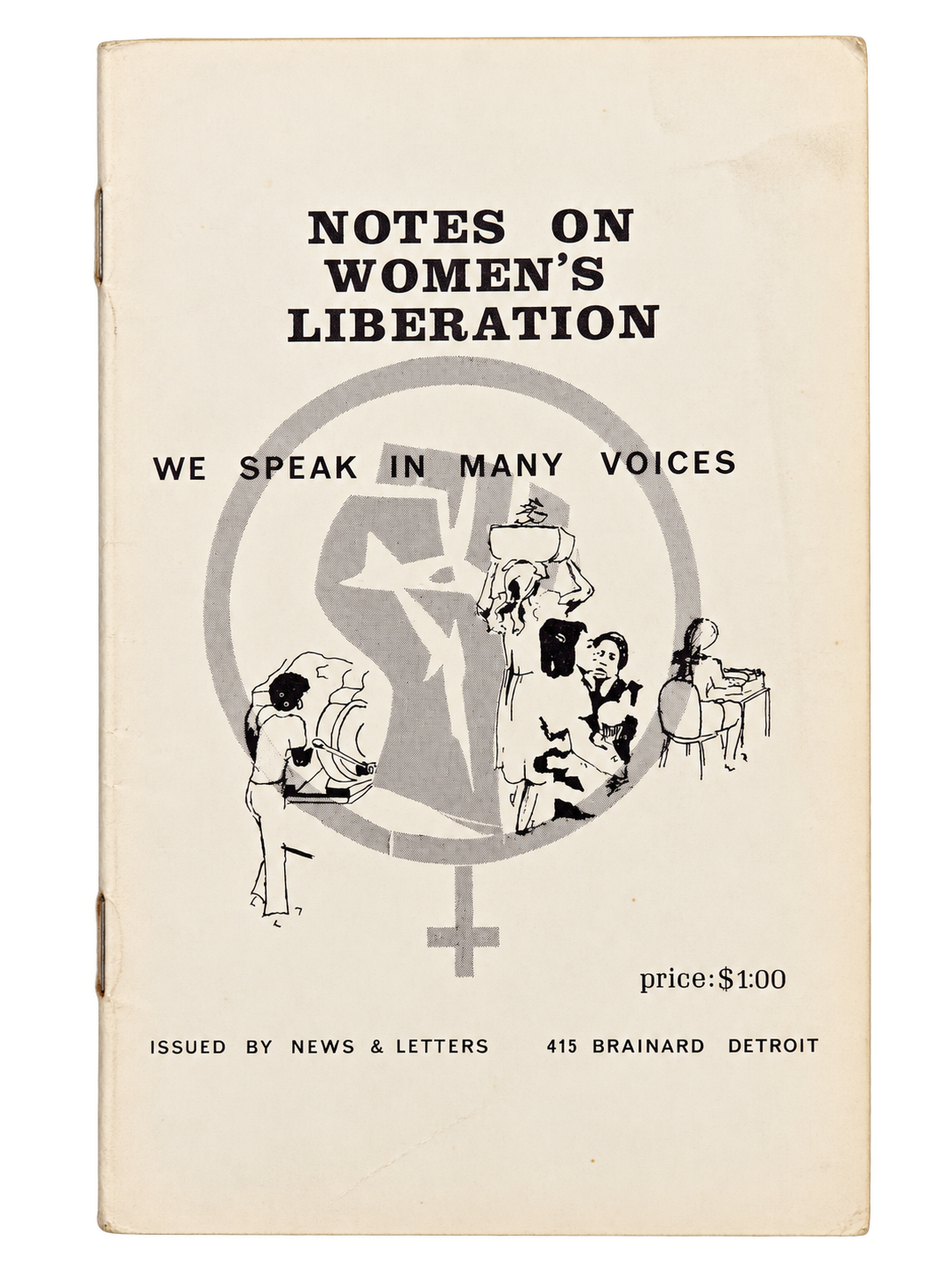
The first printed edition, first printing of Notes on Women's Liberation: We Speak in Many Voices, published by News & Letters in Detroit in October 1970. Expanded from an earlier January 1970 mimeographed publication, this 86-page pamphlet assembles firsthand accounts and political analysis from women participating in the emerging women's liberation movement. Original illustrated white wrappers with black typography, gray women's liberation symbol, and printed $1.00 cover price.
Condition:
Near Fine. Original illustrated wrappers remain bright and exceptionally well preserved, with faint surface discoloration, minor handling marks, and slight corner wear. Interior pages are clean and bright, without visible foxing, annotations, or significant staining. Original binding remains sound, with no substantial tears, paper loss, or restoration observed.
Story Of The Book
In 1970, women across America were demanding liberation. These women weren't waiting for somebody to speak for them.
Factory workers, Black women, Mexican American women, students, mothers, and activists were discovering that the indignities they endured in isolation were part of something much bigger. Some challenged employers. Others confronted husbands, universities, unions, and political movements that promised equality while denying it to women.
Their experiences weren't identical. Their politics didn't always agree. What united them was the growing realization that the lives they had been told to accept were not the lives they had to live.
Published just weeks after the August 1970 Women's Strike for Equality, this pamphlet brought their experiences together in something more powerful than a manifesto: a chorus of women describing oppression in their own words and imagining what freedom might look like.
The women's liberation movement didn't speak with one voice. Its power came from women discovering they had voices of their own.
Why It's In The Collection
Notes on Women's Liberation belongs in Consigned to Darkness because the struggle for freedom isn't always a confrontation between people and governments. Sometimes it's a confrontation with the institutions, communities, and movements that claim to represent them.
This pamphlet is particularly revealing because its contributors challenged not only established structures of gender inequality but also the limitations of political and labor movements that promised liberation while overlooking women's experiences.
Its connection to Raya Dunayevskaya and Marxist-Humanist thought adds another dimension: an insistence that political freedom must begin with the lived experiences of individuals rather than the ideological priorities of institutions or movements.
This October 1970 first printing preserves those arguments while the women's liberation movement was actively defining itself. Its original publication format, contemporary photographs, and firsthand testimony make it a particularly compelling publication-event object.
The women represented here weren't simply asking to be included in someone else's vision of freedom. They were insisting on the authority to define freedom for themselves.
Collection Categories: Publication-Event Object · Women's History & Feminism · Civil Rights · Human Rights · Labor & Economic Justice · Political Movements · Political Dissent · Witness Literature
Authentication Evidence
Original front wrapper identifies Notes on Women's Liberation: We Speak in Many Voices.
Front wrapper identifies News & Letters, 415 Brainard, Detroit, as the issuing organization.
Original printed $1.00 cover price remains present.
Introductory page explicitly states “Published by News & Letters” and “October, 1970.”
Publisher's Detroit address and ZIP code correspond to the contemporary News & Letters imprint.
Original introductory note identifies the publication's purpose as gathering the voices of women participating in the liberation movement.
Table of contents establishes the three-part organization: “The New Voices,” “Women's Liberation Speaks in Many Voices,” and “The Historic Past, Present, and Future ... and the Need for Philosophy.”
Original photograph of the August 26, 1970 Women's Strike for Equality in New York appears at the beginning of Part I.
Contents include writings by Mary Ann Murphy, Raya Dunayevskaya, women workers, students, and other movement participants.
Final numbered page is 86, consistent with documented copies of the October 1970 printed edition.
Page 86 contains excerpts from Karl Marx's “Private Property and Communism,” corresponding to the final entry in the table of contents.
Original terminal publisher advertisements remain present.
Rear wrapper advertises the expanded third edition of American Civilization on Trial: Black Masses as Vanguard, published by News & Letters.
The Raya Dunayevskaya Collection independently documents the earlier January 1970 mimeographed version and the expanded October 1970 printed pamphlet.
Institutional bibliographic records independently document the October 1970 printed edition as an 86-page publication.
Antiquarian dealer Common Crow Books independently identifies the October 1970 News & Letters publication as a first printing.
Publisher, date, wrapper design, contents, and examined pagination correspond to the documented October 1970 printed edition.
No later-printing statement, revised publisher imprint, or evidence of a subsequent impression was identified in the examined copy.
Combined bibliographic and physical evidence supports identification as the First Printed Edition · First Printing, distinct from the earlier January 1970 mimeographed version.