
 Image 1 of 1
Myra Breckinridge — Gore Vidal
Gore Vidal
Little, Brown and Company · Boston · 1968
First Edition · First Printing
The Book:
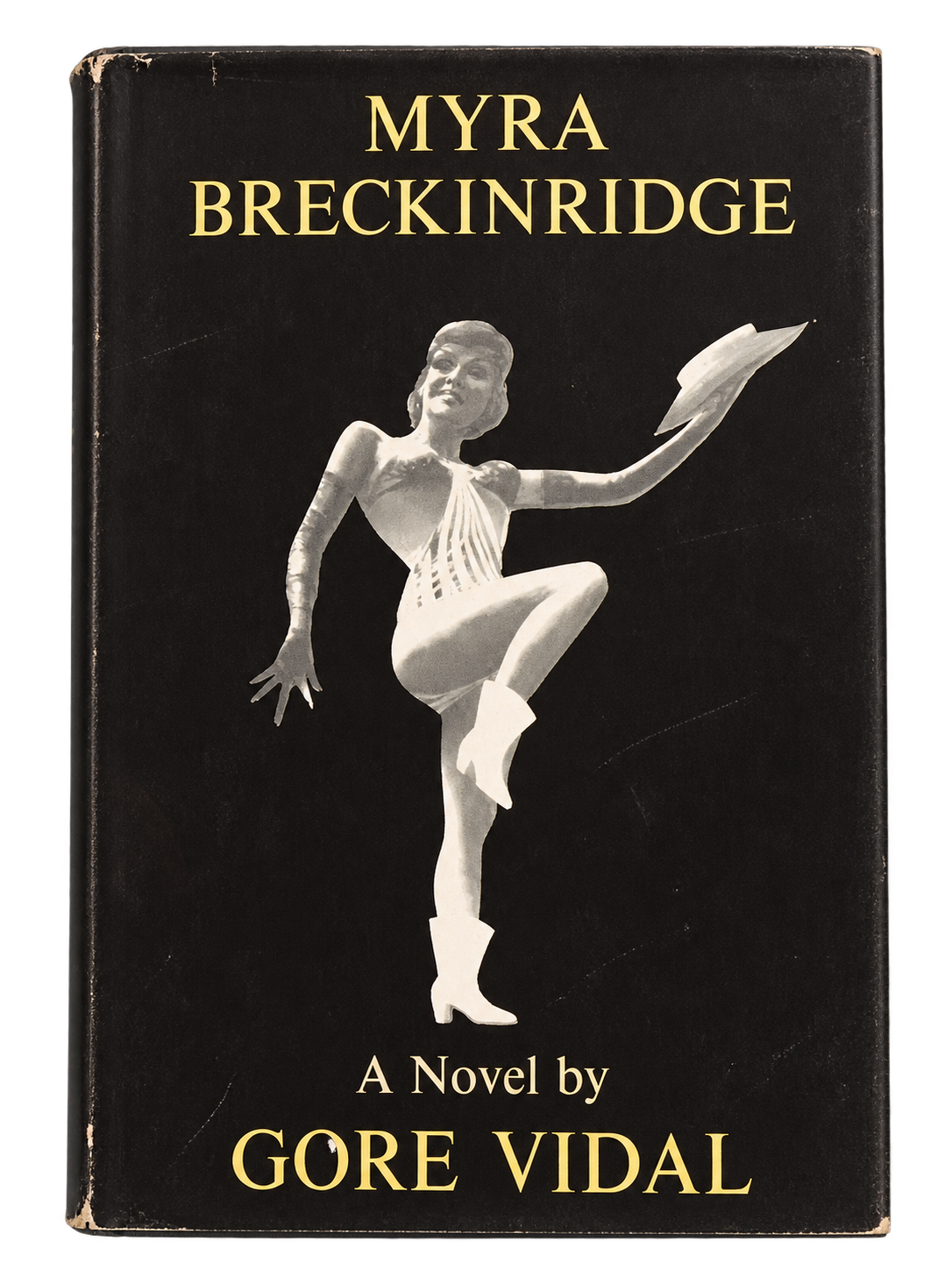
The true first edition, first printing of Gore Vidal’s Myra Breckinridge, published by Little, Brown in 1968. One of Vidal’s most provocative novels, Myra used outrageous satire, sexual inversion, Hollywood mythology, and deliberate attacks on conventional masculinity and femininity to place questions of gender and sexual identity before a mass American readership. This copy retains its original black publisher’s cloth and original unclipped $5.95 dust jacket.
Condition:
Near Fine book in a Near Fine original dust jacket. The black cloth remains exceptionally clean with bright gilt spine lettering, sharp corners, a square binding, and a clean interior free of ownership markings, foxing, restoration, or structural defects. The original jacket remains exceptionally bright and glossy, showing only light rubbing, minor edge wear, and tiny chips at the upper extremities.
Story Of The Book
Gore Vidal did not politely question America’s ideas about sex and gender. He turned them into a farce and dared the culture to recognize itself.
Published in 1968, Myra Breckinridge arrived in an America already fighting over sexual liberation, feminism, homosexuality, masculinity, censorship, and the authority of traditional social norms. Vidal pushed those arguments into deliberately outrageous territory. Myra—who arrives in Hollywood after transitioning from the identity of Myron Breckinridge—becomes Vidal’s vehicle for dismantling supposedly fixed distinctions between male and female, masculine and feminine, respectable and obscene.
The result was confrontational even by the standards of the late 1960s. Vidal mixed gender transformation with explicit sexuality, Hollywood satire, camp, and attacks on conventional American manhood. The novel became a bestseller as critics and readers argued over whether it was brilliant, obscene, liberating, offensive, or some combination of all four.
Its historical importance does not depend upon treating Myra as a straightforward representation of transgender life by contemporary standards. What matters is that a major American novelist made the instability of gender and sexual identity impossible for mainstream literary culture to ignore.
Why It’s In The Collection
Myra Breckinridge belongs in Consigned to Darkness because some books expand the boundaries of expression by refusing to behave respectably inside them.
Vidal took subjects that mainstream American culture still struggled even to name openly and made them the organizing principles of a major commercial novel. Rather than asking permission to discuss gender, sexuality, and identity seriously, he weaponized satire and provocation against the assumptions surrounding them.
This first printing preserves that confrontation at its point of entry into American culture—not after Myra had become a period artifact, cult novel, or subject of later debates about gender, but when readers first had to decide what to make of it.
The scandal was part of the argument: identities treated as fixed could be unsettled, conventions treated as natural could be mocked, and subjects considered unfit for polite literature could become bestsellers.
Collection Categories: LGBTQ+ History · Free Expression · Literature · Cultural Criticism · Publication-Event Object · Sexuality & Culture
———
Authentication Evidence
Title page identifies the work as Myra Breckinridge by Gore Vidal.
Title page identifies Little, Brown and Company, Boston and Toronto as publisher.
Copyright page carries the original 1968 copyright.
Copyright page explicitly states “FIRST EDITION,” directly establishing first-edition status.
No subsequent-printing statement appears; Little, Brown’s first-edition statement and absence of later-printing identification are consistent with first-printing status.
Original black publisher’s cloth with gilt spine lettering and blind-stamped publisher’s device remains present and is consistent with the first issue.
Original dust jacket remains present.
Original dust jacket is unclipped and retains the $5.95 publisher’s price, consistent with the first issue.
No evidence of book-club manufacture, remainder marking, ex-library ownership, rebinding, facsimile dust jacket, or replacement components is observed.
Observable bibliographic evidence supports identification as the 1968 First Edition · First Printing.