
 Image 1 of 1
My Life and Loves — Frank Harris
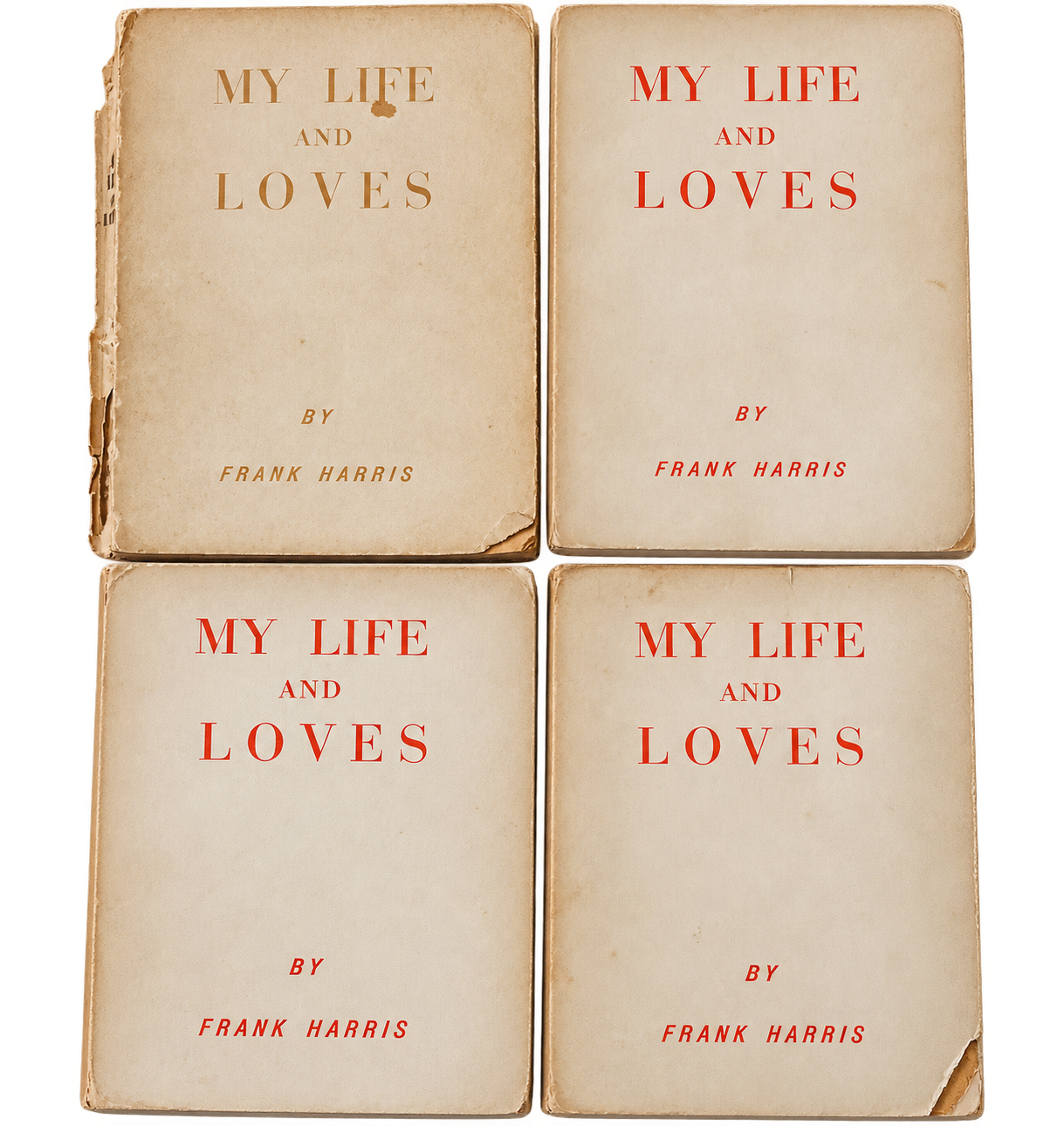
My Life and Loves (Complete Four-Volume Set)
Full Title:My Life and Loves (Complete Four-Volume Set)
Frank Harris
Paris: The Obelisk Press, 1945
1945 Obelisk Press Edition · First Printing · Complete Four-Volume Set
The Book:
The complete four-volume first printing of the 1945 Obelisk Press edition of Frank Harris’s My Life and Loves, published in Paris while the controversial autobiography remained prohibited from legal circulation in Britain and the United States. All four volumes retain their original publisher’s printed wrappers. Most strikingly, the rear wrappers carry the explicit warning “Must Not Be Imported into England or U.S.A.”—a restriction printed directly onto the books themselves. Original wrapper prices are also retained: 600 francs on Volumes I–II and 500 francs on Volumes III–IV. The title pages and publication statements have been physically examined and confirmed as corresponding to the first printing of the 1945 Obelisk Press edition.
Condition:
Good overall. The complete set remains in its original printed wrappers, which show moderate to heavy age toning, edge wear, creasing, corner wear, and varying degrees of spine deterioration. Volume I has substantial spine splitting, paper loss, and partial wrapper separation; the remaining three volumes show lesser but noticeable wrapper wear. The set remains complete, with no evidence of rebinding or restoration.
Story Of The Book
Governments spent decades trying to prevent English-speaking readers from owning this autobiography. Paris simply printed it anyway.
Frank Harris filled My Life and Loves with sexual candor, scandal, literary gossip, and accounts of encounters with many of the prominent figures of his age. To British and American authorities, the sexual content made the work unacceptable for legal circulation.
But prohibition did not make the book disappear. It changed where the book had to come from.
Paris became one of the great escape routes of twentieth-century English-language publishing. Expatriate presses could produce books that publishers in Britain and the United States could not safely—or legally—put into circulation at home. Readers who wanted them depended on foreign booksellers, private circulation, and importation.
The Obelisk Press operated inside that world.
Its 1945 edition of My Life and Loves therefore preserves something more interesting than another appearance of Harris’s autobiography. It preserves the physical infrastructure through which a prohibited English-language book continued to reach readers despite the censorship regimes of the countries in which many of those readers lived.
And unusually, the evidence of that censorship is printed directly on the object.
“Must Not Be Imported into England or U.S.A.”
Those words transform the rear wrappers into historical evidence.
They tell us that censorship had become part of the book’s physical design and commercial geography. A copy intended for sale had to announce the countries into which it could not legally travel.
The government did not need to destroy My Life and Loves. It could attempt to control the border instead.
The book existed. The readers existed. The law tried to keep the two in different countries.
Why It’s In The Collection
My Life and Loves belongs in Consigned to Darkness because it demonstrates one of the collection’s central ideas with unusual physical clarity:
When censorship closes one route between a writer and a reader, publishing finds another.
This complete four-volume set is particularly collection-relevant because it does not merely contain a text that was once suppressed. It is an artifact of the system created to circumvent that suppression.
The distinction matters.
A later legal edition can tell us what Frank Harris wrote. These Obelisk Press volumes tell us what had to happen for people to read it while authorities were still trying to prevent them from doing so. The place of publication is therefore part of the story. Paris was not incidental. It was what made publication possible.
And the export warning makes that history unusually tangible. Unlike a censorship story that has to be reconstructed entirely from court records or later scholarship, the restriction survives on the books themselves. The rear wrappers effectively preserve the border that governments attempted to place between controversial literature and its readers.
That is why the collection values the complete 1945 Obelisk Press set as a publication-event object. Its significance lies not in being the first appearance of Harris’s memoir, but in documenting the expatriate publishing network that kept a prohibited English-language work circulating beyond the reach of British and American censorship.
Four volumes survived together in their original wrappers. On the back of each sits the reason they had to be published where they were.
Britain and America could prohibit the book. Paris could still print it.
Collection Categories: Free Expression · Censorship · Publication-Event Object · Memoir & Testimony · Obscenity Law & Court History · Literature
———
Authentication Evidence
• Complete four-volume set published by The Obelisk Press, Paris.
• Original publisher's printed wrappers retained throughout the set.
• Rear wrappers bear the export statement "Must Not Be Imported into England or U.S.A.", consistent with Obelisk Press distribution outside British and American censorship.
• Wrapper prices of 600 francs (Volumes I–II) and 500 francs (Volumes III–IV) are consistent with the 1945 Obelisk issue.
• Wrapper typography, design, and construction are consistent across all four volumes.
• No evidence of rebound construction, facsimile wrappers, or later commercial rebinding observed.
• Title pages and publication statements were examined directly during physical inspection and confirmed by the owner to correspond to the first printing of the 1945 Obelisk Press edition.
• Edition and printing characteristics are consistent throughout the complete set.