
 Image 1 of 1
Moments of Reprieve — Primo Levi
Primo Levi
Translated from the Italian by Ruth Feldman
New York: Summit Books, 1986
First American Edition · First Printing
The Book:
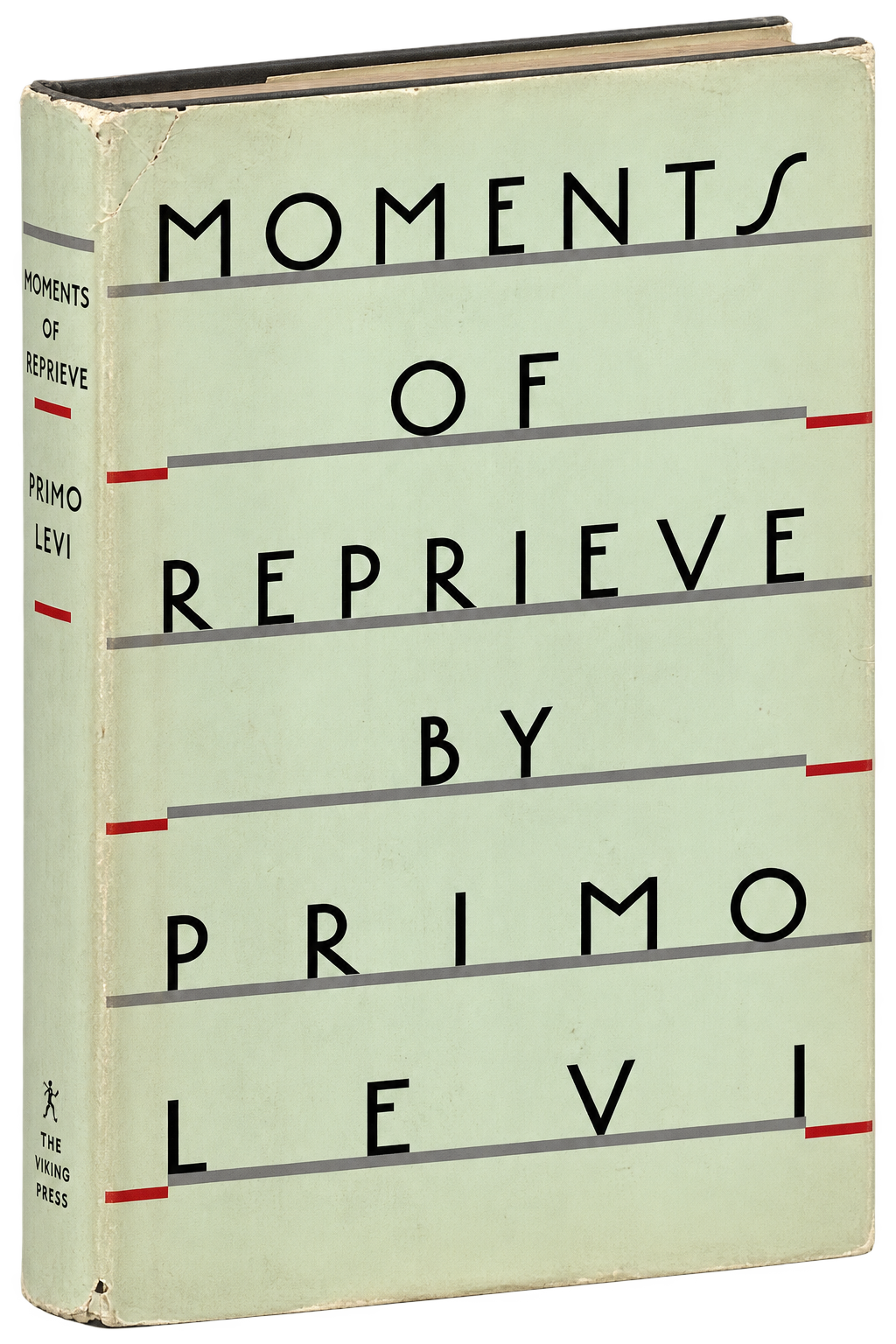
The true first American edition, first printing of Primo Levi’s Moments of Reprieve, published by Summit Books in 1986. The copyright page identifies the first American edition and carries the complete number line 10 9 8 7 6 5 4 3 2 1, establishing first-printing status. This copy retains its original gray paper-covered boards over dark gray cloth and the original unclipped $14.95 dust jacket. Published near the end of Levi’s life, the book gathers portraits of people he encountered during Auschwitz and its aftermath, preserving individuals whom the machinery of the camps had attempted to reduce to categories and numbers.
Condition:
Near Fine in a Very Good dust jacket. The book remains square and tight with bright silver spine lettering, clean pages, and no ownership markings or structural defects. The original $14.95 jacket retains strong color and complete typography, with moderate age toning, scattered foxing to the flaps and verso, and light handling wear. It is protected in an archival polyester jacket.
Story Of The Book
The Nazis tried to turn people into numbers. Primo Levi spent the rest of his life giving them back their names.
Much of Holocaust literature necessarily records systems: deportation, forced labor, starvation, selections, extermination. Primo Levi understood those systems intimately. Arrested as a member of the Italian resistance and deported to Auschwitz in 1944, he survived a machinery explicitly designed to strip human beings of identity before destroying them.
But Moments of Reprieve looks in another direction.
Rather than constructing another comprehensive account of Auschwitz, Levi returns to individual people—prisoners, survivors, companions, eccentrics, and unforgettable personalities whose particular humanity persisted inside a system organized around its destruction. The stories are small because that is precisely their point. A gesture, personality, friendship, absurdity, argument, act of generosity, or moment of dignity becomes evidence that the individual had not entirely disappeared.
For Levi, remembering those details was itself a form of resistance.
The concentration camp depended upon dehumanization. People became categories, labor units, prisoners, numbers. Moments of Reprieve reverses that process. Levi restores distinctions. One person is not interchangeable with another. Each possesses habits, weaknesses, humor, intelligence, contradictions, and a story worth preserving.
That gives the title its meaning. These are not reprieves from history. They are brief reprieves within it—moments when human personality somehow survives circumstances designed to extinguish it.
Published in America in 1986, near the end of Levi’s life, the book belongs to the final phase of a literary project that had occupied him for decades: insisting that what happened at Auschwitz be remembered accurately, specifically, and humanly. The collection’s inventory accordingly treats it as a concluding work in Levi’s lifelong act of witness.
A system tried to make its victims anonymous. Levi’s answer was to remember them individually.
Why It’s In The Collection
Moments of Reprieve belongs near the center of Consigned to Darkness because it demonstrates one of the collection’s foundational ideas: restoring humanity to people whom power attempted to dehumanize is itself an act of resistance.
The Holocaust represents authoritarian power carried to its most murderous extreme. The concentration camp did not merely imprison human beings. It attempted to erase individuality systematically—replacing names with numbers, private lives with classifications, personal agency with commands, and ultimately living people with administrative records of extermination.
Levi’s response was witness.
What makes Moments of Reprieve particularly valuable within that tradition is its scale. Levi does not allow the incomprehensible enormity of the Holocaust to swallow the individuals inside it. He turns instead toward particular people and preserves what the machinery of genocide could not fully destroy: personality, memory, humor, dignity, relationships, and moral choice.
That makes the book an especially strong expression of this collection’s interest in witness literature. Witness is not only the documentation of atrocity. It is also the preservation of the human beings whom atrocity attempts to reduce to statistics.
This first American edition strengthens that story as a publication object. Its complete first-printing number line and original $14.95 jacket preserve the book in the form through which American readers first encountered this late work by one of the twentieth century’s defining witnesses.
The book does something deceptively simple and profoundly anti-authoritarian: it refuses to let the victims of a system designed around dehumanization remain anonymous.
Power reduced people to numbers. Witness turns the numbers back into people.
Collection Categories: Witness Literature · Holocaust · Human Rights · Anti-Authoritarianism · Literature · Free Expression
———
Authentication Evidence
• Title page bears the correct Summit Books imprint for the first American edition.
• Copyright page records publication by Summit Books in 1986.
• Copyright page contains the complete first-printing number line 10 9 8 7 6 5 4 3 2 1, indicating a first printing.
• Copyright page identifies the work as the first American edition of the English translation.
• Dust jacket retains the original unclipped $14.95 price on the front flap, consistent with the first issue.
• Binding, typography, and jacket design correspond with the first American issue published by Summit Books.
• All observed bibliographical points support identification as a true first American edition, first printing.