
 Image 1 of 1
Molly Ivins Can’t Say That, Can She? — Molly Ivins
Molly Ivins
New York: Random House, 1991
First Edition · First Printing · Signed & Inscribed by Molly Ivins
The Book:
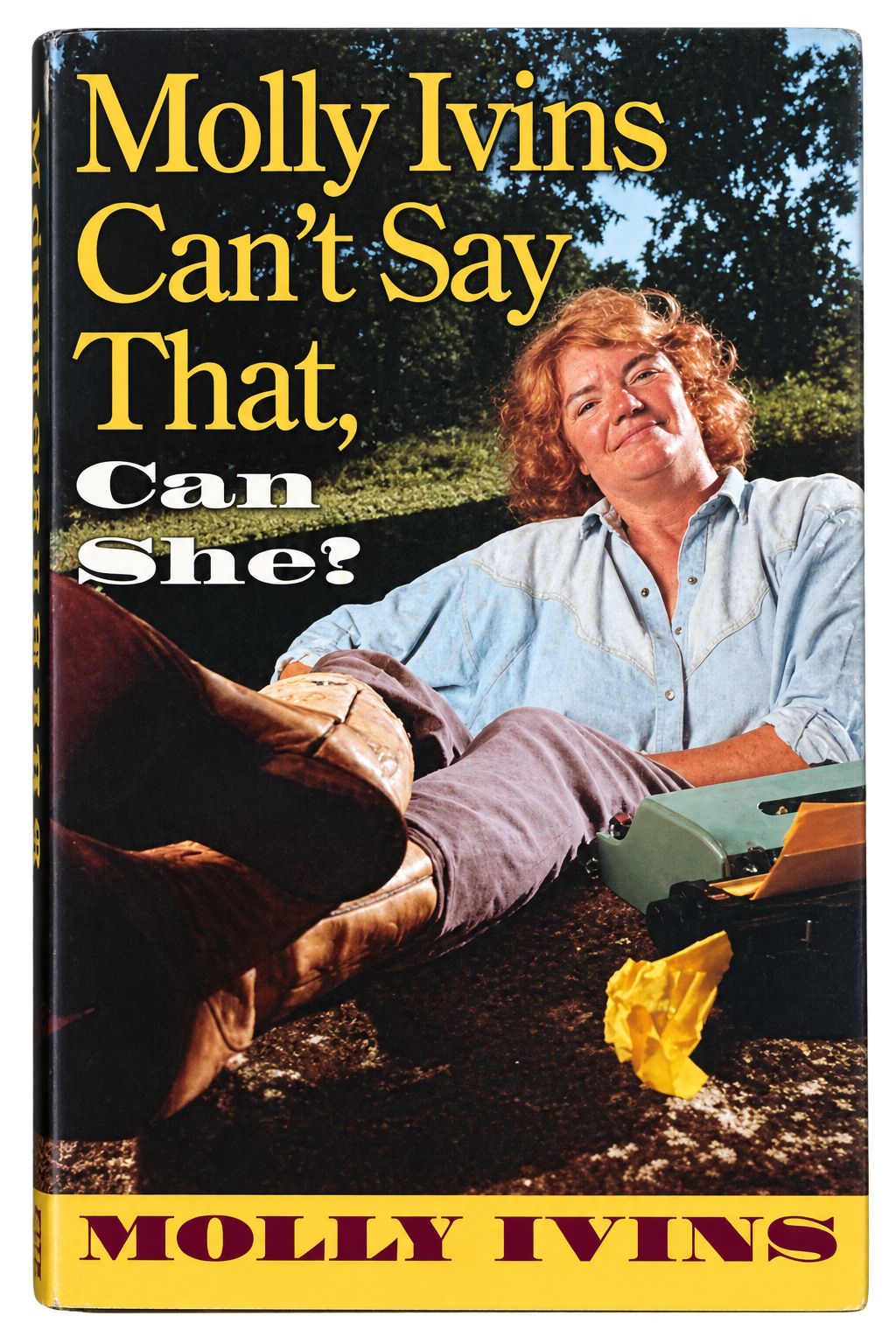
The true first edition, first printing of Molly Ivins’s first book, Molly Ivins Can’t Say That, Can She?, published by Random House in October 1991. The copyright page states “First Edition,” as confirmed by direct physical examination of the copy. It retains its original maroon boards, white endpapers, and original pictorial dust jacket. The front free endpaper is inscribed by Ivins to “Maggie” and dated October 2, 1991, within weeks of publication, thanking her for her help and kindness, referring to her service as a juror, and signing “Best wishes / Molly Ivins.”
Condition:
Near Fine in a Near Fine dust jacket. The boards are square and tight, the hinges sound, and the text block clean and bright, with no remainder or library markings observed. There is light bumping to one lower corner. The jacket remains bright and unfaded with light rubbing, a small scuff at the head of the spine fold, and a small bookseller’s label on the lower rear panel.
Story Of The Book
Her editors could have fired her. They rented billboards instead.
Molly Ivins left The New York Times for the Dallas Times Herald on an important promise: she could write whatever she pleased. That promise was tested when she wrote of a Texas congressman that if his IQ slipped any lower, they would have to water him twice a day. Subscriptions were cancelled. Advertisers walked. Influential people in Dallas pressured the newspaper to rein her in. The Times Herald had every commercial reason to discipline its columnist. Instead, it bought billboards across the city carrying the complaint itself: MOLLY IVINS CAN’T SAY THAT, CAN SHE? Ivins later made the phrase the title of her first book.
That history turns the title from a joke into a remarkably concise story about press freedom. The pressure on Ivins did not come from a government censor. It came through subscriptions, advertising dollars, political influence, and local power—the informal mechanisms that can narrow public speech without anyone passing a law. What mattered was that the institution behind her refused to yield. Instead of treating controversy as a reason to silence its writer, the newspaper advertised its willingness to let her keep writing.
Published in October 1991, the book collected the columns that established Ivins nationally as a political humorist and went on to spend more than a year on the New York Times bestseller list. This particular copy was inscribed on October 2, within weeks of publication, giving it a direct physical connection to the book’s original publication moment.
The question on those billboards was never really whether Molly Ivins could say it. It was whether anybody standing behind her had the nerve to let her.
Why It’s In The Collection
Molly Ivins Can’t Say That, Can She? is an intentional exception within Consigned to Darkness. The inventory classifies it as a Curator’s Selection and explicitly acknowledges that it does not satisfy the collection’s normal scarcity requirement. It was admitted instead because the story behind the title is unusually immediate and on-thesis, because this copy carries a contemporary inscription by Ivins, and because the object communicates the mechanics of free expression exceptionally well.
It also illustrates a form of pressure that can disappear from conventional histories of censorship. No government banned Ivins’s column. No court declared it obscene or seditious. The threat was economic and institutional: advertisers, subscribers, political figures, and community influence could make publishing controversial speech costly. The Dallas Times Herald had to decide whether those costs would determine what its columnist was permitted to say.
This copy adds something the ordinary first edition does not. Ivins inscribed it to “Maggie” within weeks of publication, thanking her for her kindness and commenting on the importance of thoughtful jurors. The recipient cannot be identified beyond what the inscription itself establishes, and the inventory appropriately makes no stronger provenance claim. But the inscription places Ivins’s own hand inside a first printing from the moment the book was entering public circulation. Ivins died in 2007, permanently closing the supply of newly signed copies.
The book is therefore not here because it is conventionally rare. It is here because sometimes the clearest artifact of free expression is not a banned book or a court decision. Sometimes it is an institution being given every reason to silence someone—and deciding not to.
Collection Categories: Free Expression · Investigative Journalism · Political History · Signed & Inscribed
———
Authentication Evidence
• Jacket front panel reads MOLLY IVINS CAN'T SAY THAT, CAN SHE? with the author photograph and MOLLY IVINS to the lower yellow band; rear panel carries praise attributed to David Broder of the Washington Post and an extract from the book's introduction.
• Publisher's maroon boards with white endpapers; text block clean and complete as photographed.
• Front free endpaper bears an inscription in black ink dated 10/2/91 and signed Molly Ivins.
• No remainder mark visible on the fore-edge; no library stamps, pockets, or perforations observed.
• ISBN 0-679-40445-7, Random House, 294 pp. as catalogued for this edition; pagination not verified for this copy.
• Edition evidence: Random House, New York, 1991, first edition, established on your direct examination of the stated "First Edition" on the copyright page, consistent with Random House's practice of stating it on first printings only.
• Printing evidence: First printing, on the same direct examination. The inscription date of 2 October 1991 falls within weeks of the October 1991 publication, consistent with a first-printing copy signed on the initial tour, though the date does not independently establish printing.