
 Image 1 of 1
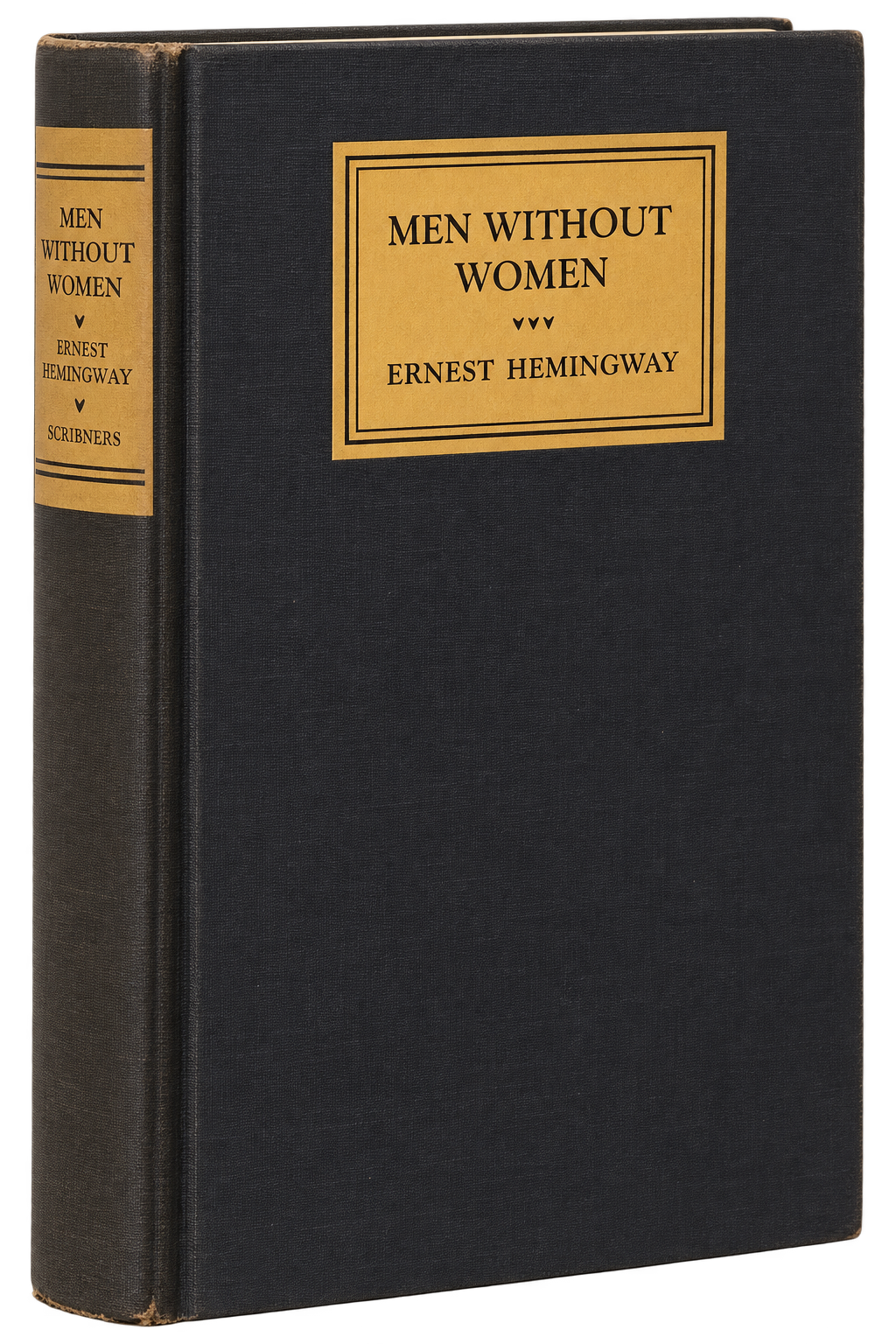
Men Without Women — Ernest Hemingway
Ernest Hemingway
New York: Charles Scribner’s Sons, 1927
First Edition · First Printing
The Book:
The true first edition, first printing of Ernest Hemingway’s Men Without Women, published by Charles Scribner’s Sons in 1927. The copy is authenticated as Hanneman A7a by the intact numeral “3” on page 3, a recognized first-state point distinguishing the first printing from later issues. It retains the original black publisher’s cloth, gold paper spine and front-board labels, and illustrated endpapers. The original dust jacket is no longer present; the book is housed in a modern facsimile jacket for protection and display only.
Condition:
Very Good+. The binding remains sound, the original black cloth is attractive, and both publisher’s paper labels are intact. The interior is bright with light, even age toning. A former owner’s name appears on the front pastedown. No rebinding, restoration, ex-library markings, or alteration to the text block is evident. The modern facsimile dust jacket is not original to the book and is identified as such.
Story Of The Book
After the First World War, Ernest Hemingway found a way to write about damage without explaining it.
Published in 1927, Men Without Women brought together fourteen stories about war, violence, loneliness, love, masculinity, loss, and the enormous emotional distances people can place between themselves and one another.
But what made the collection transformative was not only what Hemingway wrote about.
It was what he refused to say.
His characters rarely explain themselves. Trauma is not followed by diagnosis. Grief does not necessarily become confession. Violence arrives without speeches telling the reader how to interpret it.
Instead, Hemingway strips the prose down until actions, gestures, pauses, and omissions carry the emotional weight.
The result was a radically different relationship between writer and reader.
Hemingway trusted that what remained beneath the surface could be more powerful than what appeared explicitly on the page. A conversation about something ordinary could contain fear. A silence could reveal humiliation. An apparently simple action could carry the residue of war.
The inventory identifies precisely this use of omission as one of the book’s defining contributions to literary Modernism: emotional truth emerging through restraint rather than exposition.
That technique became one of the most influential styles in twentieth-century fiction.
Hemingway did not describe every wound. He taught readers how to recognize the wound from what the character could no longer say.
Why It’s In The Collection
Men Without Women occupies a quieter place in Consigned to Darkness than the collection’s censorship trials, revolutionary texts, and firsthand political testimony.
Its importance is fundamentally literary.
But the collection is also concerned with witness—with the ways printed language can preserve human experience that conventional narratives simplify, romanticize, or obscure.
Hemingway’s stories emerged from a generation transformed by war and its aftermath. Rather than treating trauma through patriotic rhetoric or grand historical explanation, he brought the reader down to the level of individual experience: damaged relationships, fear, physical violence, loneliness, and the inability of people to articulate what has happened to them.
That restraint is itself a form of witness.
The collection’s copy is especially important because it preserves the original 1927 publication through which this method reached readers. It is not a later edition representing Hemingway after his style had become canonical. It is the authenticated first printing, complete with the first-state page-3 point, original binding, paper labels, and illustrated endpapers.
The missing original dust jacket limits the copy bibliographically, and the facsimile jacket carries no historical weight. The value of the object lies instead in the authentic book underneath it: the physical first printing of a collection that helped redefine how modern literature could represent violence, vulnerability, and what human beings are unable to say.
Some books bear witness by telling us everything. Hemingway showed that silence could bear witness too.
Collection Categories: Literature · Modernism · Witness Literature · War & Conflict · Human Condition
———
Authentication Evidence
• Title page identifies Men Without Women by Ernest Hemingway, published by Charles Scribner's Sons, New York, 1927.
• First Edition Evidence: Title page bears the correct Charles Scribner's Sons, New York · 1927 imprint, consistent with the first American edition.
• First Printing Evidence: The numeral "3" on page 3 is complete and undamaged, matching the accepted first-state point (Hanneman A7a) used to distinguish the first printing from later issues.
• Copyright page carries the original 1927 copyright with no evidence of later reset type or subsequent edition.
• Original black cloth publisher's binding with gold paper labels and illustrated endpapers matches the documented first issue.
• No evidence of rebinding, ex-library provenance, facsimile text block, or restoration observed.
• Original dust jacket is not present. The book is housed in a modern facsimile dust jacket, which is correctly identified as a replacement for display and protection purposes only.
• The observed bibliographic evidence is fully consistent with an authentic First Edition, First Printing (Hanneman A7a).