
 Image 1 of 1
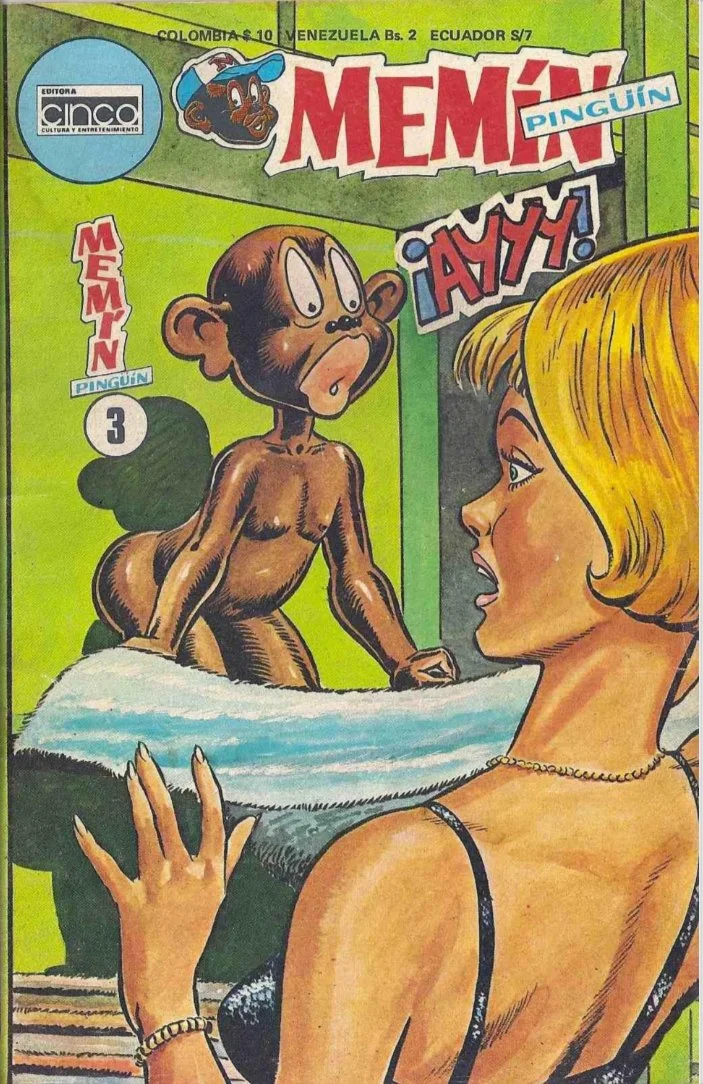
Memín (No. 3) — Yolanda Vargas Dulché
Yolanda Vargas Dulché
Editora Cinco, Colombia, 1983
First Edition · First Printing
The Book:
An original Spanish-language 1983 issue of Memín, published by Editora Cinco in the popular serialized format through which generations of Latin American readers encountered the character. The comic remains in its original color pictorial, staple-bound wrappers, with regional prices printed for the Dominican Republic, Panama, and Costa Rica. Internal advertising promotes the immediately following issue, No. 4, supporting its identification as a contemporaneous sequential issue rather than a later reproduction or collected edition.
Condition:
Very Good. Complete and structurally intact with both original staples present. The covers show moderate handling wear, including surface rubbing, creasing, edge wear, corner rounding, and noticeable toning, with small spine stresses at the staple folds but no major separation. Interior pages appear complete with expected age toning and light handling wear. No major tears, missing pages, or restoration are evident.
Story Of The Book
Memín Pinguín was a beloved comic character. He also became an international argument about race.
Created in the 1940s and repeatedly published across Latin America, Memín became one of the Spanish-speaking world's most recognizable comic figures. His exaggerated appearance, however, would eventually place the series at the center of a much larger debate. Admirers defended Memín as an affectionate character rooted in Mexican popular culture; critics argued that the depiction of its Afro-descendant protagonist perpetuated racist caricature and stereotypes.
That disagreement is what makes an original issue like this more historically interesting than a retrospective book about the controversy. This copy was printed in 1983, before later international disputes transformed Memín into a symbol in arguments over race, representation, cultural identity, censorship, and historical memory. It preserves the imagery in the ordinary mass-market form in which readers actually encountered it—not isolated in a textbook, exhibition, or modern reproduction, but surrounded by the advertisements, editorial material, pricing, and serial context of a working popular comic.
The difficult question Memín leaves behind is therefore larger than whether the character was offensive.
What happens when something a culture once embraced becomes something later generations struggle to defend?
And once that happens, what should we do with the object itself—remove it, contextualize it, condemn it, preserve it, or continue arguing over what it meant?
Why It’s In The Collection
Memín No. 3 belongs in Consigned to Darkness because anti-authoritarianism is not only concerned with governments banning books. It is also concerned with who has the authority to define acceptable representation, whose dignity popular culture protects or diminishes, and what societies choose to do with uncomfortable evidence from their own past.
This issue was acquired as a primary artifact of mass-market visual culture, not because it is an especially early or premiere issue of the series. Its value to the collection lies in preserving the controversial imagery in its original publication context—before later debates changed the way the character was understood. That original editorial, advertising, and distribution context preserves evidence that later reproductions and collected editions cannot.
The collection does not need to resolve the argument over Memín to justify preserving it. In some ways, the unresolved argument is the reason to preserve it. Hiding an uncomfortable object makes it easier to forget the assumptions that produced it. Keeping the original allows those assumptions to be examined.
The point is not to protect Memín from criticism. It is to protect the evidence that makes criticism possible.
Collection Categories: Graphic Literature · Race & Representation · Censorship · Cultural History · Human Dignity · Publication-Event Object · Counter-Thesis Object
———
Authentication Evidence
• The indicia identifies the publication as Memín No. 3 published by Editora Cinco, with copyright dated 1983, consistent with the stated publication.
• Publisher information, editorial staff, distribution data, and copyright notice correspond with known Editora Cinco production.
• Original staple binding remains present and consistent with period production.
• Internal advertising promotes the immediately following issue (No. 4), consistent with sequential first-release publication.
• No evidence of facsimile production, modern reprint markings, or reproduction printing is visible in the supplied photographs.
• Based on the available evidence, this copy is consistent with a contemporaneous 1983 first-edition, first-printing issue.