
 Image 1 of 1
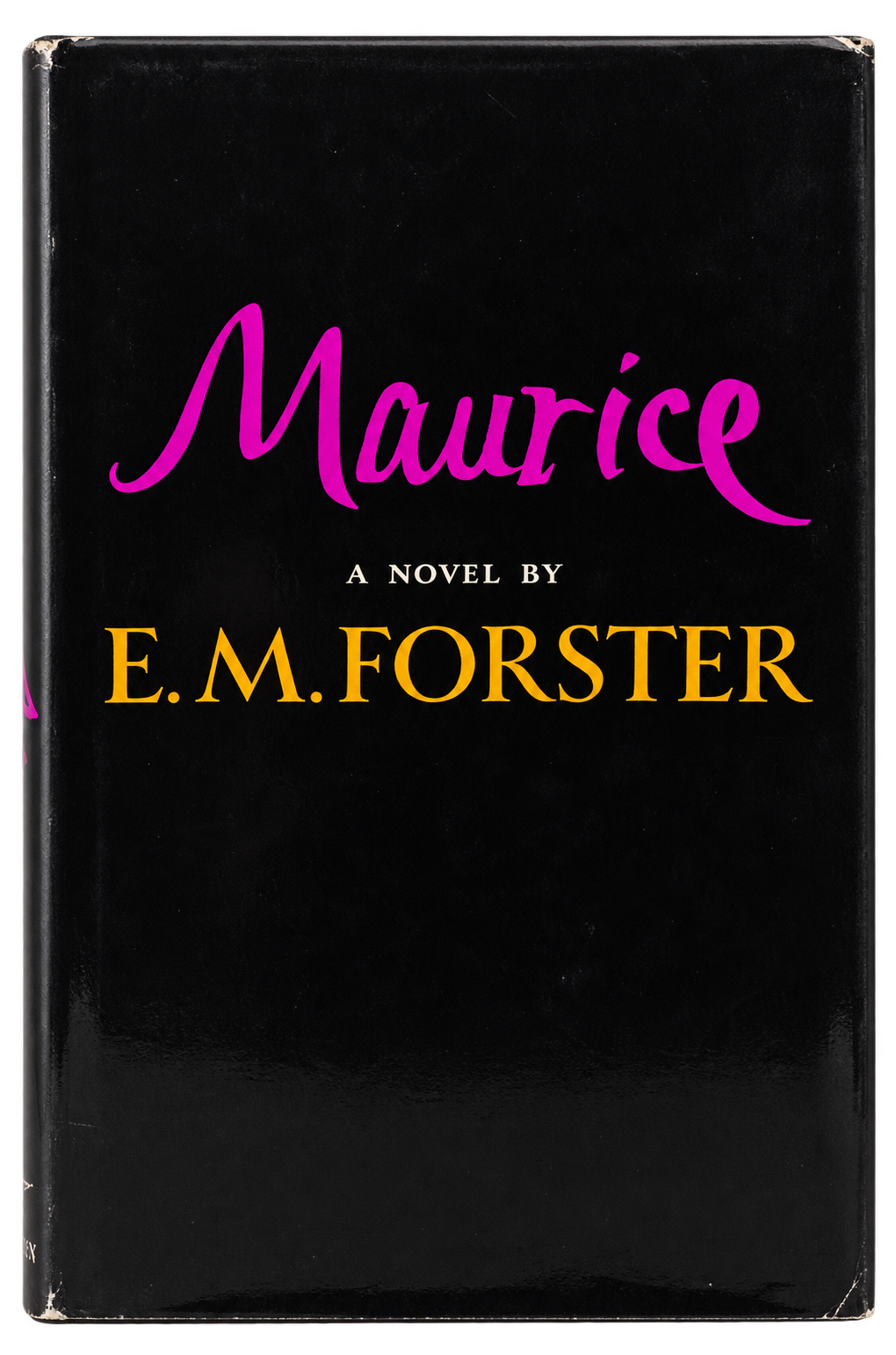
Maurice — E. M. Forster
E. M. Forster
New York: W. W. Norton & Company, Inc., 1971
First American Edition · First Printing
The Book:
The first American edition, first printing of E. M. Forster’s long-suppressed novel Maurice. The copyright page carries the complete number line 1 2 3 4 5 6 7 8 9 0, confirming the first printing. This copy retains its original black cloth binding with gilt spine lettering, original yellow top-edge stain, and original unclipped dust jacket priced at $6.95. No book-club indicators, later printing statements, remainder marks, rebinding, or restoration are evident.
Condition:
Near Fine in a Near Fine dust jacket. The binding is square and tight, the gilt remains bright, the original yellow top-edge stain is intact, and the interior is clean and free of ownership markings. The dust jacket retains excellent color and presentation with only trivial handling wear and is protected in an archival polyester sleeve.
Story Of The Book
E. M. Forster finished Maurice in 1914. Then he waited more than half a century for the world to catch up.
Written between 1913 and 1914 and revised over the decades that followed, Maurice tells the story of love between men without resolving that love through punishment, disgrace, or death. Forster instead allowed his protagonist the possibility of an honest and fulfilled life.
That choice made publication extraordinarily difficult.
Forster believed that a novel so direct and ultimately affirmative about homosexual love could not safely appear under the legal and social conditions of his lifetime. Rather than compromise the story or alter its ending to make it acceptable, he withheld it. The manuscript remained unpublished until after his death in 1970.
That makes the history of Maurice inseparable from the history of silence.
It was not an unfinished manuscript rediscovered by chance. It was a completed work deliberately kept out of public view because its author understood what publication might cost him.
When the book finally appeared in 1971, it entered a world radically different from the one in which Forster had written it. What had once been effectively unpublishable could now be placed openly into readers’ hands.
The novel waited fifty-seven years not because Forster was unsure of what he had written, but because the world was not yet willing to read it.
Why It’s In The Collection
Maurice is one of the collection’s clearest examples of censorship operating without a censor.
No government officially banned the manuscript. No court ordered it destroyed. No police seized the first edition.
Forster censored himself because the legal and social environment made publication too dangerous.
That distinction matters. Power does not always need to prohibit speech explicitly if people already understand the consequences of speaking.
The collection acquired this first American edition because it preserves the moment that calculation finally changed. A manuscript deliberately withheld for more than half a century entered public circulation essentially as the work Forster had intended, restoring to literature one of its earliest major affirmative portrayals of same-sex love. The inventory identifies it as a cornerstone publication-event object precisely because the delayed publication itself is part of the book’s meaning.
Read in that context, Maurice is not merely an important LGBTQ+ novel.
It is physical evidence of the distance between having something to say and living in a society where saying it feels possible.
Forster did not change the ending to fit his world. He waited for the world to change enough to receive it.
Collection Categories: Publication-Event Object · LGBTQ+ History · Free Expression · Literature · Anti-Authoritarianism
———
Authentication Evidence
• Correct title page reading Maurice by E. M. Forster.
• Title page identifies W. W. Norton & Company, Inc., New York, consistent with the first American edition.
• Copyright page states Copyright © 1971 by The Trustees of the Late E. M. Forster, matching the year of first publication after Forster's death.
• Copyright page carries a complete number line 1 2 3 4 5 6 7 8 9 0, confirming the first printing under Norton's numbering practice.
• Library of Congress Catalog Card Number 76-170181 is present and consistent with the first American edition.
• Original black cloth publisher's binding with gilt spine lettering remains present.
• Original unclipped dust jacket retains the printed $6.95 price.
• Jacket design, typography, publisher imprint, and spine styling correspond to documented first-printing examples.
• Original yellow top-edge stain remains present.
• No book-club indicators, later printing statements, remainder marks, or evidence of rebinding or restoration are observed.
• The observable bibliographic evidence supports identification as the first American edition, first printing.