
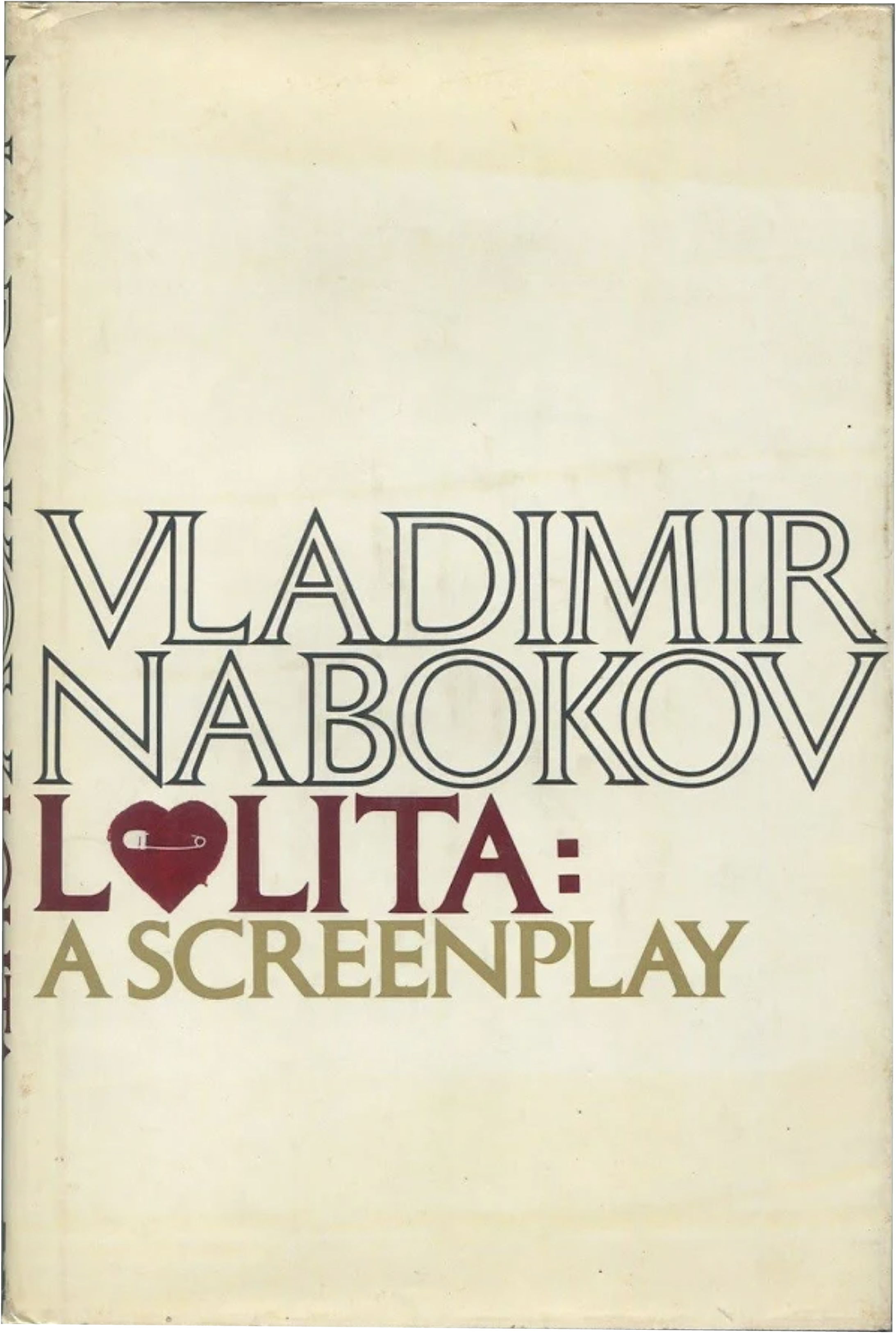
 Image 1 of 1
Lolita: A Screenplay — Vladimir Nabokov
Vladimir Nabokov
McGraw-Hill Book Company · New York · 1974
First Edition · First Printing
The Book:
The first edition, first printing of Vladimir Nabokov’s Lolita: A Screenplay, published by McGraw-Hill in 1974. Written for Stanley Kubrick’s 1962 film adaptation but substantially altered during production, Nabokov’s own screenplay remained unpublished for more than a decade. This copy retains its original black cloth binding and original unclipped $7.95 dust jacket. The copyright-page number sequence matches the documented first printing.
Condition:
Near Fine in a Near Fine original dust jacket. The book remains square and tight with clean black cloth, bright gilt spine lettering, and a clean interior. The original unclipped jacket remains bright and complete with only minor age and handling wear. No restoration, rebinding, or replacement components are observed.
Story Of The Book
Nabokov wrote the screenplay for Lolita. Kubrick filmed something very different.
After the controversial novel became an international phenomenon, Nabokov was hired to adapt it for Stanley Kubrick’s 1962 film. His screenplay transformed the novel for cinema while attempting to preserve its linguistic playfulness, dark comedy, and unreliable narration. But the version that reached theaters incorporated only fragments of what Nabokov had written.
For years, his screenplay remained inaccessible on its own terms. After securing the ability to publish it, Nabokov revised the text in 1973, and McGraw-Hill finally issued it in 1974. The book therefore allows readers to encounter not simply an adaptation of Lolita, but Nabokov’s version of an adaptation that Hollywood had substantially transformed.
It preserves the distance between what an author wrote for the screen and what the machinery of filmmaking ultimately allowed audiences to see.
Why It’s In The Collection
Lolita: A Screenplay belongs in Consigned to Darkness because it extends the collection’s Lolita story beyond obscenity and censorship into another form of control over expression: adaptation.
Nabokov surrendered a degree of authority when his novel became a film. Kubrick’s Lolita became culturally important in its own right, but it was not the screenplay Nabokov had written. This first printing restores that missing version to the historical record and lets the author’s intended cinematic interpretation exist independently of the film made from it.
The object preserves a simple but consequential distinction: the work that was written and the work the public was originally allowed to see were not the same.
Collection Categories: Literature · Free Expression · Censorship · Film & Media · Publication-Event Object · Sexuality & Culture · Obscenity Law & Court History
———
Authentication Evidence
Title page identifies McGraw-Hill Book Company and Vladimir Nabokov as author, consistent with the 1974 first edition.
Copyright page carries the first-printing number sequence “123456789BPBP7987654,” matching the sequence documented for the first printing in the Nabokov bibliography.
ISBN 0-07-045732-8 matches the documented first edition.
Original black cloth binding is present.
Front board bears the title and author blind-stamped in the cloth, consistent with documented first-printing copies.
Spine carries the correct gilt-stamped title, author, and McGraw-Hill imprint.
Original red endpapers are present.
Original white dust jacket is retained.
Dust jacket retains the original $7.95 price on the front flap.
Dust jacket design and Halsman photograph of Nabokov on the rear panel correspond to the documented first-edition jacket.
Collation of xiv, 213, [1] pages is consistent with documented first-printing copies.
No evidence of rebinding, facsimile jacket, or replacement components is observed.
Observable bibliographic evidence supports identification as the 1974 McGraw-Hill first edition, first printing.