
 Image 1 of 1
Lady Chatterley’s Lover (UK) — D. H. Lawrence
D. H. Lawrence
Harmondsworth: Penguin Books, 1960
First Penguin Edition · First Printing
The Book:
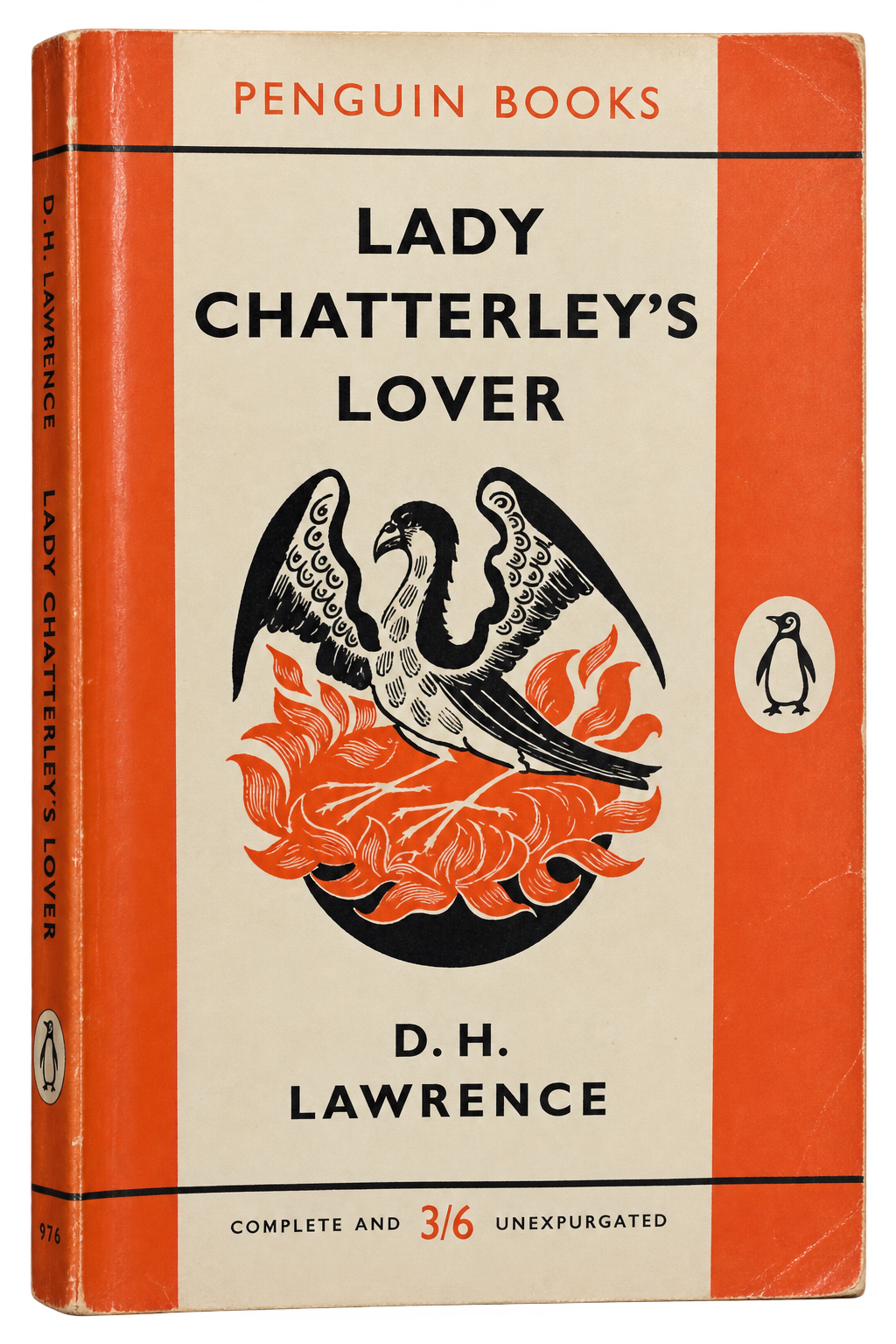
The first Penguin edition, first printing of the complete, unexpurgated Lady Chatterley’s Lover, published in Britain in 1960 as Penguin No. 1484. The copyright page states both “First printed 1960” and “This complete text first published in Great Britain 1960,” while this copy retains the correct original pictorial wrappers and 3/6 cover price. These physical points identify it as the first issue of the edition at the center of one of the defining censorship battles in modern British publishing.
Condition:
Very Good+. The original pictorial wrappers remain clean and structurally sound, showing light rubbing and minor edge wear. The spine remains square, the binding is sound, and the interior is clean, with uniform toning to the text block consistent with the inexpensive paper used for the edition. The original 3/6 cover price remains present, with no ownership inscriptions observed.
Story Of The Book
The British government put a novel on trial. Penguin Books put literature itself on the witness stand.
For more than thirty years after D. H. Lawrence privately published Lady Chatterley’s Lover in Florence in 1928, British readers could not openly purchase the complete novel at home. Its explicit descriptions of sex and its repeated use of language considered obscene had kept the unexpurgated text outside ordinary British commercial publishing.
Then Penguin Books decided to sell it for 3 shillings and 6 pence.
That price mattered. Penguin was not proposing an expensive edition intended for collectors or a discreet volume circulating among a literary elite. Its inexpensive paperback would make Lawrence’s complete novel available to an enormous popular readership. The question confronting British authorities was therefore no longer whether Lady Chatterley’s Lover existed. It was whether ordinary adults would be permitted to buy it.
Penguin’s decision became an early and consequential test of Britain’s new Obscene Publications Act 1959, which allowed a work accused of obscenity to be defended on the grounds that publication was justified for the public good because of its literary, artistic, scientific, or other merit.
The resulting R v. Penguin Books Ltd. trial became a cultural spectacle. The prosecution argued that the novel’s sexual content and language rendered its publication obscene. Penguin assembled writers, academics, clergy, critics, and other witnesses to defend Lawrence’s work and its literary value.
The jury returned a verdict of not guilty.
The consequences extended far beyond a single novel. Penguin’s victory demonstrated that sexually explicit literature could successfully invoke literary merit against an obscenity prosecution and became a defining moment in the liberalization of British publishing and censorship.
And this particular edition occupies an unusually direct relationship to that history. Penguin No. 1484 was not a later commemorative edition of the controversial book. It was the edition Penguin chose to publish, the edition prosecuted by the Crown, and the edition whose legality the jury was asked to decide.
After the acquittal, copies went on sale to extraordinary public demand. A book that the British state had attempted to suppress became a mass-market bestseller.
The government asked whether ordinary people should be allowed to read Lawrence. The jury answered yes.
Why It’s In The Collection
The 1960 Penguin Lady Chatterley’s Lover is almost a perfect expression of what Consigned to Darkness means by a publication-event object.
Its significance does not depend primarily upon being an early printing of an important literary work. It matters because this physical edition participated in the historical event for which the book is remembered.
Penguin deliberately took a novel that had remained unavailable in complete form through ordinary British publishing and placed it into a cheap mass-market format. When the government prosecuted the publisher, Penguin defended not merely Lawrence but the proposition that literary merit and the interests of adult readers could outweigh the state’s judgment that certain words and sexual descriptions were too dangerous to circulate.
The 3/6 price printed on this copy is therefore more than an identification point. It helps explain the stakes of the case. Penguin was democratizing access to a book that had previously circulated through expensive private editions, piracies, imports, and expurgated texts. The confrontation was partly about obscenity, but it was also about who would be permitted access to literature.
Within the collection, this copy also forms the British chapter of an unusually complete three-object censorship narrative. The contemporary 1928 Florence pirate represents the underground circulation that flourished while governments prevented lawful publication. The 1959 Grove Press first American edition represents the American challenge to suppression. And this 1960 Penguin first printing represents the British confrontation that finally brought the complete novel openly into the mass market.
Together, they show something central to the collection’s thesis: censorship does not freeze a book in one historical moment. It changes the way the book is printed, transported, sold, prosecuted, defended, and ultimately remembered.
This copy captures the moment that process broke open in Britain.
For thirty years, censorship determined how British readers could encounter Lady Chatterley’s Lover. In 1960, this is the edition that changed the terms.
Collection Categories: Free Expression · Censorship · Obscenity Law & Court History · Anti-Authoritarianism · Publication-Event Object · Literature
———
Authentication Evidence
• Correct Penguin Books wrappers for Penguin No. 1484.
• Copyright page states "First printed 1960," confirming first printing.
• Copyright page states "This complete text first published in Great Britain 1960," confirming the first complete British Penguin edition.
• Original 3/6 cover price present.
• Correct Penguin cover design and typography for the 1960 first issue.
• Penguin imprint and publication information consistent throughout.
• No evidence of later Penguin reprint or reset text observed.
• First Penguin edition, first printing characteristics consistent throughout.