
 Image 1 of 1
Lady Chatterley’s Lover (Pirated Edition) — D. H. Lawrence
D. H. Lawrence
Florence: Privately Printed, 1928
Pirated Florence Edition · First Pirate Printing (pirating the Roberts A42 issue)
The Book:
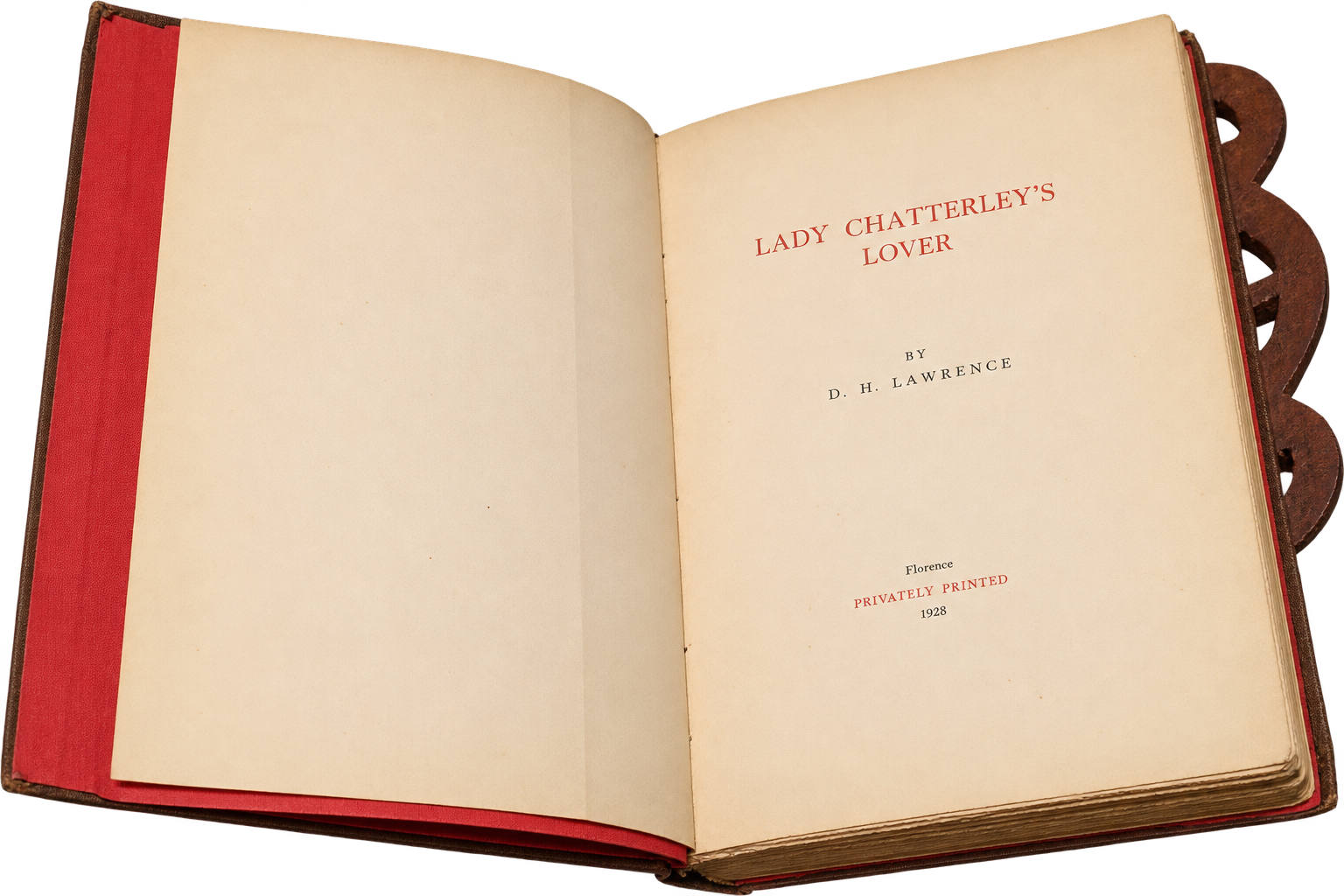
A contemporary pirated Florence edition of Lady Chatterley’s Lover, issued in 1928 during the novel’s first wave of underground circulation. This copy is not the authorized Giuseppe Orioli limited first edition. Instead, it belongs to the contemporary pirate issues that appeared almost immediately afterward to meet demand for a book that ordinary readers could not legally obtain through conventional publishing channels. The title page is printed in red and black and reads “Florence / Privately Printed / 1928.” The verso is blank, with no limitation statement or Orioli signature, distinguishing it from the authorized edition. The copy retains its original black moiré-pattern cloth binding, paper spine label, and red endpapers. Its construction and pagination are consistent with a Roberts A42-type pirate issue.
Condition:
Very Good. The original black moiré-pattern cloth shows light rubbing and wear at the spine ends and corners. The original paper spine label remains intact but worn. The text block is clean and structurally sound, with no evidence of later rebinding or restoration observed from the available photographs.
Story Of The Book
Before governments legalized Lady Chatterley’s Lover, printers simply found ways around them.
When D. H. Lawrence privately published Lady Chatterley’s Lover in Florence in 1928, he did so outside the ordinary mechanisms of British and American commercial publishing. The novel’s explicit sexual language and subject matter made conventional publication extraordinarily difficult, and access to the authorized edition was restricted by both price and legal risk.
Demand did not disappear.
Instead, pirate editions began appearing almost immediately.
This copy belongs to that first underground life of the book: a privately printed Florence issue produced outside the authorized Orioli edition and without its limitation statement or signature. It was not created as a later collector’s facsimile or retrospective curiosity. It was part of the contemporary shadow market that emerged because official publishing and legal distribution could not satisfy readers who wanted the complete text.
That makes the book’s piracy inseparable from its censorship history. The usual story of a pirated edition is one of unauthorized commercial exploitation. Here, piracy also became one of the mechanisms through which the text survived and traveled while governments and publishers were still attempting to control access to it.
The physical details matter. The anonymous “Privately Printed” imprint, the absence of a limitation statement, and the plain but distinctive black moiré binding all reflect a publication that existed outside the authorized edition’s formal structure. The book itself documents the alternative route Lawrence’s novel took once prohibition made ordinary circulation difficult.
Censorship did not make Lady Chatterley’s Lover disappear.
It changed the way people printed it.
Why It’s In The Collection
This is one of the collection’s clearest examples of censorship producing the very behavior it was intended to prevent.
Governments could restrict lawful publication, importation, mailing, and sale of Lady Chatterley’s Lover, but they could not extinguish demand for the novel. Instead, suppression helped create an underground economy of unauthorized editions that moved outside normal publishing channels.
That is what this object preserves.
The collection does not value it because piracy itself is inherently admirable. It values it because the physical book records a specific historical consequence of censorship: when legal distribution becomes impossible, texts often find alternate routes.
The copy is especially important as part of the collection’s three-object Lady Chatterley’s Lover sequence. This 1928 pirate documents the clandestine circulation that followed the novel’s initial private publication. The 1959 Grove Press first American edition documents the American legal confrontation with obscenity law. The 1960 Penguin first printing documents the corresponding British confrontation and the moment the complete novel entered lawful mass-market circulation.
Together, the three copies tell a remarkably complete story: first the book circulates underground, then publishers openly challenge the law, and finally the law loses its power to keep the text out of ordinary readers’ hands.
This pirate edition is where that story is most materially visible.
When censorship closed the front door, the book came in through the side.
Collection Categories: Free Expression · Censorship · Obscenity Law & Court History · Anti-Authoritarianism · Publication-Event Object · Literature
———
Authentication Evidence
• Correct title page reading "Florence / Privately Printed / 1928," consistent with contemporary Florence pirate editions.
• Blank verso to title page, consistent with known pirate issues lacking limitation statements.
• Original black moiré-pattern cloth binding present.
• Original paper spine label present.
• Original red endpapers present.
• No numbered limitation page or Orioli signature present, distinguishing this copy from the authorized Orioli first edition.
• Binding, typography, title page, and construction consistent throughout with a contemporary pirated Florence edition.
• Contemporary pirated Florence edition characteristics consistent throughout.