
 Image 1 of 1
Lady Chatterley’s Lover (US) — D. H. Lawrence
D. H. Lawrence
New York: Grove Press, Inc., 1959
First American Edition · First Printing
The Book:
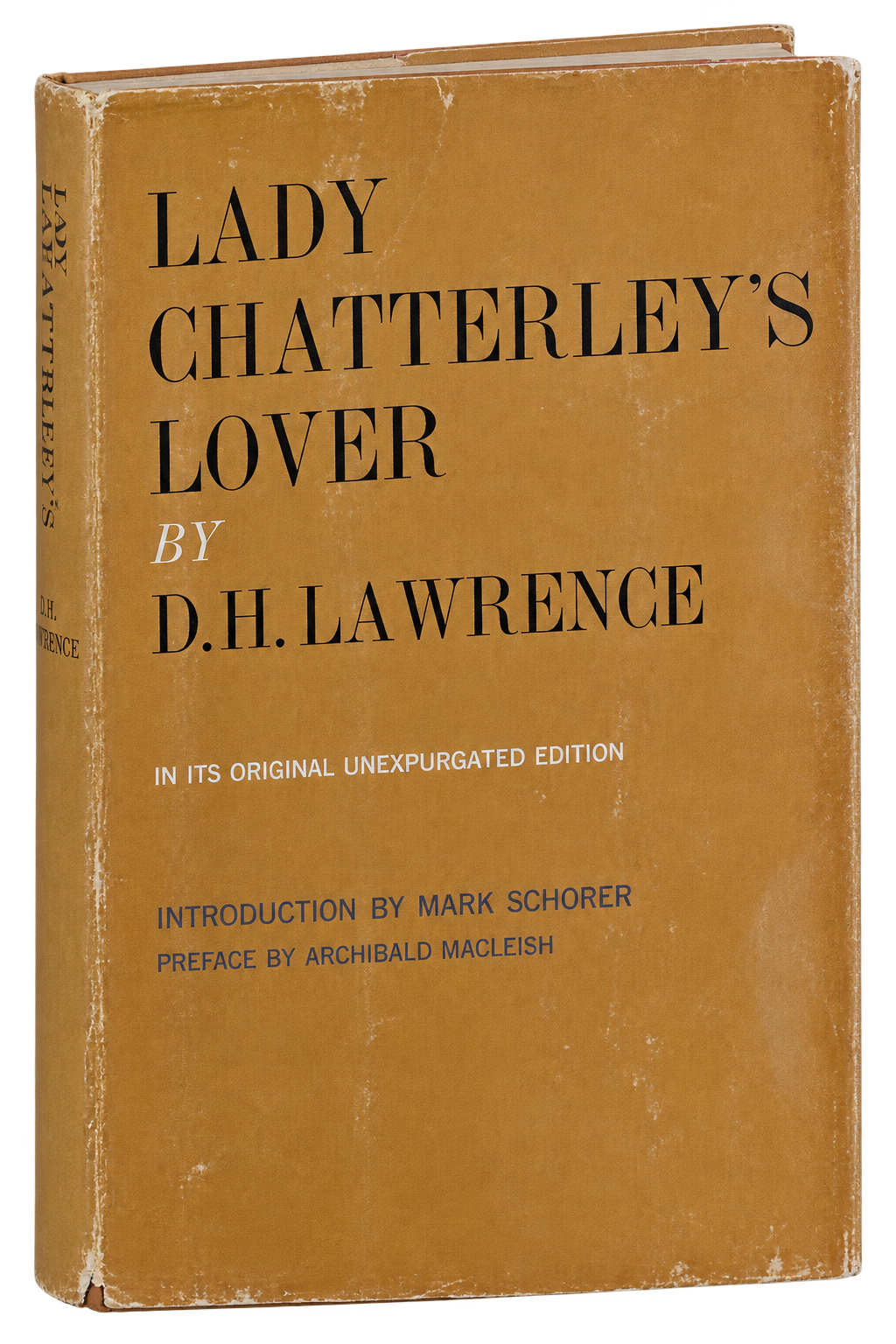
The first American edition, first printing of the complete, unexpurgated Lady Chatterley’s Lover, published by Grove Press in 1959. The copyright page identifies the text as Lawrence’s third manuscript version, first published by Giuseppe Orioli in Florence in 1928, and contains the correct copyrights for Mark Schorer’s introduction and Archibald MacLeish’s prefatory letter. This copy retains its original cloth binding and original $6.00 first-state dust jacket, with no later-printing statement or evidence of book-club manufacture.
Condition:
Very Good+ in a Very Good dust jacket. The book remains clean, square, and structurally sound, with light age toning and a dealer pencil notation on the front free endpaper. The original $6.00 jacket shows rubbing, spine and edge wear, toning and spotting, and shallow chipping at the spine ends and corners, but remains complete and presents well overall.
Story Of The Book
Grove Press did not wait for America’s obscenity laws to change. It published the book that would help change them.
For three decades after D. H. Lawrence privately published Lady Chatterley’s Lover in Florence in 1928, American readers could not legally obtain an authorized, complete edition of the novel through ordinary commercial channels. Its explicit treatment of sex, adultery, class, and the human body made it a recurring target of the obscenity regime that gave government authorities enormous power over what could enter the country or move through the mails.
In 1959, Grove Press deliberately challenged that system.
Publisher Barney Rosset issued Lawrence’s complete, unexpurgated text in this edition and immediately encountered federal suppression. The United States Post Office declared the book obscene and barred it from the mails. Grove responded not by withdrawing the novel but by taking the government to court.
That distinction is essential to understanding this particular edition. The book was not published after Grove Press won the censorship battle. This is the edition over which the battle was fought.
In Grove Press, Inc. v. Christenberry, federal judge Frederick van Pelt Bryan rejected the government’s obscenity determination and held that Lady Chatterley’s Lover, considered as a whole, could not properly be excluded from the mails. The decision became part of the rapid transformation of American obscenity law in the middle of the twentieth century, weakening the legal machinery through which controversial literature had long been suppressed.
The physical book therefore participated directly in the event it now documents. Its Grove Press imprint, complete text, and original $6.00 jacket belong to the commercial edition whose distribution forced the government’s censorship authority into court.
Grove Press did not publish a book celebrating a victory for free expression. It published the book that had to win one.
Why It’s In The Collection
Few objects in Consigned to Darkness embody the collection’s thesis as literally as the 1959 Grove Press Lady Chatterley’s Lover.
This is not simply the first American edition of a famous banned novel. It is a publication-event object: the commercial edition through which a publisher deliberately confronted the government’s power to decide what American adults could legally read.
That makes its place within the collection fundamentally different from that of an ordinary literary first edition. The historical significance resides not only in Lawrence’s text but in what happened when this particular edition entered circulation. The government attempted to suppress it. Grove Press resisted. The resulting litigation helped push American obscenity doctrine away from a system capable of excluding serious literature because of sexually explicit passages and toward substantially greater constitutional protection for books and their readers.
It is also one component of the collection’s three-object Lady Chatterley’s Lover censorship history. The contemporary 1928 Florence pirate documents what happened when censorship drove the novel underground. This 1959 Grove edition documents the American confrontation with censorship. The 1960 Penguin edition documents the corresponding British confrontation and the landmark R v. Penguin Books Ltd. trial. Together, the three objects show the same text moving from clandestine circulation to open legal publication on both sides of the Atlantic.
The original $6.00 first-state jacket strengthens this copy as a publication artifact. It preserves the book not merely as Lawrence’s novel but in the commercial form in which Grove Press placed the unexpurgated text before the American public and challenged the government to stop it.
Some banned books become symbols of free expression long after the fight is over. This copy comes from the fight itself.
Collection Categories: Free Expression · Censorship · Obscenity Law & Court History · Anti-Authoritarianism · Publication-Event Object · Literature
———
Authentication Evidence
• Correct Grove Press title page, confirming First American Edition.
• Copyright page includes the 1957 Mark Schorer introduction copyright and 1959 Archibald MacLeish letter copyright, consistent with the 1959 Grove Press first edition.
• Copyright page states "This edition is the third manuscript version, first published by Giuseppe Orioli, Florence, 1928," consistent with the first Grove Press unexpurgated edition.
• No later printing statement present, consistent with Grove Press's first-printing practice for this edition.
• Original $6.00 first-state dust jacket present, consistent with the first printing.
• Grove Press imprint and typography consistent throughout.
• No evidence of book-club manufacture observed.
• First American edition, first printing characteristics consistent throughout.