
 Image 1 of 1
Ladies of the Press — Ishbel Ross
Full Title: Ladies of the Press: The Story of Women in Journalism by an Insider
Ishbel Ross
Harper & Brothers · New York · 1936
First Edition · First Printing
The Book:
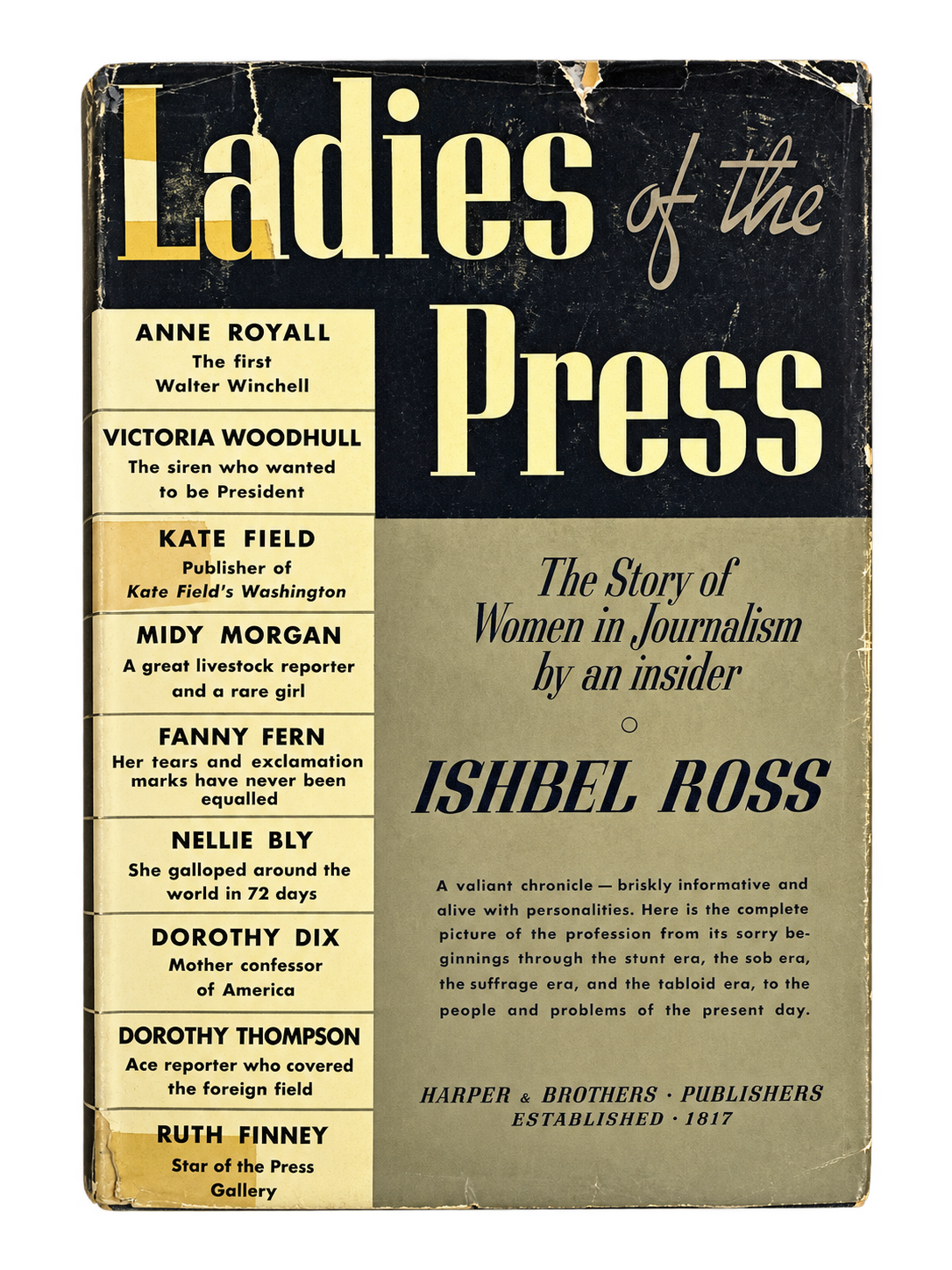
The first edition, first printing of Ishbel Ross’s pioneering history of women in American journalism, published by Harper & Brothers in 1936. Written by a veteran newspaper reporter who had experienced the profession’s barriers firsthand, the extensively illustrated volume traces women’s struggle to enter and reshape the American press through the lives of reporters, editors, publishers, columnists, and foreign correspondents. This copy retains its original black publisher’s cloth with blue-and-gilt spine label, illustrated photographic endpapers, and scarce original unclipped $3.75 dust jacket.
Condition:
Very Good+ book in a Good+ dust jacket. The binding remains square and sound with clean interior pages and no ownership markings observed. The original jacket remains substantially complete and highly displayable, with moderate edge wear, scattered rubbing and soiling, several chips, and paper loss concentrated at the head of the spine and upper front panel. The jacket is protected in archival polyester.
Story Of The Book
Before women could report the news, they first had to defeat the assumption that they were not entitled to enter the newsroom.
Ishbel Ross knew that struggle from inside the profession. She had worked as a newspaper reporter when women were routinely confined to society pages, “women’s interests,” and novelty assignments while the newsroom’s most consequential beats remained overwhelmingly controlled by men. In Ladies of the Press, she turned that experience toward recovering the women who had forced their way into one of America’s principal institutions of public power.
Published in 1936, the book follows generations of reporters, editors, publishers, political correspondents, foreign correspondents, and professional provocateurs—including Anne Royall, Victoria Woodhull, Nellie Bly, Dorothy Dix, and Dorothy Thompson. Their careers reveal a profession slowly transformed by women who repeatedly accepted assignments others dismissed, created opportunities where none existed, and demonstrated that authority over the public record did not belong exclusively to men.
They were not simply fighting to appear in newspapers. They were fighting for the authority to decide what became news.
That distinction gives the book its enduring importance. Journalism determines whose experiences become public knowledge, which abuses receive scrutiny, and what enters the first draft of history. By documenting women’s struggle to participate in that process while many of those struggles remained unresolved, Ross preserved something later histories could not: a history of women changing the press written by a woman who had lived inside that change herself.
Why It’s In The Collection
Ladies of the Press expands the collection’s story of free expression beyond the right to speak and toward an equally important question: who gets access to the institutions powerful enough to make a voice heard?
The women Ross documents confronted barriers that were often not formal acts of government censorship. Editors, professional customs, social expectations, and institutional hierarchies could determine who received serious assignments, whose reporting carried authority, and whose perspective entered the public record at all.
Their resistance therefore changed more than individual careers. By becoming investigative reporters, editors, correspondents, and publishers, women claimed a role in deciding what democratic society knew about itself.
Published in 1936 by a participant in that transformation, this first edition preserves an early attempt to record that history before later generations could take women’s presence in the newsroom for granted. They did not merely demand to be represented in public life. They claimed the authority to report, interpret, and shape it.
Collection Categories: Women’s History & Feminism · Free Expression · Investigative Journalism · Civil Rights · Publication-Event Object · Political History
———
Authentication Evidence
Title page identifies Ladies of the Press: The Story of Women in Journalism by an Insider by Ishbel Ross.
Title page identifies Harper & Brothers Publishers, New York and London, and is dated 1936.
Copyright page explicitly states “FIRST EDITION.”
Copyright page records Copyright © 1936 by Ishbel Ross.
No later-edition or subsequent-printing statement appears in the photographed preliminary matter.
The explicit “FIRST EDITION” statement, together with the absence of a later-printing designation, supports identification as the First Printing.
Original black publisher’s cloth binding is present with blind-ruled boards and the blue-and-gilt Harper spine label.
Original illustrated photographic endpapers are present.
Original dust jacket is present and retains the correct $3.75 publisher’s price on the front flap.
Contemporary 1936 publication information records the book at 622 pages and a $3.75 publication price.
Jacket front panel, spine typography, yellow flaps, author photograph, publisher information, and Harper jacket codes are internally consistent with the original issue.
No book-club statement, book-club blind stamp, altered imprint, reprint notice, or later-edition indicator is observed.
Observable bibliographic evidence supports identification as the 1936 Harper & Brothers First Edition · First Printing in the original priced dust jacket.