
 Image 1 of 1
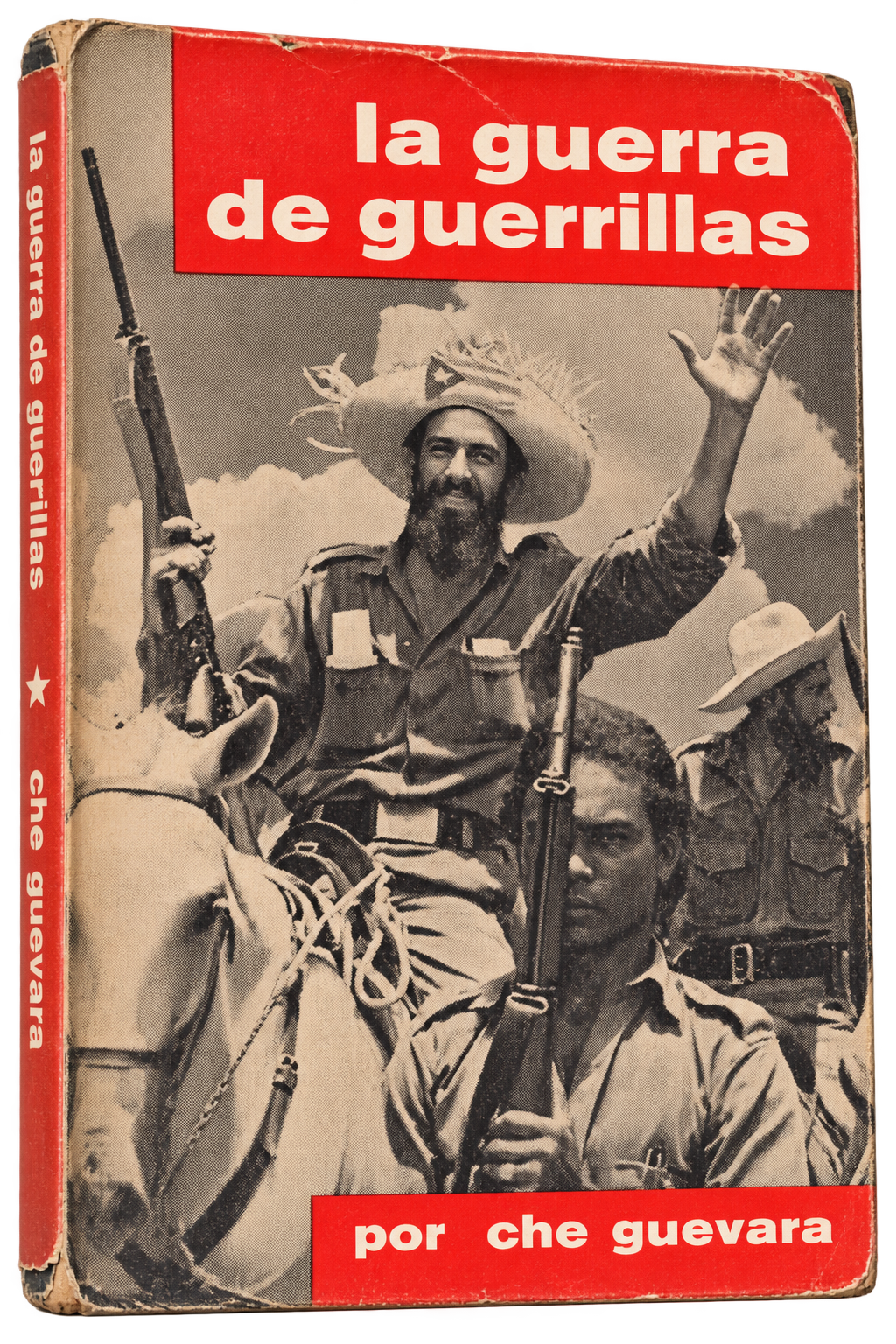
La Guerra de Guerrillas — Ernesto “Che” Guevara
Ernesto “Che” Guevara
Havana: Departamento de Instrucción del MINFAR, 1960
First Edition · First Printing
The Book:
The very rare, true first edition, first printing of Che Guevara’s La Guerra de Guerrillas, published in Havana in 1960 by the Departamento de Instrucción del Ministerio de las Fuerzas Armadas Revolucionarias (MINFAR) and printed by the Talleres Tipográficos del I.N.R.A. Issued in its original illustrated staple-bound wrappers, the title page bears Guevara’s dedication “A Camilo,” honoring revolutionary commander Camilo Cienfuegos. The rear publication statement records an original print run of 50,000 copies on Cuban paper. This copy retains its original wrappers and carries the contemporary ownership inscription “Martin Prieto” inside the front wrapper. Independent bibliographic references cited in the inventory identify this MINFAR / INRA issue as the original 1960 first edition, first printing.
Condition:
Very Good. The original staple-bound wrappers remain intact and the book structurally sound, with moderate age toning and handling wear consistent with an ephemeral revolutionary publication of the period. The original binding, wrappers, typography, format, and paper are preserved, with no evidence of facsimile production, rebinding, restoration, or later commercial issue. Contemporary ownership inscription, “Martin Prieto,” to the inside front wrapper.
Story Of The Book
The Cuban Revolution had succeeded. Che Guevara wanted to explain how others could do it again.
Published in 1960, La Guerra de Guerrillas was not written as a history of the revolution that had brought Fidel Castro and his guerrillas to power.
It was written as instruction.
Drawing directly from the experience of revolutionary warfare in Cuba, Guevara attempted to turn that experience into a transferable theory of insurgency: how small guerrilla forces should organize themselves, operate in hostile territory, develop relationships with local populations, sustain a campaign, and transform armed struggle into political revolution.
The distinction matters.
Many revolutionary books explain why an existing political order should be overthrown. La Guerra de Guerrillas addresses the much more consequential question of how to overthrow it.
And this particular edition was not separated from the new revolutionary government whose experience it codified. It was issued directly by the instructional department of Cuba’s Revolutionary Armed Forces, printed by the I.N.R.A., dedicated to the recently deceased Camilo Cienfuegos, and produced in 50,000 copies.
The book therefore occupies an extraordinary historical moment.
Guevara was no longer simply an insurgent fighting Batista. He was now part of the government created by that insurgency—and was using the publishing machinery of the revolutionary state to explain the methods by which revolutionary warfare might be reproduced elsewhere.
Those ideas traveled.
La Guerra de Guerrillas became one of the twentieth century’s most influential texts on insurgency, circulating through revolutionary movements while also becoming an object of study for governments, military theorists, and counterinsurgency institutions attempting to understand and defeat the kind of warfare Guevara advocated. The inventory accordingly identifies its influence across Latin America, Africa, and Asia.
A revolution had become a government. One of its leaders immediately published the instructions for making another revolution.
Why It’s In The Collection
La Guerra de Guerrillas is one of the clearest counter-thesis objects in Consigned to Darkness.
The collection preserves resistance to power. But it is equally interested in the moment resistance becomes power.
Guevara embodies that transition unusually well.
The tactics described here emerged from an insurgency against an authoritarian government. But this book was published after that insurgency succeeded, when Guevara had become a powerful figure within a new revolutionary state—one that would itself restrict political opposition and exercise coercive authority.
That tension is precisely why the object matters.
Consigned to Darkness does not preserve La Guerra de Guerrillas because revolutionary violence is inherently anti-authoritarian, nor because Guevara’s political program deserves endorsement. It preserves the book because understanding power requires preserving the ideas, strategies, and printed objects through which people attempt to acquire it.
And few copies could tell that story better than this one.
This is not a later translation or retrospective edition explaining Guevara’s theories after they became historically famous. It is the original Cuban first edition, first printing, issued by the Revolutionary Armed Forces in 1960, immediately after the revolution whose experience supplied its argument.
The publication itself therefore marks a transition:
insurgency → doctrine → dissemination → power.
La Guerra de Guerrillas did not merely describe revolutionary warfare. This edition was one of the physical instruments through which revolutionary Cuba attempted to teach it to the world.
Che Guevara helped win a revolution. Then the revolutionary government printed 50,000 copies of his instructions for doing it again.
Collection Categories: Revolutionary Texts · Guerrilla Warfare · Guerrilla Military · Political Movements · Anti-Colonialism · Political History · Counter-Thesis Object
———
Authentication Evidence
• Title page identifies the work as "La Guerra de Guerrillas" by Che Guevara with the dedication "A Camilo," matching the original Cuban issue.
• Rear publication page states "Esta edición consta de 50,000 ejemplares...", consistent with the original Cuban printing.
• Rear wrapper states the booklet was printed by the Talleres Tipográficos del I.N.R.A. for the Departamento de Instrucción del MINFAR, matching known first-edition bibliographic descriptions.
• Physical construction (original staple binding, wrappers, typography, format, and paper) is consistent with authenticated revolutionary-era Cuban government publications.
• Independent bibliographic references identify this exact MINFAR / INRA "A Camilo" edition as the original 1960 first edition, first printing.
• No evidence of facsimile production, modern reproduction, rebinding, or later commercial issue is present in the supplied photographs.