
 Image 1 of 1
Kingsblood Royal — Sinclair Lewis
Sinclair Lewis
New York: Random House, 1947
First Edition · First Printing
The Book:
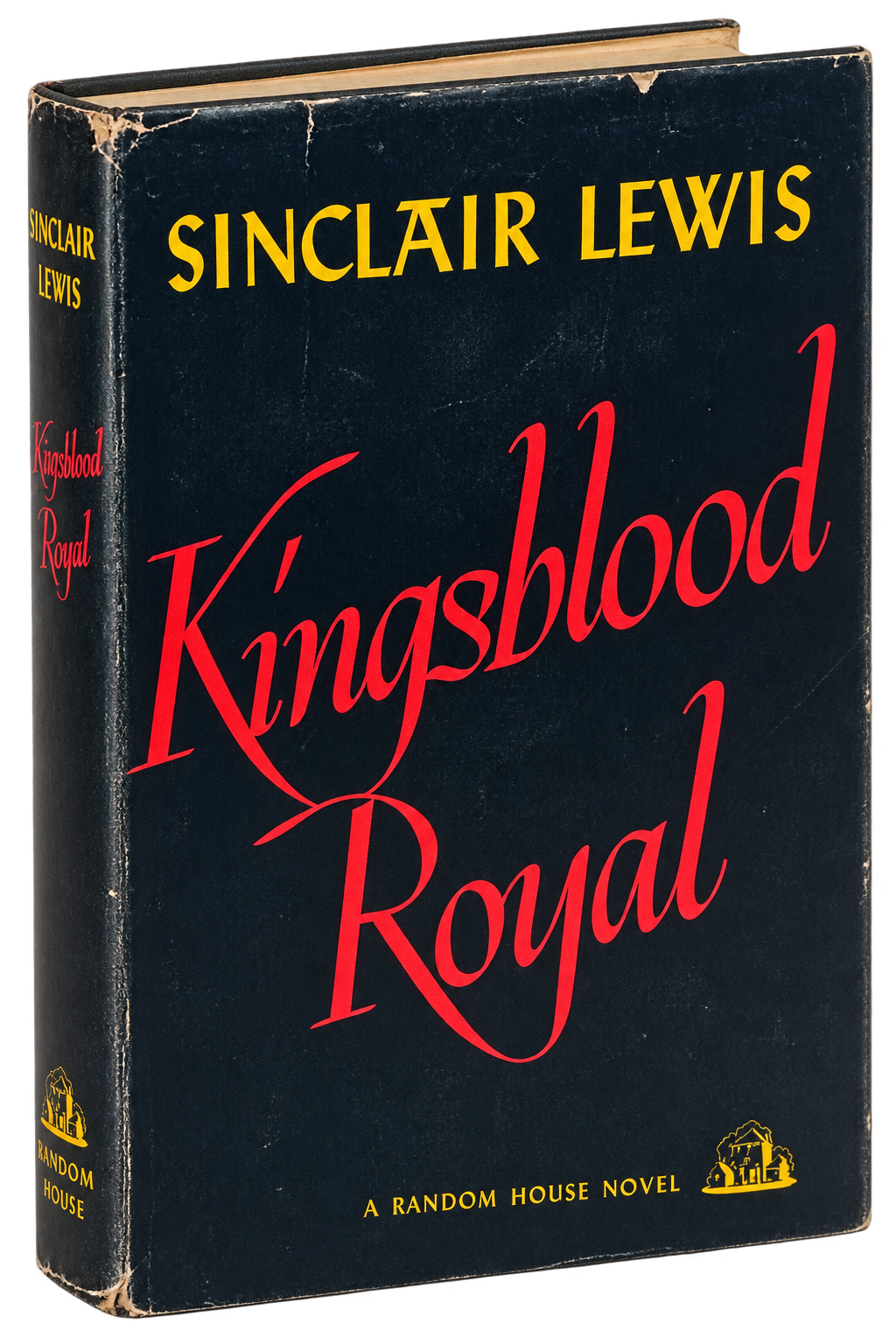
The first edition, first printing of Sinclair Lewis’s Kingsblood Royal, published by Random House in 1947. The copyright page explicitly states “First Printing,” while the title page carries the correct Random House imprint. This copy retains the original gray publisher’s cloth with black spine labels and the original unclipped dust jacket. No later-printing statement, book-club indicator, or evidence of a revised issue is present.
Condition:
Very Good+ in a Very Good dust jacket. The book remains clean, square, and structurally sound, with bright spine labels and an unmarked interior. The original jacket remains complete and unclipped, showing moderate rubbing, light edge wear, several small chips at the spine ends and corners, and a larger chip at the lower front panel. It is housed in a modern archival sleeve.
Story Of The Book
Sinclair Lewis asked white America a brutal question: what if the rules of segregation suddenly applied to you?
Published in 1947, Kingsblood Royal follows Neil Kingsblood, a prosperous white banker and military veteran who discovers that one of his ancestors was Black. The revelation does not change his character, his intelligence, his work, or his relationships. What changes is the way American society is prepared to classify and treat him.
That premise allowed Lewis to attack the logic of racial hierarchy at its foundation.
The novel appeared at a moment when segregation remained entrenched across much of the United States and long before the major legislative victories of the modern Civil Rights Movement. By making racial identity hinge on ancestry rather than appearance or conduct, Lewis exposed how arbitrary the system was—and how much violence and exclusion were required to sustain it.
Neil’s discovery becomes socially explosive because American racism depends upon categories that claim to be natural while being enforced politically, legally, and culturally. Once he is understood to possess Black ancestry, the privileges attached to his perceived whiteness begin to disappear. The person has not changed. The hierarchy has.
Lewis was already one of the most famous American writers alive, and he had become the first American to receive the Nobel Prize in Literature seventeen years earlier. That made Kingsblood Royal more than an obscure protest novel. It was a major mainstream author using popular fiction to confront segregation, racial identity, and institutional discrimination before those issues had become central to the national political consensus.
The novel’s method is deliberately uncomfortable. It asks readers who may never have questioned the social benefits attached to whiteness to imagine those protections disappearing overnight.
Nothing about Neil Kingsblood changes except what society believes he is. That is exactly Lewis’s point.
Why It’s In The Collection
Kingsblood Royal belongs in Consigned to Darkness because it exposes racial hierarchy as a system of institutional power.
The novel is not merely about prejudice between individuals. Its deeper target is the network of social, economic, legal, and cultural rules that determines whose identity carries privilege and whose identity carries punishment.
That distinction makes it a strong anti-authoritarian object. Authority does not always arrive in the form of a dictator, censor, or prison. It can also be embedded in institutions, customs, hiring practices, housing, law, and the accepted assumptions through which a society decides who belongs.
Lewis published the novel in 1947, before Brown v. Board of Education, before the Montgomery bus boycott, and long before the Civil Rights Act of 1964. The first edition therefore preserves a mainstream American literary challenge to racial segregation at a moment when the system remained deeply entrenched and politically defended.
This copy’s first-edition, first-printing status matters because the collection values books that participated in the argument while the underlying system of power was still operating—not merely later works explaining why that system was wrong.
The book also complements the collection’s more documentary civil-rights objects by showing how fiction could force readers to confront political structures through identification rather than argument alone. Lewis did not ask readers merely to condemn segregation in the abstract. He asked them to imagine waking up one morning on the other side of it.
The novel’s radical proposition is simple: if changing a label changes a person’s rights, the injustice lies in the system—not the person.
Collection Categories: Civil Rights · Literature · Anti-Authoritarianism · Free Expression
———
Authentication Evidence
• Copyright page states "First Printing," directly establishing first-printing status.
• Copyright page records Copyright 1947 by Sinclair Lewis and publication by Random House, consistent with the first edition.
• Title page identifies Kingsblood Royal by Sinclair Lewis with the Random House imprint.
• Original dust jacket remains present and unclipped, consistent with the first issue.
• Original publisher's gray cloth binding with black spine labels matches the known first-edition binding.
• No indication of later printings, book club issue, or revised edition is present.
• The observable bibliographic evidence supports identification as the first edition, first printing.