
 Image 1 of 1
Justice in War-Time — Bertrand Russell
Bertrand Russell
The Open Court Publishing Co. · Chicago and London · 1916
First American Edition · First Printing
The Book:
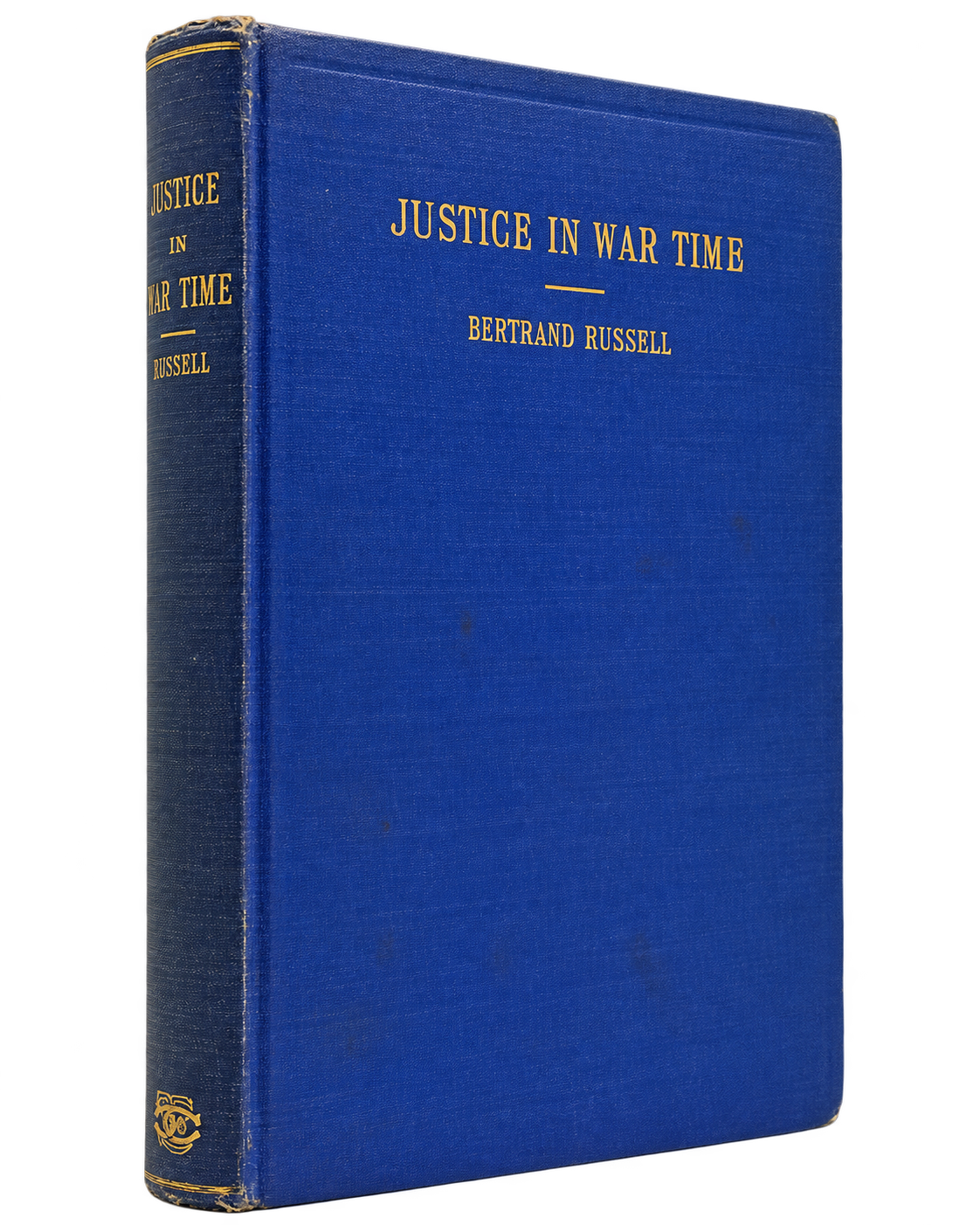
The first American edition, first printing of Bertrand Russell’s Justice in War-Time, published by The Open Court Publishing Co. in 1916 while the First World War was still raging. A collection of Russell’s contemporary essays opposing militarism, compulsory patriotism, and the moral assumptions used to justify warfare, the book appeared during the period in which his anti-war activism was bringing him into direct conflict with British authorities. Original blue publisher’s cloth with gilt lettering, retaining the frontispiece portrait of Russell. This copy lacks the original dust jacket.
Condition:
Very Good+. The binding remains square and sound with bright gilt lettering and an unusually clean, unmarked interior. Light age toning is present as expected. The blue publisher’s cloth exhibits scattered moisture spotting and moderate rubbing concentrated at the spine and extremities, with minor fraying at the spine ends and corners. No ownership inscriptions, bookplates, institutional markings, rebinding, or restoration are observed. Lacking the original dust jacket.
Story Of The Book
When governments go to war, dissent is often treated as treason. Bertrand Russell insisted that conscience owed its loyalty to truth before nation.
Published in 1916 while the First World War still raged, Justice in War-Time challenged the patriotic consensus consuming Britain and much of the Western world. Russell rejected militarism, compulsory patriotism, and the idea that the existence of war suspended ordinary standards of morality.
His argument was more unsettling than simple pacifism. Russell insisted that governments remained accountable to reason, justice, and humanity precisely when national emergency made abandoning those principles easiest. War did not relieve individuals of moral responsibility. And it did not give the state an unlimited claim over individual conscience.
Russell did not make these arguments safely in retrospect. His opposition to the war brought consequences while the conflict was still underway. His activism contributed to his dismissal from his lectureship at Trinity College, Cambridge, and brought prosecution by the British government. In 1918, he would be imprisoned for anti-war writings.
That chronology transforms Justice in War-Time from a philosophical meditation into something more immediate. Russell was publishing arguments against wartime conformity while the institutions enforcing that conformity still possessed the power to punish him for doing so.
Why It’s In The Collection
Justice in War-Time belongs in Consigned to Darkness because war presents one of the oldest and most difficult tests of free expression: how much dissent will a society tolerate when dissent is easiest to portray as disloyalty?
Governments at war possess extraordinary incentives to demand unity. Fear makes censorship easier to justify, opposition easier to stigmatize, and individual conscience easier to subordinate to national purpose. Russell argued that these were precisely the conditions under which dissent mattered most.
This 1916 first American edition, first printing is therefore important not merely because of the ideas contained within it, but because of when those ideas were put into print. It carried Russell’s challenge to militarism and compulsory patriotism across the Atlantic while the First World War remained unresolved and while Russell himself was becoming a target of official sanction for his anti-war advocacy.
The collection contains many books written after governments abused their power. This one is different. Russell challenged that power while it was still being exercised—and before he knew what challenging it would ultimately cost him.
Collection Categories: Anti-War · Free Expression · Political Dissent · Anti-Authoritarianism · Political Philosophy · Literature · War & Conflict
———
Authentication Evidence
Title page identifies the work as Justice in War-Time by Bertrand Russell.
Title page bears the imprint The Open Court Publishing Co., Chicago and London, 1916.
Copyright page records Copyright by The Open Court Publishing Co., 1916.
Matching 1916 dates on the title page and copyright page place this copy in the year of the original Open Court American publication.
No statement of a revised edition, later edition, or subsequent American edition appears on the title page or copyright page.
No later-printing statement, impression number, reprint notice, or subsequent-printing designation appears on the copyright page.
Specialist bibliographic cataloguing identifies the 1916 Open Court issue as the First American Edition; a 1917 Open Court issue is separately documented as the Second American Edition.
Original publisher’s blue cloth binding with gilt lettering to the front board and spine remains present and corresponds to documented hardcover copies of the 1916 First American Edition.
Original frontispiece portrait of Bertrand Russell is present.
Typography, publisher imprint, paper, and binding construction are consistent with the original Open Court American issue.
No evidence of rebinding, ex-library provenance, facsimile leaves, supplied pages, modern reproduction, or other bibliographic alteration is observed.
The 1916 Open Court issue is catalogued by specialist dealers with reference to Blackwell & Ruja A15.2a; because published dealer records also apply that bibliographic citation to the documented 1917 Second American Edition, the citation is treated here as supporting bibliographic context rather than independent proof of this copy’s first-printing status.
Taken together, the observed 1916 Open Court imprint, matching 1916 copyright date, absence of any later-edition or later-printing designation, original publisher’s binding, and correspondence with documented 1916 First American Edition copies support identification as an authentic First American Edition · First Printing.