
 Image 1 of 1
Invitation to a Beheading — Vladimir Nabokov
Vladimir Nabokov
G. P. Putnam’s Sons · New York · 1959
First American Edition · First Printing · First English-Language Edition
The Book:
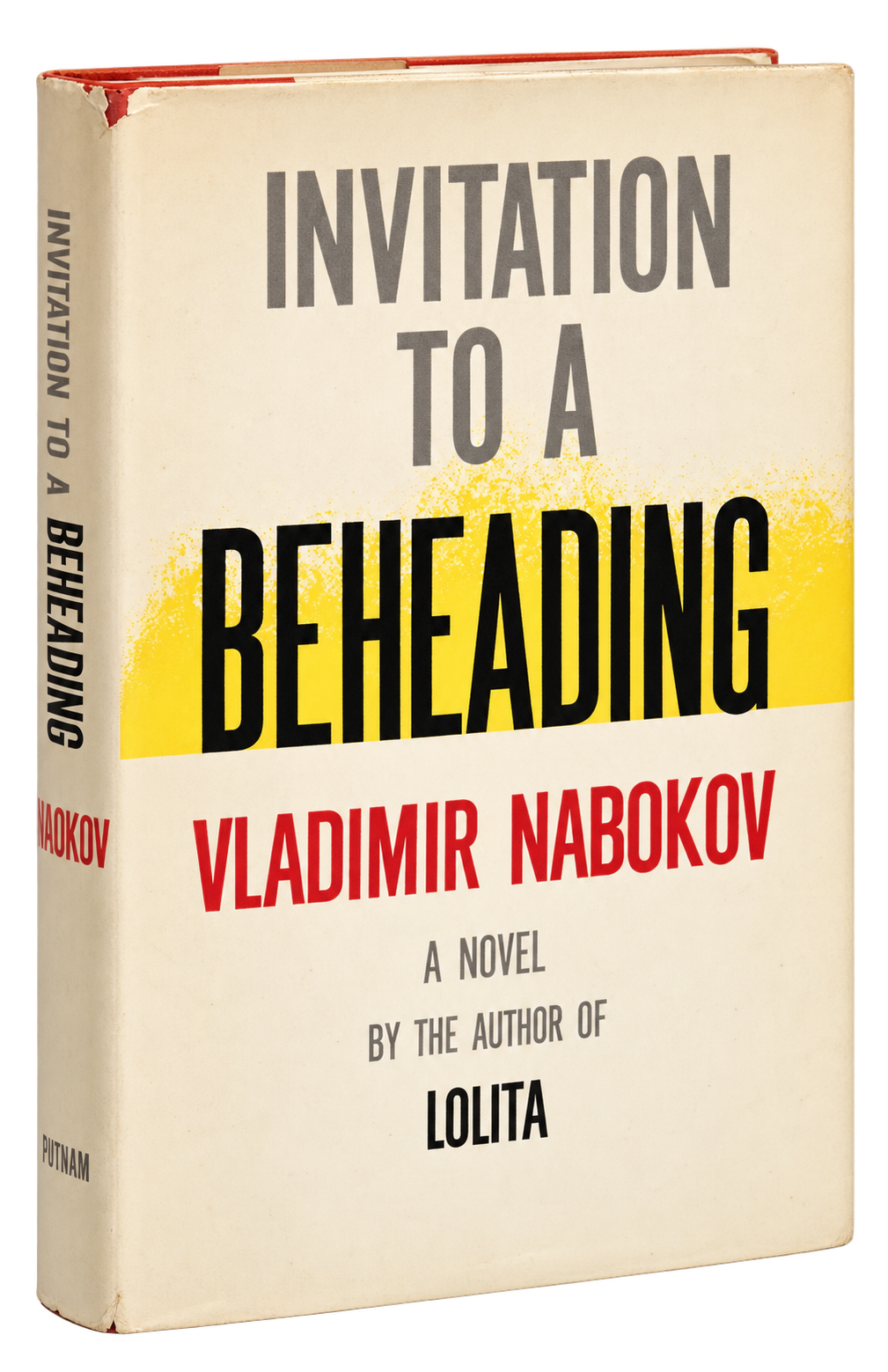
The first American edition, first printing—and first English-language edition—of Vladimir Nabokov’s Invitation to a Beheading, published by G. P. Putnam’s Sons in 1959. Translated from the Russian by Dmitri Nabokov in collaboration with his father, this edition brought one of Nabokov’s major Russian-language novels into English for the first time. This copy retains its original red cloth-backed patterned boards, red topstain, and original dust jacket. Specialist bibliography identifies the edition as Juliar A16.2.
Condition:
Near Fine in a Very Good+ original dust jacket. The book remains square and tight with clean patterned boards, bright spine lettering, and a clean interior. The original jacket remains complete and attractive, showing light rubbing, modest toning, and minor edge wear consistent with age. No restoration, rebinding, or replacement components are observed.
Story Of The Book
Cincinnatus C. has been condemned to death for the crime of being different in a society that demands transparency.
Written in Russian during Nabokov’s European exile, Invitation to a Beheading follows a prisoner awaiting execution for the deliberately absurd offense of “gnostical turpitude.” Around him operates a grotesque bureaucracy of jailers, officials, lawyers, and spectators whose cheerful conformity makes the machinery of execution seem almost ordinary.
The novel is less a portrait of one historical dictatorship than a nightmare about systems that cannot tolerate an individual who refuses to become completely legible to them. Cincinnatus’s private consciousness—his ability to imagine, think, and remain inwardly himself—becomes the one territory his captors cannot successfully govern.
The state can imprison Cincinnatus and sentence his body. Nabokov’s question is whether it can ever possess the person inside it.
Why It’s In The Collection
Invitation to a Beheading belongs in Consigned to Darkness because it reduces authoritarian power to its most fundamental ambition: the demand that the individual surrender an inner life the state cannot control.
Unlike the collection’s documentary witnesses to dictatorship, Nabokov approaches repression through allegory. The bureaucracy is ridiculous, the crime nonsensical, and the world deliberately unstable—but the underlying conflict is deadly serious.
This 1959 edition matters because it was the novel’s first appearance in English, carrying a work written during Nabokov’s European exile into the language in which he had since become internationally famous. It transformed an earlier Russian novel into part of his English-language literary legacy.
Collection Categories: Literature · Anti-Authoritarianism · Political Dissent · Exile & Émigré Literature · Publication-Event Object
———
Authentication Evidence
Title page identifies G. P. Putnam’s Sons, New York, consistent with the 1959 first American edition.
Copyright page is dated 1959, consistent with the first American publication.
Translation is credited to Dmitri Nabokov in collaboration with the author, consistent with the first English-language edition.
Original red cloth-backed patterned boards are present, matching documented first-edition copies.
Original yellow endpapers are present, consistent with documented first-edition copies.
Original gilt spine lettering is present.
Original bright red topstain is present.
Original dust jacket is retained.
Dust jacket retains the original $3.95 publisher’s price.
Collation of 223 pages is consistent with documented first-edition copies.
Bibliographic characteristics correspond to Juliar A16.2.
No later-printing designation is present.
No evidence of rebinding, facsimile jacket, book-club manufacture, or replacement components is observed.
Observable bibliographic evidence supports identification as the 1959 G. P. Putnam’s Sons first American edition, first printing, and first English-language edition.