
 Image 1 of 1
I Never Had It Made — Jackie Robinson
Full Title: I Never Had It Made: An Autobiography
Jackie Robinson & Alfred Duckett
G. P. Putnam’s Sons · New York · 1972
First Edition · First Printing
The Book:
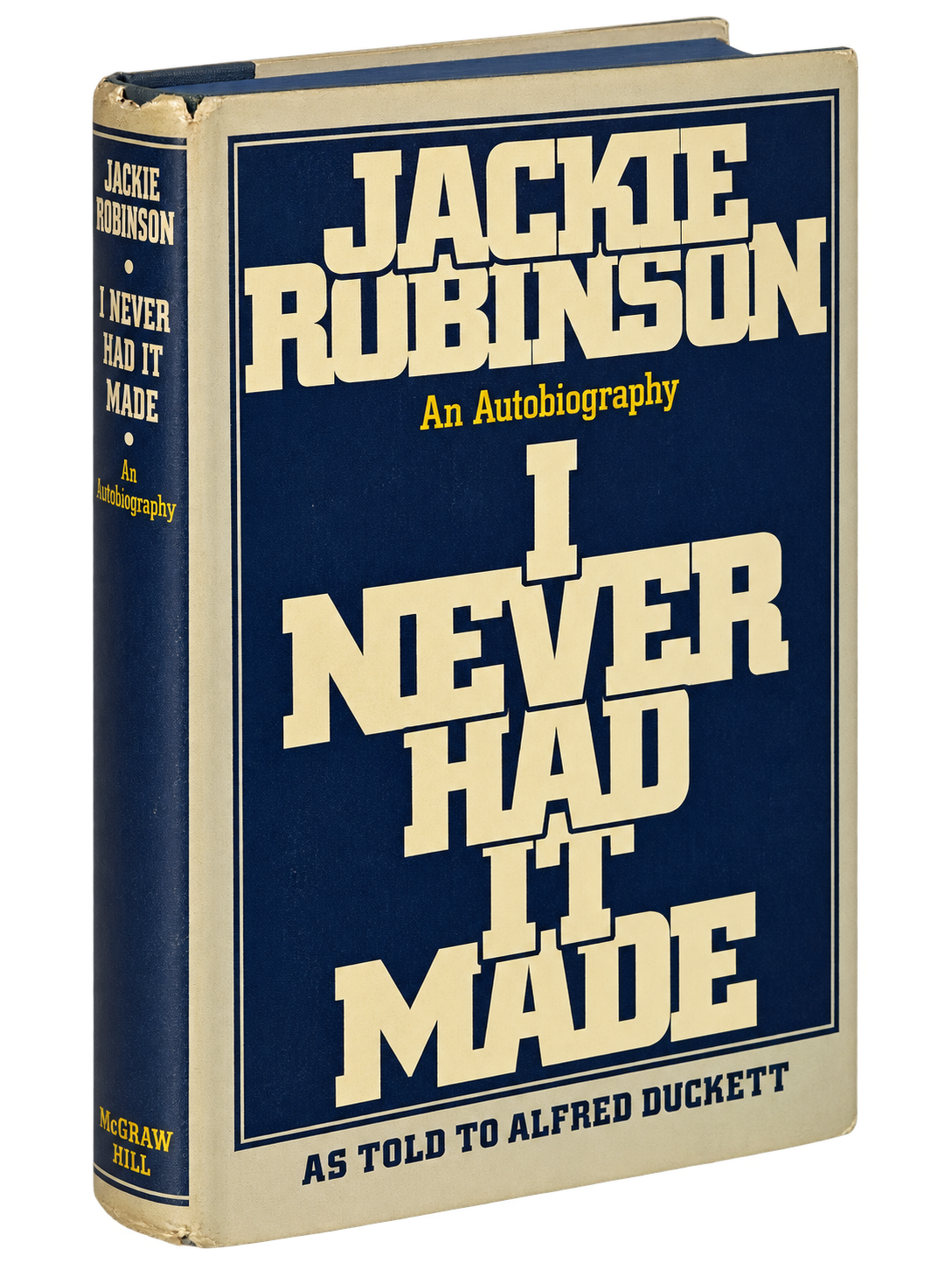
The first edition, first printing of Jackie Robinson’s final autobiography, written with Alfred Duckett and published by G. P. Putnam’s Sons in 1972. Original dark blue publisher’s cloth with gilt “J.R.” initials to the front board, retaining the original unclipped $7.95 dust jacket. This copy is additionally accompanied by the original G. P. Putnam’s Sons publisher’s review slip dated November 17, 1972, preserving evidence of the book’s original promotional distribution.
Condition:
Near Fine+ book in a Near Fine dust jacket. The binding remains exceptionally clean and square with bright gilt stamping, sharp corners, and an unmarked interior showing only light natural toning to the text-block edges. The original jacket retains excellent color with minor spine-end compression, light edge rubbing, and a few isolated spots of soiling on the lower rear panel. The original publisher’s review slip remains present.
Story Of The Book
Jackie Robinson broke baseball’s color barrier. Then he spent the rest of his life insisting that breaking a barrier was not the same thing as achieving equality.
Published in 1972, I Never Had It Made allowed Robinson to tell the story that the mythology surrounding his baseball career could not. Written with Alfred Duckett, the autobiography returns to his historic arrival with the Brooklyn Dodgers, but refuses to end the story there. Robinson writes about the racism he confronted in the military and professional baseball, his involvement in the Civil Rights Movement, his political disagreements and alliances, and his growing conviction that symbolic progress meant little without substantive equality.
By the time the book appeared, Robinson had become far more than the athlete who integrated Major League Baseball. He had worked with the NAACP, founded Freedom National Bank, entered national political debates, and repeatedly challenged institutions and political leaders—including former allies—when he believed they had failed Black Americans.
The man remembered for having the courage to enter an institution spent the rest of his life demanding that the institution actually change.
The timing makes the book especially poignant. I Never Had It Made was published in 1972, the final year of Robinson’s life. He died on October 24 at only fifty-three, leaving the autobiography as his final sustained account of what integration had accomplished—and what America still had not. This copy’s surviving publisher’s review slip further preserves the book at the moment Robinson’s final testimony was being sent into the world.
Why It’s In The Collection
Jackie Robinson is often remembered through a single triumphant image: walking onto a Major League Baseball field in 1947. I Never Had It Made complicates that image by allowing Robinson himself to explain what came afterward.
His story demonstrates one of the collection’s central ideas: challenging power does not end when a barrier falls. It continues in the struggle over what replaces it. Robinson’s integration of baseball was historic, but he refused to allow his personal success to become evidence that the larger fight against racial inequality had been completed.
Published during Robinson’s lifetime and preserving his own mature reflections on civil rights, politics, race, and American democracy, this first edition transforms an American icon back into something more interesting: a participant, critic, dissenter, and human being who remained dissatisfied with symbolic victory.
Jackie Robinson made history by becoming the first. He spent the rest of his life arguing that being first mattered only if others were allowed to follow.
Collection Categories: Civil Rights · Human Rights · Memoir & Testimony · Political History · Literature
———
Authentication Evidence
Title page identifies I Never Had It Made: An Autobiography by Jackie Robinson as told to Alfred Duckett.
Title page identifies G. P. Putnam’s Sons, New York, as publisher.
Copyright page records Copyright © 1972 by Jackie Robinson and Alfred Duckett.
The 1972 G. P. Putnam’s Sons publication is the original first edition of the work.
No later-printing statement, subsequent-impression statement, or revised-edition designation is present.
The absence of a later-printing designation is consistent with Putnam’s first-printing practice for this title.
Original dark blue publisher’s cloth is present with gilt “J.R.” initials to the front board and gilt spine lettering, consistent with documented first-edition copies.
Original unclipped dust jacket is present and retains the correct $7.95 publisher’s price.
Jacket design, typography, publisher information, and binding correspond to documented first-edition copies.
Original G. P. Putnam’s Sons publisher’s review slip accompanies the volume and records a publication date of November 17, 1972.
The surviving review slip is consistent with contemporaneous publisher distribution for review purposes.
No evidence of book-club manufacture, remainder marking, rebinding, supplied dust jacket, or facsimile components is observed.
Observable bibliographic evidence supports identification as the 1972 G. P. Putnam’s Sons First Edition · First Printing.