
 Image 1 of 1
Hiroshima — John Hersey
John Hersey
New York: Alfred A. Knopf, 1946
First Edition · First Printing
The Book:
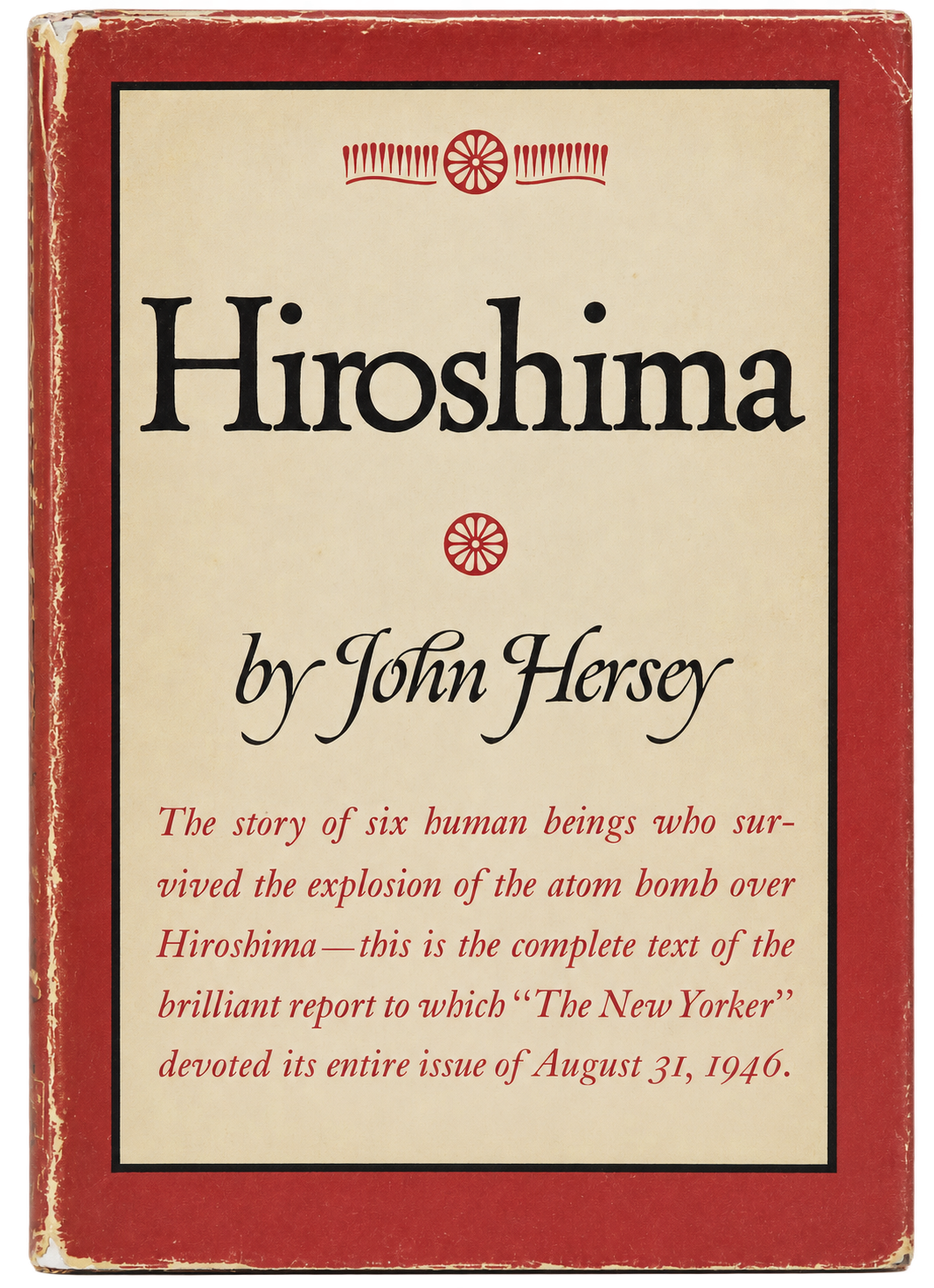
The first book edition, first printing of John Hersey’s Hiroshima, published by Alfred A. Knopf in 1946 only months after the work’s unprecedented appearance as the entire August 31 issue of The New Yorker. The copyright page explicitly states “First Edition,” with no later printing statement. This copy retains its original gray cloth binding with blind-stamped front title and gilt spine lettering, as well as its original unclipped dust jacket with the correct $1.75 price on the front flap.
Condition:
Good+ in a Good dust jacket. The book remains structurally sound, with light rubbing to the lower boards and expected age toning. The original jacket shows moderate edge wear, rubbing, chipping, and losses concentrated at the lower rear panel. The jacket remains unclipped with the original $1.75 price intact. No restoration or replacement components are documented.
Story Of The Book
Before Hiroshima, the atomic bomb was largely described as a weapon. John Hersey made readers encounter the people underneath it.
On August 6, 1945, the United States dropped an atomic bomb on Hiroshima.
The scale of the destruction was almost impossible to comprehend. Numbers could describe casualties. Military reports could describe explosive force. Governments could argue about strategy, necessity, surrender, and victory.
Hersey chose something else.
He followed six ordinary survivors.
Their experiences became the structure of Hiroshima: what they were doing when the bomb exploded, what they saw afterward, whom they tried to help, what happened to their bodies, and how a city destroyed almost instantaneously was experienced by the human beings inside it.
The method transformed the story.
Instead of explaining nuclear war from the perspective of states, generals, or policymakers, Hersey brought readers down to the level of individual lives.
That decision was so striking that The New Yorker did something unprecedented.
For its August 31, 1946 issue, the magazine abandoned its normal mixture of fiction, criticism, cartoons, and other material and devoted the entire issue to Hersey’s report. Public response was immediate and extraordinary. Alfred A. Knopf then published the work in book form later that same year, giving the testimony a permanent life beyond the magazine issue.
The power of Hiroshima came from a simple change in scale.
A technological achievement became burned skin.
A military operation became missing family members.
A geopolitical event became six people trying to survive the morning.
Hersey did not make the bomb smaller. He made its victims impossible to keep abstract.
Why It’s In The Collection
Hiroshima is one of the clearest examples in Consigned to Darkness of witness changing the meaning of history.
Governments inevitably describe war from above.
They speak in strategy, military necessity, objectives, casualties, and national interest.
Hersey wrote from below.
That does not make Hiroshima a conventional work of political dissent. Its power comes from something more fundamental: it restores individual human experience to an event whose scale made abstraction almost unavoidable.
That makes the book foundational to the collection’s interest in witness literature.
The collection’s copy is the first book edition, first printing, preserving the moment Hersey’s report moved from its extraordinary initial magazine publication into permanent book form. The distinction matters: the August 31 New Yorker issue preserves the work’s first appearance, while this Knopf edition preserves the publication that allowed it to remain continuously accessible as a standalone historical document.
Its original $1.75 dust jacket strengthens the copy as a publication object, preserving not merely the text but the form in which American readers encountered Hersey’s account as a book in 1946.
Many histories tell us that Hiroshima was destroyed.
Hersey made the more difficult contribution.
He asked readers to understand what destruction meant to the people who were there.
Before Hiroshima, the atomic bomb could remain a statistic of war. After Hersey, it had faces.
Collection Categories: Witness Literature · Investigative Journalism · War & Conflict · Human Rights
———
Authentication Evidence
• Correct Alfred A. Knopf title page, confirming first edition
• Copyright page states "FIRST EDITION," confirming first edition
• No later printing statement present, consistent with Alfred A. Knopf's first-printing practice for this edition
• Original publisher gray cloth binding present
• Original dust jacket present
• Front jacket flap retains original $1.75 price
• Jacket design and typography consistent with first issue
• Borzoi imprint and publisher information consistent throughout
• First edition, first printing characteristics consistent throughout