
 Image 1 of 1
Harper’s Magazine (No. 1015, Dec '34) — Dorothy Thompson, Lee F. Hartman (Ed.)
First Appearance of Dorothy Thompson’s “Good-By to Germany”
Edited by Lee F. Hartman
Featuring Dorothy Thompson, Emma Goldman & others
Harper & Brothers, Publishers · New York · December 1934
Volume 170 · Number 1015
First Edition · First Printing
The Magazine:
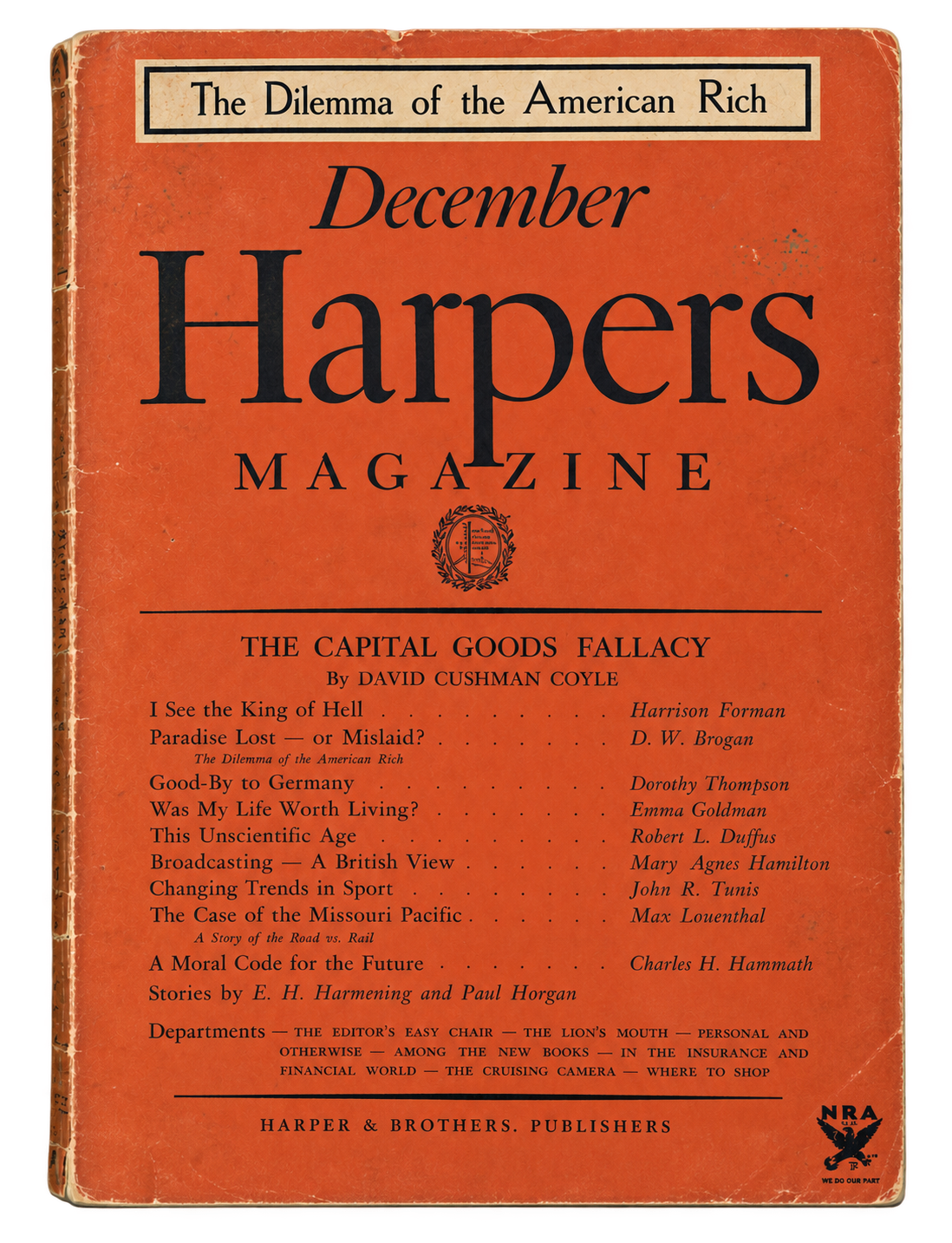
The original December 1934 issue of Harper’s Magazine, preserving the first appearance of Dorothy Thompson’s “Good-By to Germany,” written after the Nazi government expelled her from Germany that August. Thompson’s essay begins on page 43 and records her eyewitness observations of a country rapidly surrendering individual liberty to dictatorship. The issue also contains Emma Goldman’s “Was My Life Worth Living?”, placing two major twentieth-century voices of political dissent within the same original publication. Original orange printed front wrapper, printed spine, pictorial advertising rear wrapper, and 40¢ cover price retained. 130 textual pages; 6⅝ × 9½ inches.
Condition:
Good. Original wrappers remain present but show substantial wear along the spine fold, including paper loss, partial splitting, rubbing, edge chipping, scattered dark spotting, rounded corners, and contemporary pencil annotations. Wrapper attachment is weakened, although complete detachment is not established. Text block remains substantially held together with moderate age toning, light waviness, handling wear, and localized marginal discoloration.
Story Of The Magazine
The Nazi regime ordered Dorothy Thompson out of Germany because it could not control what she told the world.
On August 25, 1934, the Gestapo informed Thompson that her criticism of Hitler’s government had made her continued presence unacceptable. Given twenty-four hours to leave, she became the first American foreign correspondent expelled from Nazi Germany.
Three months later, Harper’s published “Good-By to Germany.” Thompson was not interpreting dictatorship from the safety of hindsight. She was describing a regime she had watched consolidate power—and which had personally removed her for refusing to accept its version of events.
The timing matters. Hitler had been chancellor for less than two years. The Night of the Long Knives had occurred only months earlier. The Nuremberg Laws, Kristallnacht, the Second World War, and the Holocaust were still in the future.
The issue contains another extraordinary voice in Emma Goldman’s “Was My Life Worth Living?”, placing the lifelong anarchist and critic of state power alongside Thompson in the same magazine. Together, their contributions give this issue two distinct voices confronting questions of authority, individual freedom, and the costs of dissent.
Germany closed its border behind Dorothy Thompson. Harper’s opened the page in front of her.
Why It’s In The Collection
This issue of Harper’s Magazine belongs in Consigned to Darkness because an authoritarian government attempted to remove a witness—and publication ensured that her testimony traveled farther instead.
That is what makes the original magazine more important to the collection than a later reprinting of Thompson’s essay. This is the physical platform through which American readers first encountered “Good-By to Germany,” only months after the regime she described had expelled her.
Thompson’s testimony is especially valuable because she wrote before history supplied certainty. She could identify repression, propaganda, militarization, and the subordination of the individual to the state, but neither she nor her readers knew how far those forces would ultimately go.
Goldman’s presence makes the object richer still: two women with radically different lives and political perspectives confronting authority and individual freedom within the same December 1934 publication.
The regime expelled the witness. The magazine preserved what she had seen.
Collection Categories: Witness Literature · Investigative Journalism · Free Expression · Censorship · Anti-Authoritarianism · Anti-Totalitarianism · Political Dissent · Political History · War & Conflict · Women’s History & Feminism · Publication-Event Object · Magazine & Periodical History
———
Authentication Evidence
Original front wrapper identifies the publication as the December issue of Harper’s Magazine.
Original spine identifies the issue as “December 1934” and “No. 1015.”
Independent periodical records identify the issue as Volume 170, Number 1015, corroborating the issue designation.
Original printed 40¢ price remains present.
Contents page identifies Harper’s Magazine: The Contents for December 1934.
Contents page identifies Lee F. Hartman as editor.
Contents page lists Dorothy Thompson’s “Good-By to Germany” beginning on page 43.
Article opening bears the heading “GOOD-BY TO GERMANY” and byline “BY DOROTHY THOMPSON.”
Harper’s official archive identifies “Good-By to Germany” with the December 1934 issue, independently establishing this issue as its original periodical publication setting.
Contents page also lists Emma Goldman’s “Was My Life Worth Living?”
Original orange printed front wrapper, printed spine, and pictorial advertising rear wrapper remain present.
Publisher information identifies Harper & Brothers, Publishers, New York.
Issue collates to 130 textual pages, consistent with documented copies of the December 1934 issue.
Documented complete copies include unpaginated advertising sections at the front and rear; the presence of both complete advertising sections in this copy has not yet been physically confirmed.
Physical dimensions of approximately 6⅝ × 9½ inches are consistent with documented copies of the issue.
Issue date, number, typography, contents, pagination, publisher information, price, and wrapper construction are internally consistent with the original December 1934 issue.
No evidence of facsimile production, later reproduction, extracted-page assembly, or modern reprinting is observed.
“Good-By to Germany” appears here in its first published form, establishing this issue as the first appearance rather than a later collected or reprinted version.
Observable and independently corroborated evidence supports identification as the original Harper’s Magazine, December 1934, No. 1015 · First Edition · First Printing.