
 Image 1 of 1
Guerrilla Television — Michael Shamberg
Michael Shamberg & Raindance Corporation
Holt, Rinehart and Winston · New York · 1971
First Edition · First Printing
The Book:
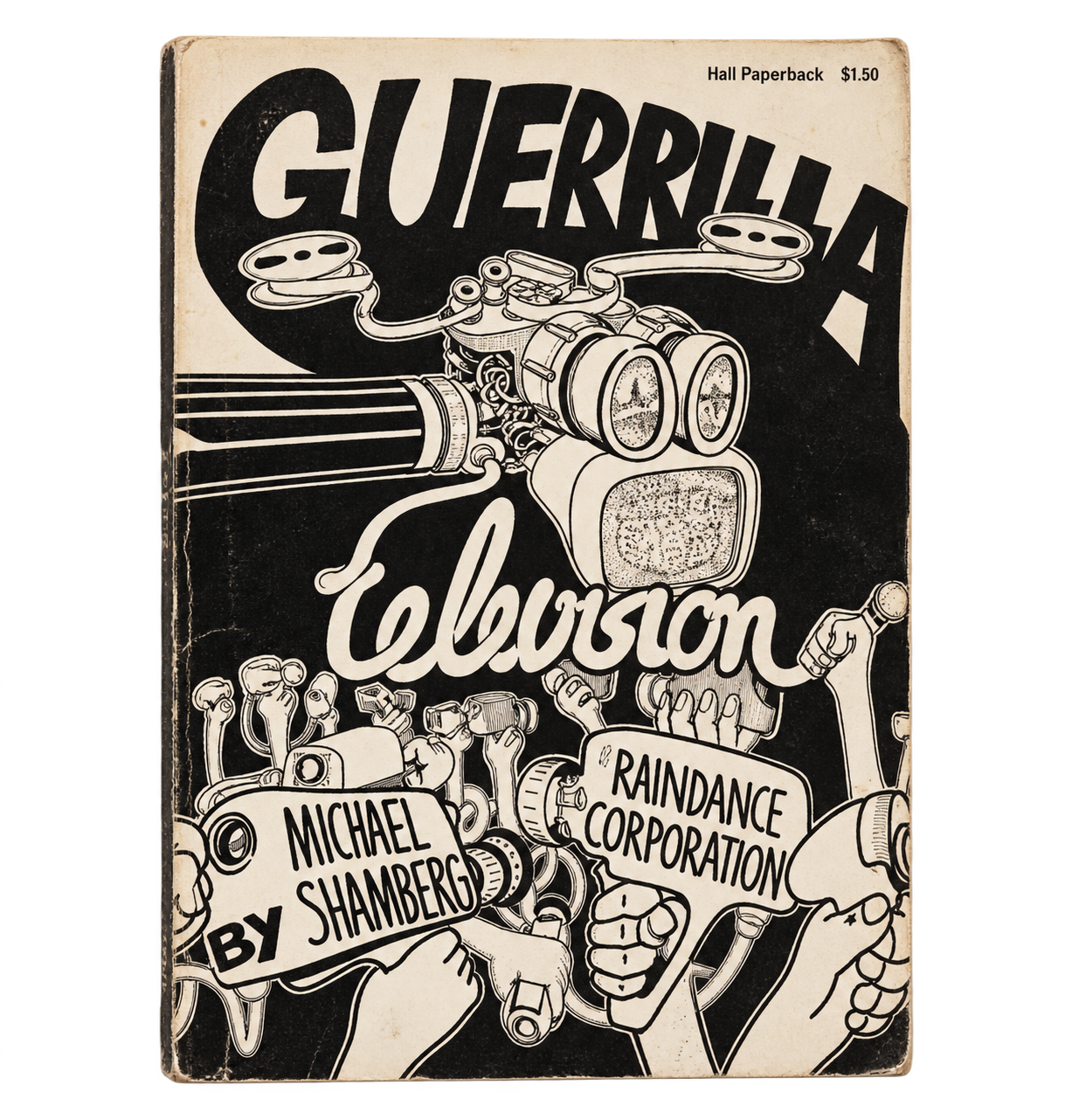
The first edition, first printing of Michael Shamberg and Raindance Corporation’s Guerrilla Television, published by Holt, Rinehart and Winston in 1971. Part manifesto and part practical manual, the book proposed using portable videotape, cable television, and decentralized networks to challenge the dominance of institutional broadcasting. 108 pp. Original illustrated publisher’s wrappers.
Condition:
Very Good+. The original illustrated wrappers retain strong presentation with light handling wear, scattered surface rubbing, minor edge wear, gentle corner creasing, and moderate reading wear along the spine. The binding remains sound and the interior clean, with no ownership inscriptions, highlighting, restoration, or structural defects observed. A small contemporary pencil retail notation appears on the final advertising page.
Story Of The Book
Long before everyone carried a camera, Guerrilla Television asked what would happen when ordinary people could make the media themselves.
In 1971, American television was dominated by a small number of powerful broadcast institutions. Portable video was beginning to offer something radically different: cameras that could leave the studio and place the ability to record events into far more hands.
Michael Shamberg and the countercultural media collective Raindance saw more than a new piece of technology. They saw a challenge to centralized control over information.
Guerrilla Television turned that idea into a manifesto and a manual. It explained portable video equipment, community television, alternative programming, cable networks, and strategies for creating media outside traditional broadcasting. The goal was not simply to put different programs on television. It was to change who possessed the power to make television in the first place.
The book emerged directly from the alternative-video movement surrounding Raindance and its influential journal Radical Software. Published in November 1971, it brought the collective’s ideas into book form and gave the emerging guerrilla-television movement both a name and one of its defining texts.
Why It’s In The Collection
Guerrilla Television belongs in Consigned to Darkness because freedom of expression depends not only on the right to speak, but on access to the tools capable of making speech public.
Shamberg and Raindance recognized that control over communication technology could become a form of power. When television required expensive studios, broadcast licenses, and institutional infrastructure, only a small number of organizations could determine what millions of people saw.
Portable video suggested another possibility.
This 1971 first edition preserves that argument at the moment the technology was emerging. Raindance imagined citizens documenting their own communities, building alternative information networks, scrutinizing institutions, and communicating without waiting for established broadcasters to grant them access.
Today, when a person can record an event and distribute it globally from a device in their pocket, much of that premise feels ordinary. In 1971, Guerrilla Television was arguing that the ability to make your own media could redistribute power.
Collection Categories: Free Expression · Publication-Event Object · Political Dissent · Anti-Authoritarianism
———
Authentication Evidence
Title page identifies Guerrilla Television by Michael Shamberg and Raindance Corporation.
Title page identifies Holt, Rinehart and Winston as publisher.
Copyright page records Copyright © 1971 by Michael Shamberg and Raindance Corporation.
Copyright page explicitly states “First Edition,” directly establishing first-edition status.
Independent WorldCat bibliographic records identify the 1971 Holt, Rinehart and Winston publication as the First Edition.
No later-printing statement, subsequent-impression designation, or revised-edition statement appears in this copy.
The explicit First Edition statement together with the absence of a subsequent-printing designation supports identification as the First Printing.
Independent bibliographic records collate the 1971 edition at 108 pages.
Original illustrated publisher’s wrappers are present and correspond to the original paperback issue.
Copyright page prints bibliographic information for both the hardcover and paperback issues, consistent with the publisher’s original publication.
Publisher imprint, typography, layout, and physical production remain internally consistent throughout.
No evidence of rebinding, facsimile components, book-club manufacture, or later-issue characteristics is observed.
Taken together, the explicit edition statement, original 1971 Holt imprint, absence of any subsequent-printing designation, and original publisher’s wrappers support identification as an authentic 1971 First Edition · First Printing.