
 Image 1 of 1
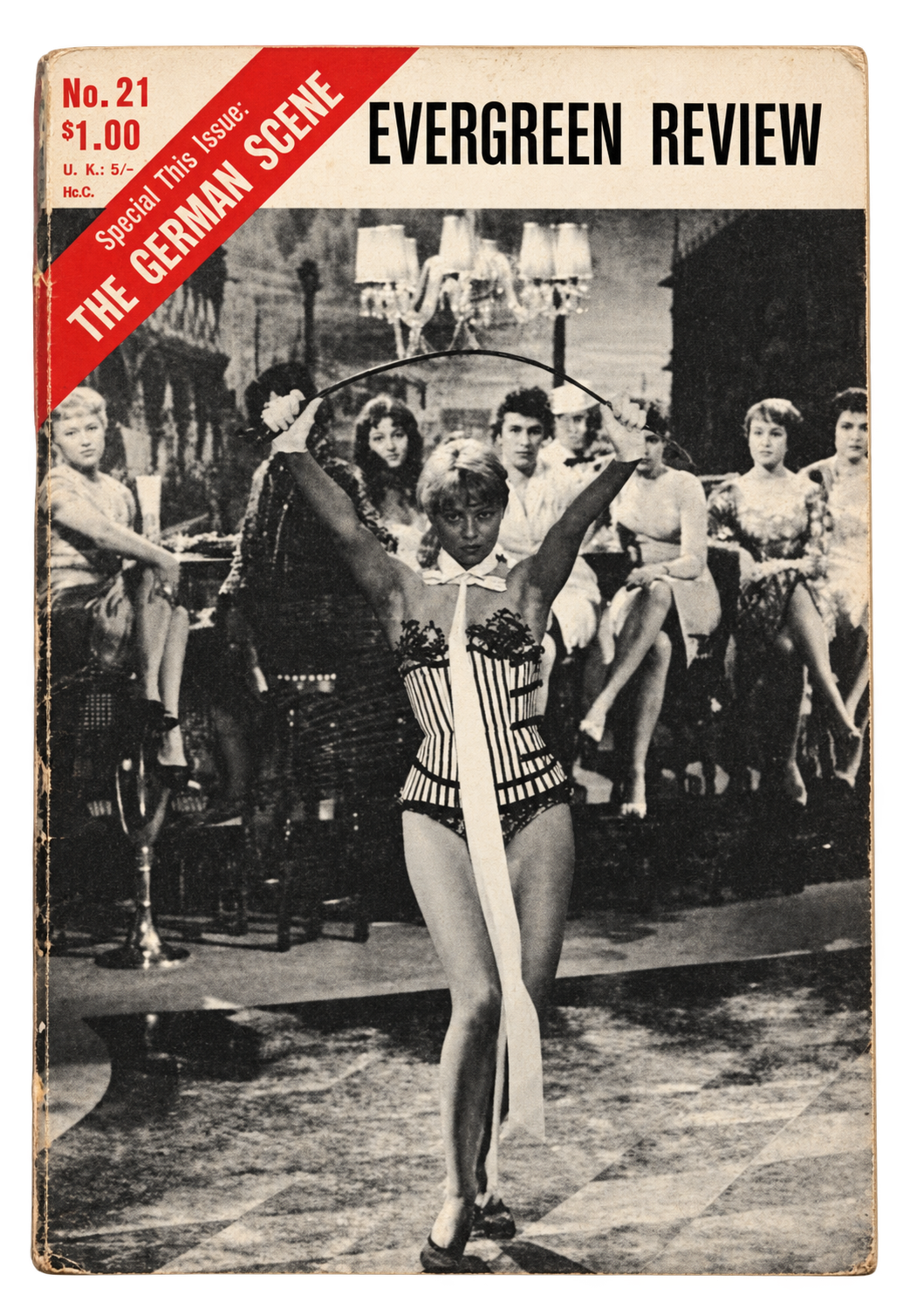
Evergreen Review (Vol. 5, # 21, Nov/Dec 1961) — Barney Rosset and Fred Jordan (Eds.)
Special Issue: The German Scene
Edited by Barney Rosset and Fred Jordan
Evergreen Review, Inc. · New York · November–December 1961
Volume 5 · Number 21
First Edition · First Printing
The Magazine:
The original November–December 1961 issue of Evergreen Review, devoted to contemporary German-language literature at a pivotal moment in postwar European history. Edited by Barney Rosset and Fred Jordan, The German Scene brought together an extraordinary generation of writers including Günter Grass, Paul Celan, Heinrich Böll, Ingeborg Bachmann, Uwe Johnson, Hans Arp, Walter Höllerer, and others. Published only months after construction of the Berlin Wall, the issue presented American readers with literature confronting war, Nazism, memory, guilt, displacement, language, and the division of postwar Germany. 128 pp. Original pictorial wrappers with original $1.00 U.S. / 5/- U.K. cover price.
Condition:
Very Good. Original pictorial wrappers remain present with strong color and complete typography, showing moderate rubbing and handling wear consistent with age. Binding remains sound and the interior complete and clean overall. Original $1.00 U.S. / 5/- U.K. cover prices remain present. No restoration or replacement components observed.
Story Of The Magazine
Sixteen years after Nazi Germany collapsed—and only months after the Berlin Wall went up—Evergreen Review asked German writers to explain the world that remained.
Published in November 1961, The German Scene brought together an extraordinary generation of German-language writers, including Paul Celan, Günter Grass, Heinrich Böll, Ingeborg Bachmann, Uwe Johnson, Hans Arp, and Walter Höllerer. Rather than interpreting postwar Germany for American readers from a distance, Evergreen Review gave its pages to writers confronting the consequences of Nazism, war, genocide, displacement, and national collapse through literature.
Their experiences and politics differed, but collectively they wrote from a culture struggling with what dictatorship had done—to people, to memory, and even to language itself. For American readers, many of these voices were still new; specialist cataloguing identifies this issue in particular with the introduction of Günter Grass to the American reading public.
Its timing gave that literary reckoning another dimension. The Berlin Wall had been erected in August 1961. The German Scene appeared three months later, as the country confronting the legacy of one dictatorship became the physical center of a new ideological division.
Germany was still reckoning with the dictatorship it had survived when the Cold War divided its future.
Why It’s In The Collection
The German Scene belongs in Consigned to Darkness because some of the most important witness to authoritarianism begins after the regime itself has fallen.
These writers were confronting the human and cultural inheritance of Nazism from within the generation that experienced its consequences. Their task was not simply to remember what happened, but to ask what literature, identity, and language could mean afterward.
That makes this issue both literature and witness. It is also an important act of cultural transmission: Evergreen Review, under Barney Rosset, placed those voices before American readers at precisely the moment Germany again became one of the central fault lines of world politics.
The physical magazine preserves that encounter as it happened—not through a later anthology explaining postwar literature in retrospect, but through the original publication in which American readers encountered these writers while Germany itself stood between two histories.
Behind it was the dictatorship Germany had survived. In front of it stood the wall that would define what came next.
Collection Categories: Witness Literature · Anti-Totalitarianism · War & Conflict · Literature · Poetry · Political History · Publication-Event Object
———
Authentication Evidence
Front wrapper identifies Evergreen Review, Volume 5, Number 21, dated November–December 1961.
Issue is identified as the special issue “The German Scene.”
Editorial credits identify Barney Rosset and Fred Jordan.
Original pictorial wrappers are present.
Original cover prices of $1.00 U.S. and 5/- U.K. are retained.
Issue collates to 128 pages, consistent with independently documented copies of the original issue.
Contents include work by Günter Grass, Uwe Johnson, Hans Arp, Paul Celan, Heinrich Böll, Walter Höllerer, Ingeborg Bachmann, and other contemporary German-language writers.
Masthead and internal publication information identify Evergreen Review, Inc. and correspond to the 1961 publication.
No evidence of later reproduction, facsimile manufacture, rebound contents, or replacement wrappers is observed.
Observed bibliographic and physical characteristics support identification as the original Volume 5, Number 21 · November–December 1961 · First Edition · First Printing.