
 Image 1 of 1
Evergreen Review (Vol. 2, No. 5) — Barney Rosset & Donald Allen (eds.)
Evergreen Review — Vol. 2, No. 5
Barney Rosset & Donald Allen, editors
Grove Press, Inc. · New York · Summer 1958
First Edition · First Printing · First Publication of Samuel Beckett’s Krapp’s Last Tape
The Book:
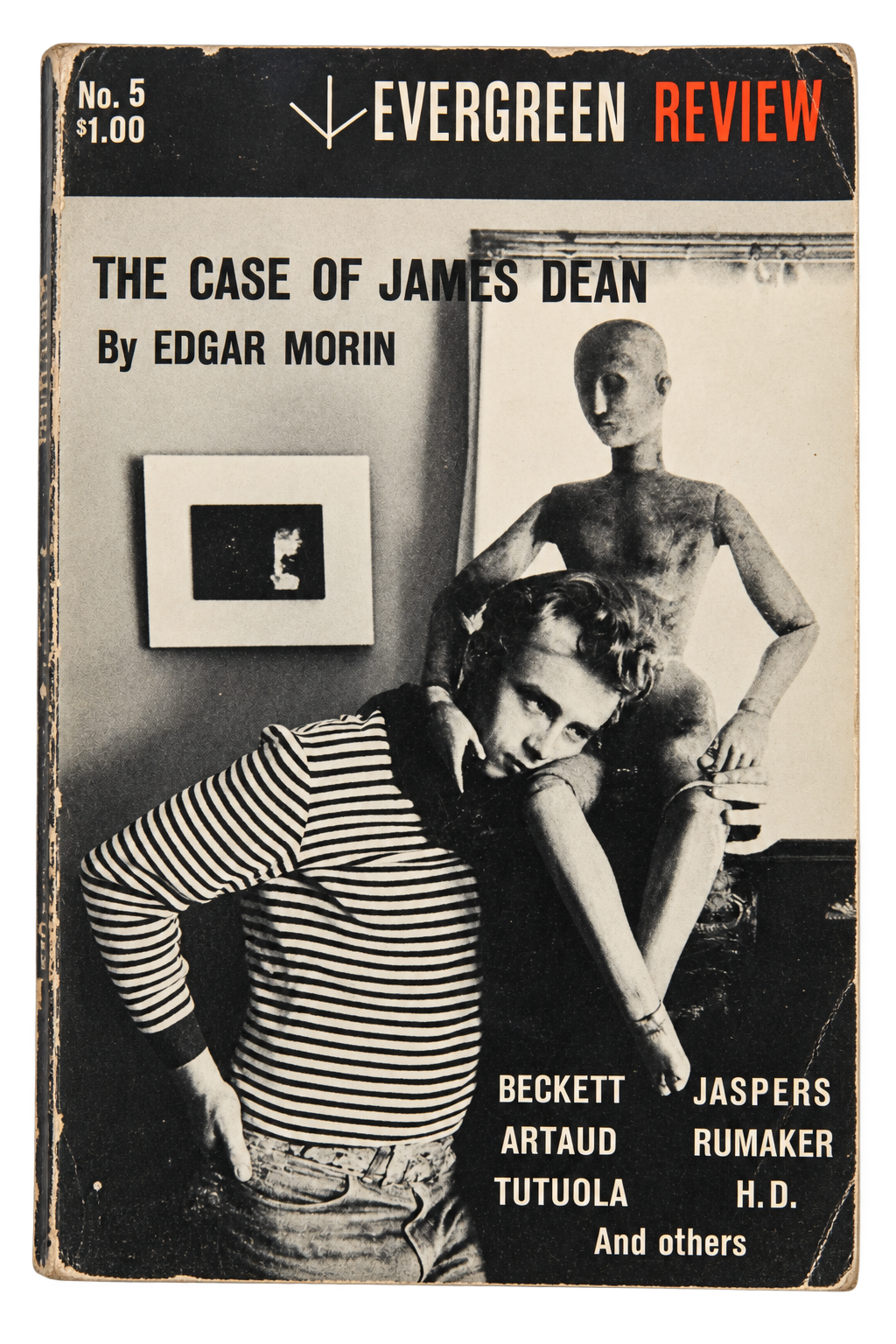
The original Summer 1958 first printing of Evergreen Review, Volume 2, Number 5, containing the first publication anywhere of Samuel Beckett’s Krapp’s Last Tape on pages 13–24. Published months before the play’s October 1958 world premiere and the 1959 Faber book edition, this is the physical object through which Beckett’s work first entered the world. Edited by Barney Rosset and Donald Allen, the issue also includes Antonin Artaud, Roland Barthes, Robert Creeley, H.D., Karl Jaspers, Jack Kerouac, Denise Levertov, Charles Olson, John Rechy, Amos Tutuola, Kenneth Koch, Philip Whalen, and others. 160 pp. Original pictorial wrappers retain the $1.00 price and Grove issue code E-102.
Condition:
Very Good. Original pictorial wrappers remain complete with substantial but predominantly cosmetic surface wear, including rubbing and scuffing, spine wear, localized foxing, and general handling evidence. An adhered bookseller label is present. Binding remains sound and the text block complete. Previous owner’s handwritten name appears on an early leaf and again at the rear; the name appears to read “H. Gugelman” or similar, but the identity has not been established. No significant association provenance documented.
Story Of The Book
Before Krapp’s Last Tape became one of Samuel Beckett’s defining plays, it first existed publicly here.
Beckett wrote the monologue in early 1958 for actor Patrick Magee. That summer, Evergreen Review printed it on pages 13–24—months before Magee performed its world premiere at London’s Royal Court Theatre on October 28, and a year before Faber published the first book edition. But look at what surrounds it.
Antonin Artaud. Roland Barthes. Jack Kerouac. H.D. Robert Creeley. John Rechy. Denise Levertov. Charles Olson. Amos Tutuola. Karl Jaspers. Evergreen was barely a year old, yet Barney Rosset and Donald Allen were already assembling writers who challenged literary convention, sexual morality, political authority, and the boundaries of what American publishing considered respectable.
That mission would soon become inseparable from Grove Press’s historic battles to publish Lady Chatterley’s Lover, Tropic of Cancer, and Naked Lunch.
This issue preserves the moment a major Beckett play entered the world inside a magazine that was helping change what could enter American culture at all.
Why It’s In The Collection
Evergreen Review, Vol. 2, No. 5 belongs in Consigned to Darkness because publication itself can be the historical event.
This is not an early reprint of Krapp’s Last Tape. It is where the public first encountered it. Before the performances, before the book editions, and before the play entered the canon, there were these twelve pages in Evergreen Review.
The surrounding magazine makes the object even stronger. Rosset was building Evergreen into a home for writers and ideas that conventional American publishing frequently marginalized—and Grove Press would soon carry that philosophy into some of the defining censorship battles of the twentieth century.
One magazine. Two publication histories: the birth of a Beckett masterpiece and the rise of a publisher determined to make room for dangerous literature.
Collection Categories: Publication-Event Object · Free Expression · Censorship · Literature · Drama · Graphic & Literary Periodicals · Counterculture · Anti-Authoritarianism · Sexuality & Culture
———
Authentication Evidence
Title and contents pages identify the publication as Evergreen Review, Volume 2, Number 5.
Editorial page identifies Barney Rosset and Donald Allen as editors and Fred Jordan as circulation and business manager.
Editorial page identifies Grove Press, Inc., 795 Broadway, New York 3, N.Y. as publisher.
Editorial page explicitly states “Summer, 1958.”
Original front wrapper identifies the issue as No. 5.
Original front wrapper retains the contemporary $1.00 price.
Spine identifies Vol. 2, No. 5, the $1.00 price, Evergreen Review, and Grove issue code E-102.
Contents page identifies Samuel Beckett’s “Krapp’s Last Tape” beginning on page 13.
The complete original periodical text of Krapp’s Last Tape is present beginning on page 13.
Éditions de Minuit’s official Beckett bibliography identifies the first publication of Krapp’s Last Tape as Evergreen Review, Volume 2, Number 5, Summer 1958.
Independent Beckett scholarship documents that the play was written in early 1958 and that by April Beckett knew publication was scheduled for the forthcoming Summer 1958 Evergreen Review.
Scholarly sources specifically identify the original Evergreen appearance as Volume II, No. 5, Summer 1958, pp. 13–24.
This issue predates the play’s October 28, 1958 world premiere at London’s Royal Court Theatre.
This issue predates the 1959 Faber book edition.
The chronology therefore establishes the Evergreen Review appearance as the first publication anywhere of Krapp’s Last Tape rather than an early reprint.
Contents page documents additional contributors including Edgar Morin, Robert Creeley, H.D., Karl Jaspers, Philip Whalen, John Rechy, Edward Field, Jack Kerouac, William Eastlake, Denise Levertov, Charles Olson, Kenneth Koch, David Little, Amos Tutuola, Roland Barthes, Michael Rumaker, Antonin Artaud, and Clement Greenberg.
Grove Press archival history identifies Evergreen Review as founded in 1957 and confirms its early trade-paperback format and role in publishing Beckett and other avant-garde and countercultural writers.
Original publisher’s pictorial wrappers remain present.
Physical collation comprises 160 pages, consistent with independently documented copies of the original issue.
No evidence of later reprinting, facsimile production, replacement wrappers, or reconstructed components is observed.
Observable physical and bibliographic evidence supports identification as the original Summer 1958 First Edition · First Printing · First Publication of Samuel Beckett’s Krapp’s Last Tape.