
 Image 1 of 1
Europe Since Versailles — David Low
Full Title:Europe Since Versailles: A History in One Hundred Cartoons with a Narrative Text
David Low
Harmondsworth: Penguin Books Ltd., 1940
First Edition · First Printing · Penguin Special S49
The Book:
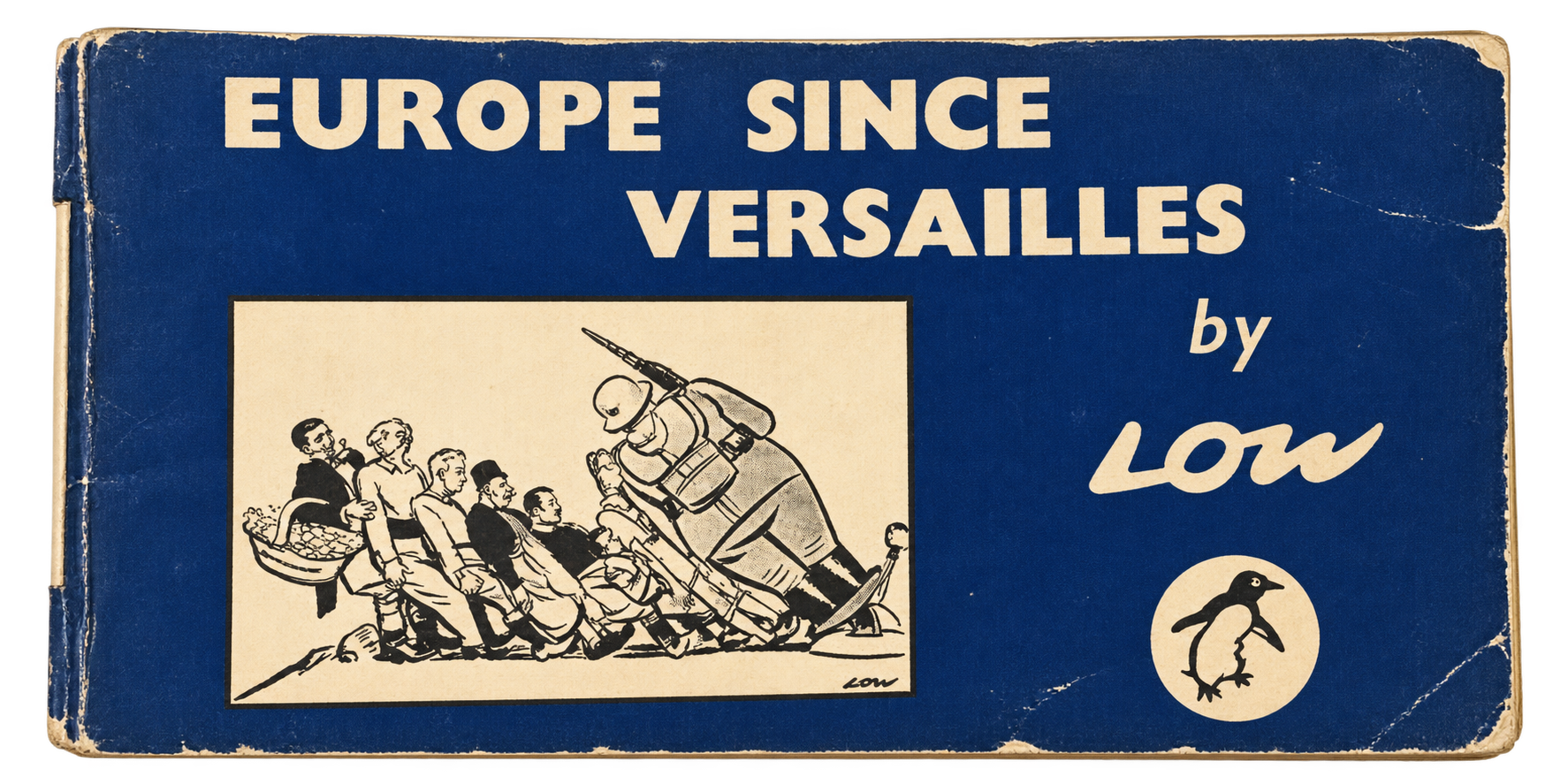
The true first edition, first printing of David Low’s Europe Since Versailles, published as Penguin Special S49 on January 19, 1940. The copyright page states “First Published 1940,” and this copy retains the correct blue horizontal wrappers, sixpence price, S49 spine designation, and Wyman & Sons printer statement. The volume assembles one hundred of Low’s political cartoons into a chronological account of Europe from the Treaty of Versailles through the opening months of the Second World War.
Condition:
Very Good+. The original blue wrappers retain unusually strong color, with light edge rubbing, minor corner wear, small nicks at the spine ends, and slight handling wear. The original staple binding remains intact and secure, with no spine splitting, detached wrappers, loose gatherings, or restoration. Moderate, even age toning is present throughout, along with small localized remnants of old adhesive near the upper inner margin of the front wrapper.
Story Of The Book
Before most people understood the Second World War, David Low tried to explain how Europe had reached it.
Published only months after Britain entered the war, Europe Since Versailles looks back across the two decades separating the Treaty of Versailles from renewed global conflict. Through one hundred cartoons and accompanying narrative, Low traces appeasement, dictatorship, diplomatic failure, political extremism, and the erosion of European democracy.
Low had spent the interwar years turning complicated political events into images newspaper readers could understand immediately. By 1940, those cartoons had acquired a terrible coherence: events once encountered individually now formed a visual history of how democratic institutions failed to contain the rise of authoritarian states.
But Low was still writing without hindsight. Hitler remained in power, the war had barely begun, and its outcome was unknowable.
This was history assembled while the consequences of that history were still unfolding.
Why It’s In The Collection
Europe Since Versailles belongs in Consigned to Darkness because it preserves anti-totalitarian political commentary from the moment Europe’s democratic crisis became a war.
Issued for sixpence as a Penguin Special, the book made Low’s visual argument available to a mass readership. It was not a later explanation of why fascism succeeded. It was an inexpensive work of democratic political education published while Britain was confronting the consequences of that success.
Its relationship with the collection’s Europe at War is particularly strong. Europe Since Versailles asks how Europe arrived at dictatorship and war; the 1941 volume documents what happened next. Together, the two first printings preserve Low interpreting the collapse of European democracy and then documenting the fight against the authoritarian regimes that emerged from it.
One explains how the disaster happened. The other records the struggle that followed.
Collection Categories: Political History · Anti-Totalitarianism · Publication-Event Object · War & Conflict
———
Authentication Evidence
• Wrapper design corresponds to Penguin Special S49, Europe Since Versailles, with the correct horizontal blue wrappers and sixpence price.
• Copyright page states "First Published 1940."
• Printer statement identifies Wyman & Sons Ltd., London, Reading and Fakenham, consistent with the first printing.
• Title page and imprint identify Penguin Books Limited.
• Spine carries the correct S49 series designation.
• Wrapper typography, Penguin device, and layout are consistent with documented first-print examples.
• Final advertising matter and overall format are consistent with the original 1940 Penguin Special.
• Edition evidence: The "First Published 1940" statement together with the correct Penguin S49 wrappers and imprint establish this as the first Penguin edition.
• Printing evidence: The first-publication statement, correct S49 wrapper design, sixpence price, and first-print bibliographic characteristics establish this as the first printing of the first edition.