
 Image 1 of 1
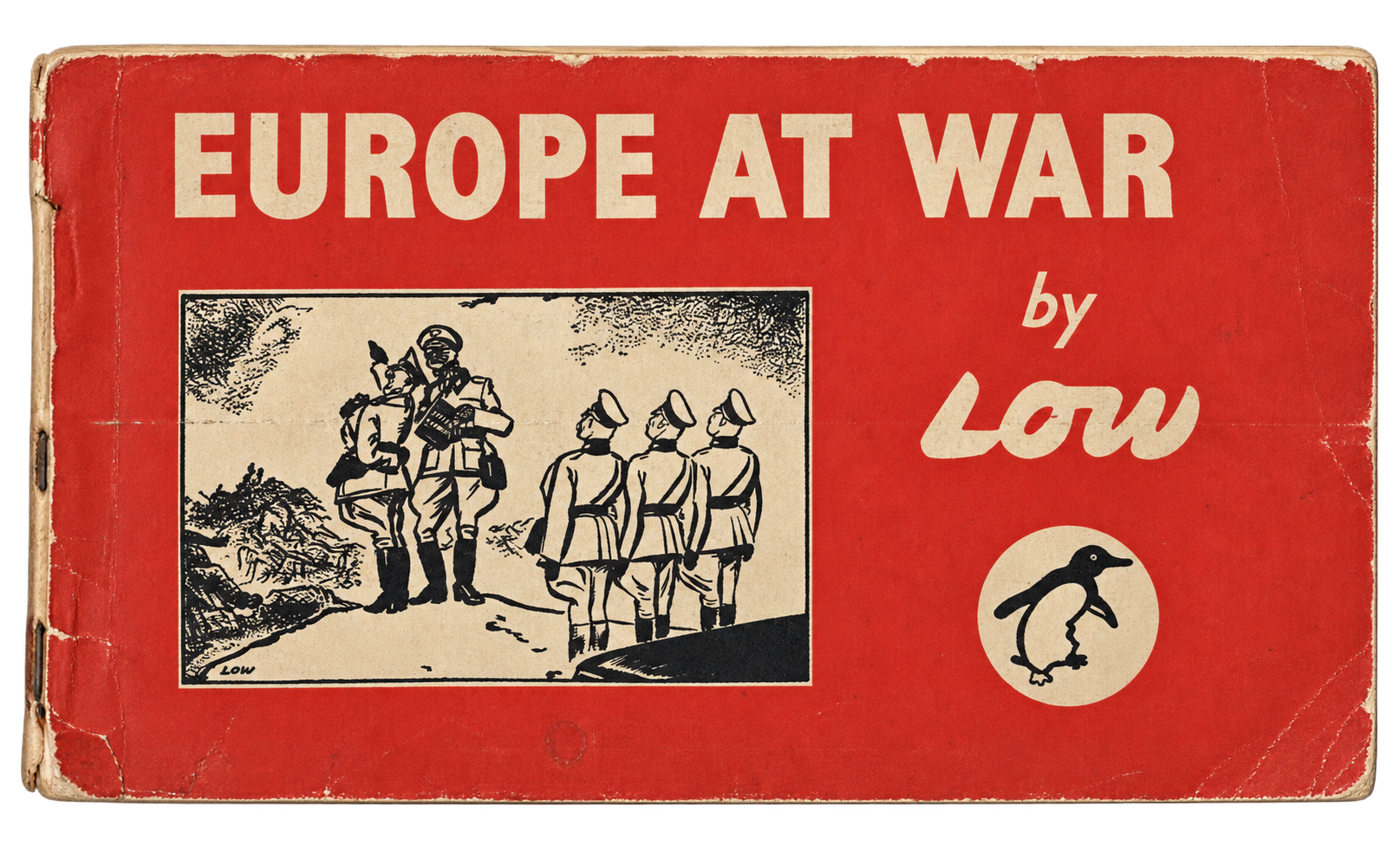
Europe at War — David Low
Full Title:Europe at War: A History in Sixty Cartoons with a Narrative Text by Low
David Low
Harmondsworth, Middlesex & New York: Allen Lane / Penguin Books, 1941
First Edition · First Printing · Penguin Special S83
The Book:
The true first edition, first printing of David Low’s Europe at War, published as Penguin Special S83 in February 1941. The acknowledgements page explicitly states “First Published February 1941.” The volume collects sixty of Low’s wartime political cartoons, most originally published in the London Evening Standard, alongside narrative commentary tracing the opening years of the Second World War. This copy retains its original printed wrappers.
Condition:
Very Good. The original wrappers remain complete and structurally sound, with moderate age toning, light edge wear, and expected rubbing at the spine extremities. The interior is clean and complete, with no ownership markings, rebinding, or restoration observed.
Story Of The Book
Before history knew how the war would end, David Low was already drawing it.
When Europe at War appeared in February 1941, Nazi Germany controlled much of continental Europe, France had fallen, Britain had survived the Battle of Britain, and the United States had not yet entered the conflict. Low was not looking backward at a settled history. He was documenting a war whose outcome remained profoundly uncertain.
One of the twentieth century’s most influential political cartoonists, Low had spent years using satire against Hitler, Mussolini, appeasement, and authoritarianism. Europe at War gathered sixty of those images into a chronological visual history, preserving cartoons originally encountered as immediate newspaper commentary in a permanent printed record.
That timing gives the book its power. Later histories could explain how fascism was defeated. Low’s cartoons record what opposition looked like before anyone knew that it would be.
This is not a retrospective celebration of resistance. It is resistance printed while the outcome was still uncertain.
Why It’s In The Collection
Europe at War belongs in Consigned to Darkness because it is an unusually direct publication-event object: political expression produced and circulated while the authoritarian power it opposed was still expanding.
Penguin transformed Low’s ephemeral newspaper cartoons into an inexpensive book for a mass readership, preserving anti-fascist satire as part of the democratic public argument taking place during the war itself. The object therefore did not merely document resistance later; it participated in the political culture of resistance at the time.
It also pairs naturally with the collection’s 1940 first printing of Europe Since Versailles. That volume asks how Europe arrived at dictatorship and war; Europe at War records what followed once the catastrophe had begun. Together, they preserve Low’s political commentary on the collapse of European democracy and the struggle against the authoritarian regimes that replaced it.
Low drew history before he knew how history would turn out.
Collection Categories: Publication-Event Object · Anti-Authoritarianism · War & Conflict · Free Expression · Political Movements · Graphic Literature
———
Authentication Evidence
• Title page identifies Europe at War by David Low, published by Allen Lane / Penguin Books.
• The acknowledgements page explicitly states "First Published February 1941," establishing first-edition publication.
• The volume carries the Penguin Special designation S83, matching contemporary Penguin bibliographies for the first issue.
• The title page includes the Allen Lane / Penguin imprint for both Harmondsworth and New York, consistent with the original wartime issue.
• The acknowledgements explain that the cartoons first appeared in the London Evening Standard, Picture Post, and American newspapers before being collected here, matching the publication history of the volume.
• Original Penguin printed wrappers remain present and consistent with documented first-issue design.
• No later printing statement, revised edition statement, or reset typography is observed.
• The observed bibliographic characteristics support identification as the first edition, first printing.