
 Image 1 of 1
Doctor Faustus — Thomas Mann
Full Title:Doctor Faustus: The Life of the German Composer Adrian Leverkühn as Told by a Friend
Thomas Mann
Translated from the German by H. T. Lowe-Porter
New York: Alfred A. Knopf, 1948
First American Edition · First Printing
The Book:
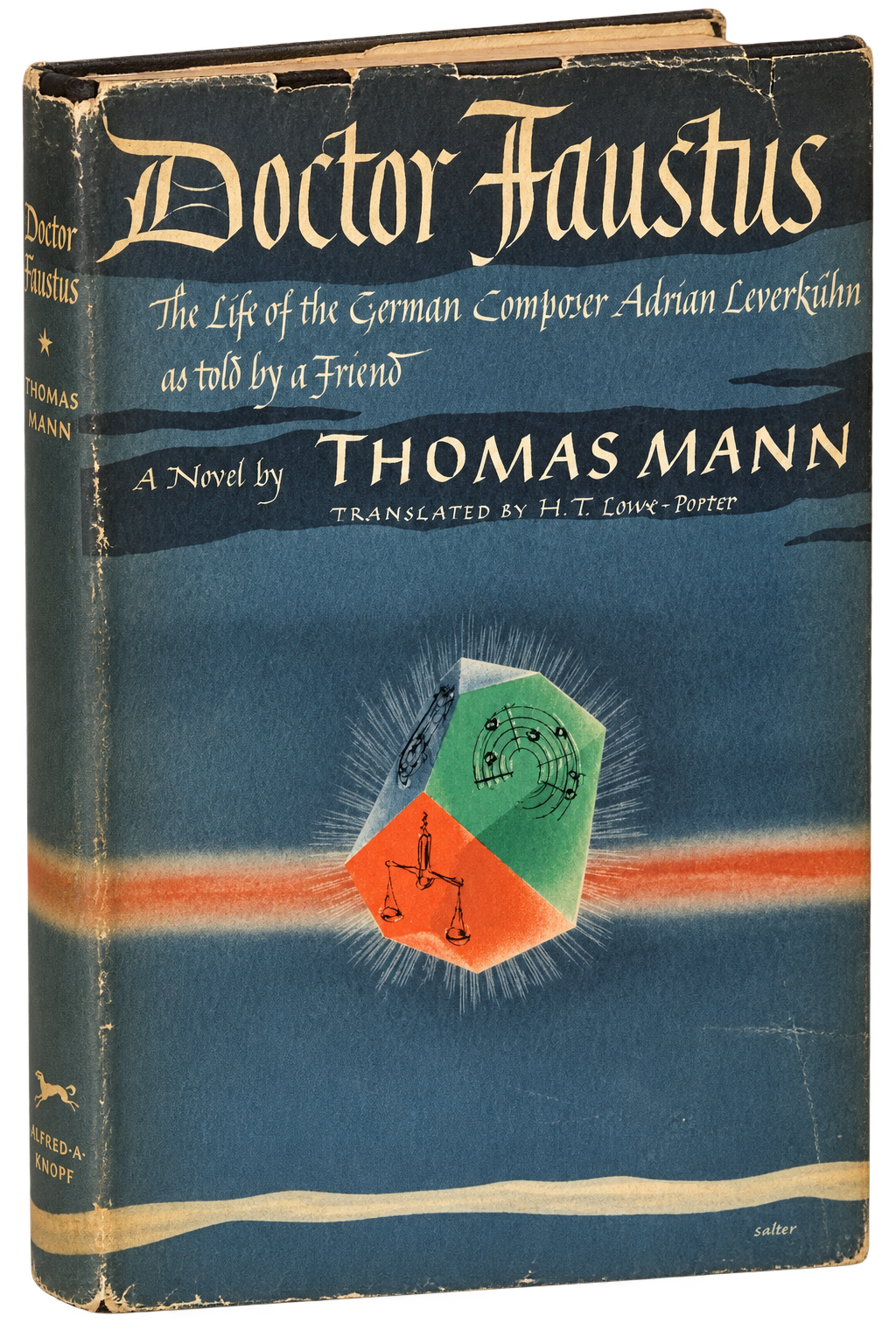
The first American edition, first printing of Thomas Mann’s Doctor Faustus, published by Alfred A. Knopf in 1948. The copyright page explicitly states “First American Edition,” with no later-printing statement present. This copy retains its original black publisher’s cloth, gilt spine decoration, blind-stamped Borzoi device, red topstain, and original George Salter dust jacket. The jacket is price clipped, preventing authentication of its original price or price-state.
Condition:
Near Fine in a Very Good+ dust jacket. The book remains square and tight with bright cloth, a clean interior, and only a small contemporary pencil price notation. The original George Salter jacket is price clipped but retains strong color and excellent presentation, with minimal handling wear and only two tiny localized edge tears. No significant chipping, paper loss, restoration, or structural weakness is observed.
Story Of The Book
Germany did not simply lose a war. Thomas Mann believed it had first surrendered something far more valuable.
Writing in exile after watching his homeland descend into dictatorship, Mann transformed the ancient Faust legend into an allegory for modern Germany. His fictional composer Adrian Leverkühn bargains away his soul for extraordinary artistic achievement while the country around him moves toward National Socialism, war, and catastrophe.
The novel asks an unsettling question: what if barbarism did not invade German civilization from outside, but grew from within a culture celebrated for its philosophy, music, intelligence, and learning? Mann challenges the comforting assumption that education, artistic greatness, or cultural sophistication can themselves protect a society from tyranny.
Published in America shortly after the Second World War, Doctor Faustus became one of Mann’s great attempts to understand the moral and cultural conditions that had made Nazism possible.
A civilized nation did not simply fall. Mann asked what it had been willing to trade away first.
Why It’s In The Collection
Doctor Faustus belongs in Consigned to Darkness because it examines authoritarianism before it reaches the prison, battlefield, or concentration camp. Mann is interested in the moral surrender that can precede political catastrophe.
That perspective makes the novel an important complement to the collection’s documentary witnesses to fascism. Rather than recording what totalitarianism did after acquiring power, Mann asks how a sophisticated society could become susceptible to it in the first place—and whether culture, intellect, and artistic achievement are sufficient defenses against moral collapse.
This first American edition preserves that argument as an immediate postwar publication by a German writer who had himself gone into exile from the Nazi regime. It is a literary attempt not merely to condemn what Germany became, but to understand how it became possible.
The danger Mann identifies is not that civilization can be destroyed by barbarism. It is that civilization can bargain with it.
Collection Categories: Publication-Event Object · Anti-Totalitarianism · Political History · Exile & Émigré Literature · Literature
———
Authentication Evidence
• Correct Alfred A. Knopf title page, confirming first American edition
• Title page dated 1948
• Translation credited to H. T. Lowe-Porter, consistent with the first American edition
• Copyright page states “First American Edition,” confirming first American edition
• No later printing statement present, consistent with Knopf’s first-printing practice for this edition
• Original black publisher’s cloth binding with gilt spine decoration present
• Blind-stamped Borzoi device present on front board
• Original red topstain present
• Original George Salter dust jacket present
• Dust jacket is price clipped; original jacket price cannot be authenticated from this copy
• Jacket design, typography, Borzoi device, rear author panel, and front-flap text consistent with documented first American edition jackets
• No book club edition indicators observed
• Knopf publisher imprint and typography consistent throughout
• First American edition, first printing characteristics consistent throughout