
 Image 1 of 1
Dispatches — Michael Herr
Michael Herr
New York: Alfred A. Knopf, 1977
First Edition · First Printing
The Book:
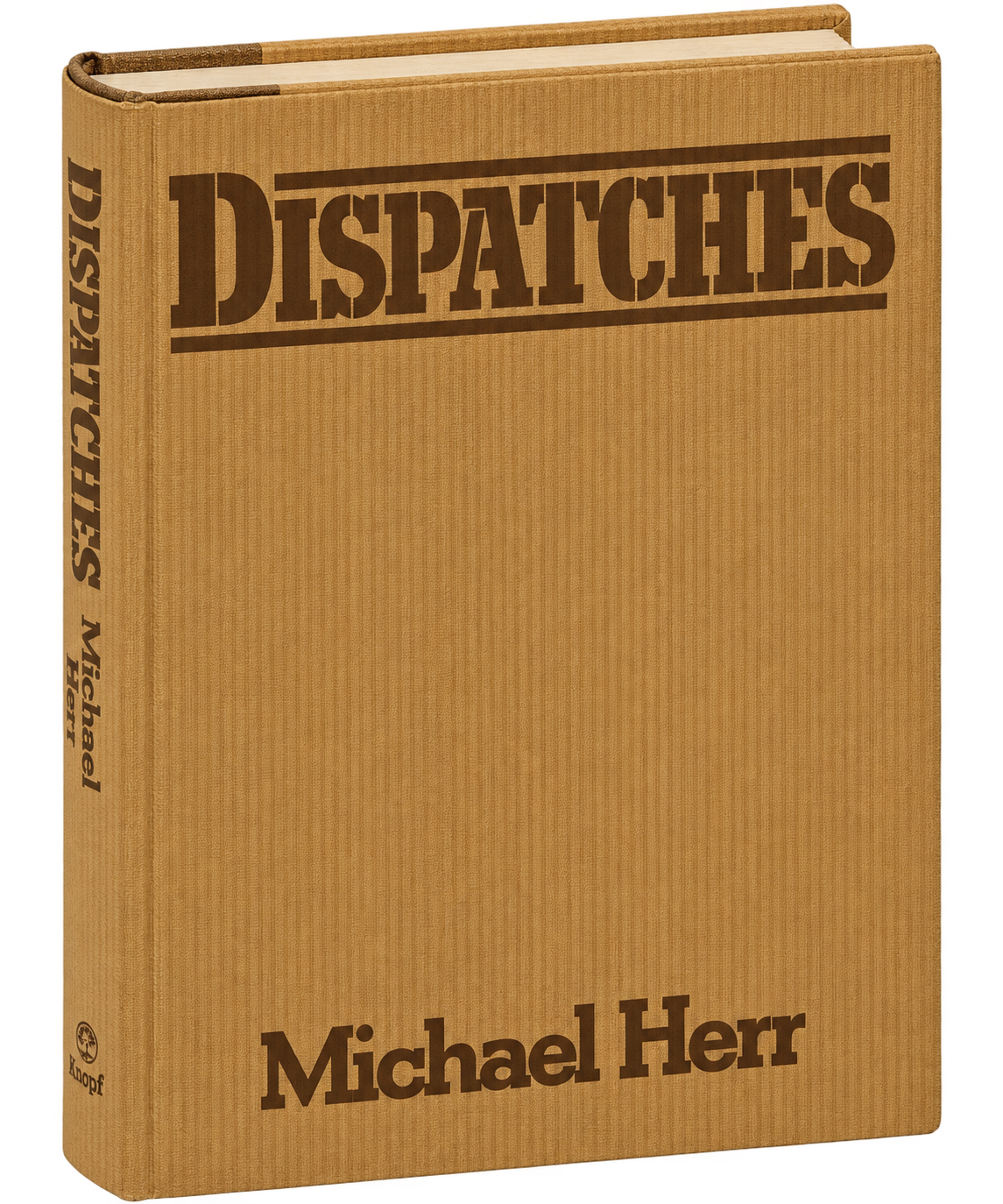
The true first edition, first printing of Michael Herr’s Dispatches, published by Alfred A. Knopf in 1977. The copyright page explicitly states “First Edition” and carries the original 1968, 1969, 1970, and 1977 copyright notices, with no indication of a later printing. This copy retains the original Knopf quarter brown cloth over beige paper-covered boards and the original first-issue dust jacket. The front flap is price-clipped, preventing direct verification of the original $8.95 price, but the jacket otherwise matches the correct 1977 first-issue design.
Condition:
Near Fine in a Near Fine dust jacket. The book is clean and tightly bound, with bright boards, crisp spine lettering, and no ownership markings, foxing, restoration, or structural defects observed. The original jacket shows light overall toning and minimal wear, with no significant chips or tears. The front flap is price-clipped.
Story Of The Book
Michael Herr rejected the comforting idea that war could be understood through official reports alone.
Dispatches grew out of Herr’s reporting from Vietnam, where he encountered a war that looked very different from the one described in briefings, statistics, and military communiqués.
The conflict he recorded was fragmented, hallucinatory, frightening, absurd, and intensely human.
Rather than writing a conventional military history, Herr reconstructed Vietnam through the language of soldiers, correspondents, helicopters, firefights, exhaustion, drugs, fear, rumor, and memory. The result was not simply reportage. It was an attempt to capture what war actually felt like to the people inside it.
That distinction made Dispatches one of the defining works of modern war journalism.
Portions of Herr’s reporting had appeared earlier in Esquire, Rolling Stone, and New American Review, but the 1977 Knopf edition brought the material together in book form for the first time.
By then, the United States had left Vietnam.
But Herr was not interested in reducing the war to lessons, strategy, or verdicts.
He was interested in memory.
What did the war sound like?
What did it do to perception?
What happened to people when terror became routine?
The book’s answer was deliberately unstable because the experience itself had been unstable.
Official history could explain what units moved where. Herr wanted to preserve what it felt like to be there when everything stopped making sense.
Why It’s In The Collection
Dispatches belongs in Consigned to Darkness because witness can challenge power in ways argument sometimes cannot.
Where America’s Vietnam Policy directly contests the government’s public explanation of the war, Dispatches undermines abstraction by restoring individual experience to the center of the story.
The difference is important.
Governments speak in objectives, casualty figures, operations, and policy. Herr gives the reader fear, confusion, violence, exhaustion, and the psychological fragmentation experienced by the people living inside those policies.
That makes Dispatches one of the collection’s strongest works of witness literature.
It does not argue that official narratives are false in the same way a political tract might. It makes those narratives feel incomplete.
The collection acquired this first edition, first printing because it preserves the first book-form appearance of one of the most influential literary accounts of the Vietnam War and one of the works that helped permanently reshape modern war reporting.
Read beside the collection’s political critiques of Vietnam, Dispatches supplies the human evidence those arguments cannot.
Power can describe a war in statistics. Witness literature asks what those statistics felt like to the people who had to live inside them.
Collection Categories: Witness Literature · Investigative Journalism · War & Conflict · Free Expression · Human Rights · Vietnam War
———
Authentication Evidence
• Title page reads Dispatches by Michael Herr, published by Alfred A. Knopf, New York, 1977, consistent with the first edition.
• Copyright page carries the original 1968, 1969, 1970, and 1977 copyright notices and explicitly states "First Edition," with no indication of later printings, consistent with a true first printing.
• Original Knopf quarter brown cloth over beige paper-covered boards is present and consistent with the publisher's first-issue binding.
• Original first-issue dust jacket is present and matches the correct 1977 design with the bold DISPATCHES typography on the front panel and review text on the rear panel.
• The front flap appears price-clipped, preventing direct verification of the original $8.95 issue price. The clipping affects collector desirability but does not alter the edition or printing of the book itself. Comparable authenticated first printings with price-clipped jackets are recognized in the antiquarian market.
• No evidence of book-club manufacture, later rebinding, remainder marking, ex-library ownership, or facsimile dust jacket is observed in the photographs.
• First edition, first printing characteristics consistent throughout.