
 Image 1 of 1
Cat on a Hot Tin Roof — Tennessee Williams
Tennessee Williams
New Directions · New York · 1955
First Edition · First Printing
The Book:
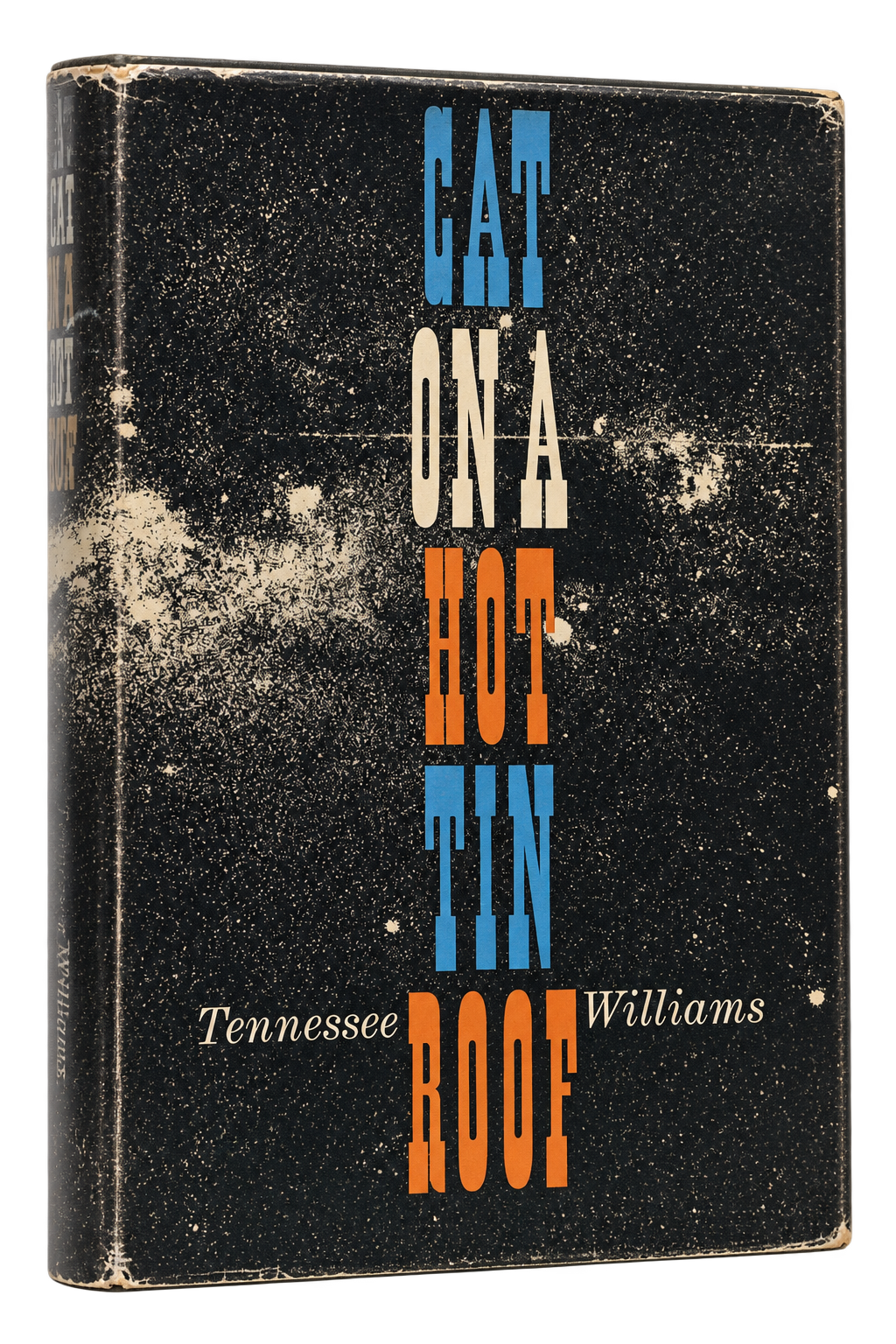
The First Edition · First Printing of Tennessee Williams’s Pulitzer Prize-winning Cat on a Hot Tin Roof, one of the defining works of postwar American theater. A drama of sexuality, masculinity, repression, and the destructive power of lives built around truths that cannot be spoken, the first edition is especially revealing: it preserves Williams’s original Act III alongside the revised version performed on Broadway, allowing readers to see the playwright’s vision beside the compromise that reached the stage. Octavo; xiv, 197 pp., with a full-page photograph of Jo Mielziner’s original Broadway stage setting. Original publisher’s cloth and unclipped $3.00 dust jacket designed by Alvin Lustig retained.
Condition:
Very Good book in a Near Fine original dust jacket. Publisher’s cloth remains sound with moderate age toning to the endpapers and a previous owner’s gift inscription on the front free endpaper. The original unclipped $3.00 jacket remains bright and highly presentable, showing moderate edge wear, light rubbing, and several small chips. No restoration or institutional markings observed.
Story Of The Book
Everyone in Cat on a Hot Tin Roof is talking. Almost no one can say what actually matters.
At the center is Brick Pollitt, a former athlete retreating into alcohol after the death of his closest friend, Skipper. Around him, the Pollitt family fights over inheritance, marriage, masculinity, desire, and appearances. Beneath everything lies a question the play deliberately refuses to resolve neatly: what did Brick feel for Skipper, and why is that possibility so unbearable to him?
In 1955, Williams wrote within a culture that made same-sex desire extraordinarily difficult to address openly on the American stage. So the play circles its deepest truths through accusation, denial, coded language, and silence.
Even its ending became contested. Director Elia Kazan pressed Williams to revise Act III for the Broadway production. Williams reluctantly did—but when New Directions published the play, he included both his original Act III and the Broadway revision, along with his explanation of the changes.
The first edition therefore preserves something the performance could not: the play Williams wrote and the play Broadway asked him to change.
Why It’s In The Collection
Cat on a Hot Tin Roof belongs in Consigned to Darkness because silence can become a form of social control even when no censor is present.
Williams understood that power can operate through shame, family expectation, compulsory masculinity, respectability, and the pressure to deny what a culture refuses to name. Brick’s tragedy is not simply that he cannot speak honestly. It is that honesty has been made dangerous.
This first printing makes that tension physical. By preserving both versions of Act III, it records the negotiation between artistic intention and cultural acceptability inside the book itself.
Williams put repression onstage—and then preserved the evidence of what the stage asked him to change.
Collection Categories: Literature · Drama · Sexuality & Culture · LGBTQ+ History · Cultural Criticism · Social Conformity · Free Expression · Anti-Authoritarianism
———
Authentication Evidence
Title page identifies the work as Cat on a Hot Tin Roof by Tennessee Williams.
Publisher is correctly identified as New Directions · New York · 1955.
Copyright-page verso lacks the later-added credit acknowledging the preface’s previous appearance in The New York Times, a diagnostic point of the true first printing.
Page xii lacks the later-added credits to Jo Mielziner and Lucinda Ballard, a diagnostic point of the true first printing.
These textual points correspond to the first-issue characteristics described in George W. Crandell’s Tennessee Williams: A Descriptive Bibliography.
Volume collates to xiv, 197 pages.
Volume includes Williams’s original Act III and the revised Act III used for the Broadway production.
A full-page black-and-white photograph of Jo Mielziner’s Broadway stage setting appears before “Notes for the Designer.”
Original publisher’s cloth binding remains present and is consistent with documented first-printing copies.
Original Alvin Lustig-designed dust jacket remains present.
Dust jacket is unclipped and retains the $3.00 publisher’s price.
Front flap lacks any statement of later printings at the foot, consistent with the first-printing jacket.
Jacket design, typography, price, and publisher information are consistent with documented first-issue jackets.
Previous owner’s gift inscription remains present on the front free endpaper.
No evidence of book-club manufacture, ex-library ownership, remainder marking, rebinding, facsimile dust jacket, or replacement components is observed.
Observable physical and bibliographic evidence supports identification as the 1955 First Edition · First Printing · First Issue, in the original unclipped $3.00 dust jacket.