
 Image 1 of 1
Cancer Ward — Alexander Solzhenitsyn
Alexander Solzhenitsyn
Translated from the Russian by Rebecca Frank
The Dial Press · New York · 1968
First American Edition · First Printing
The Book:
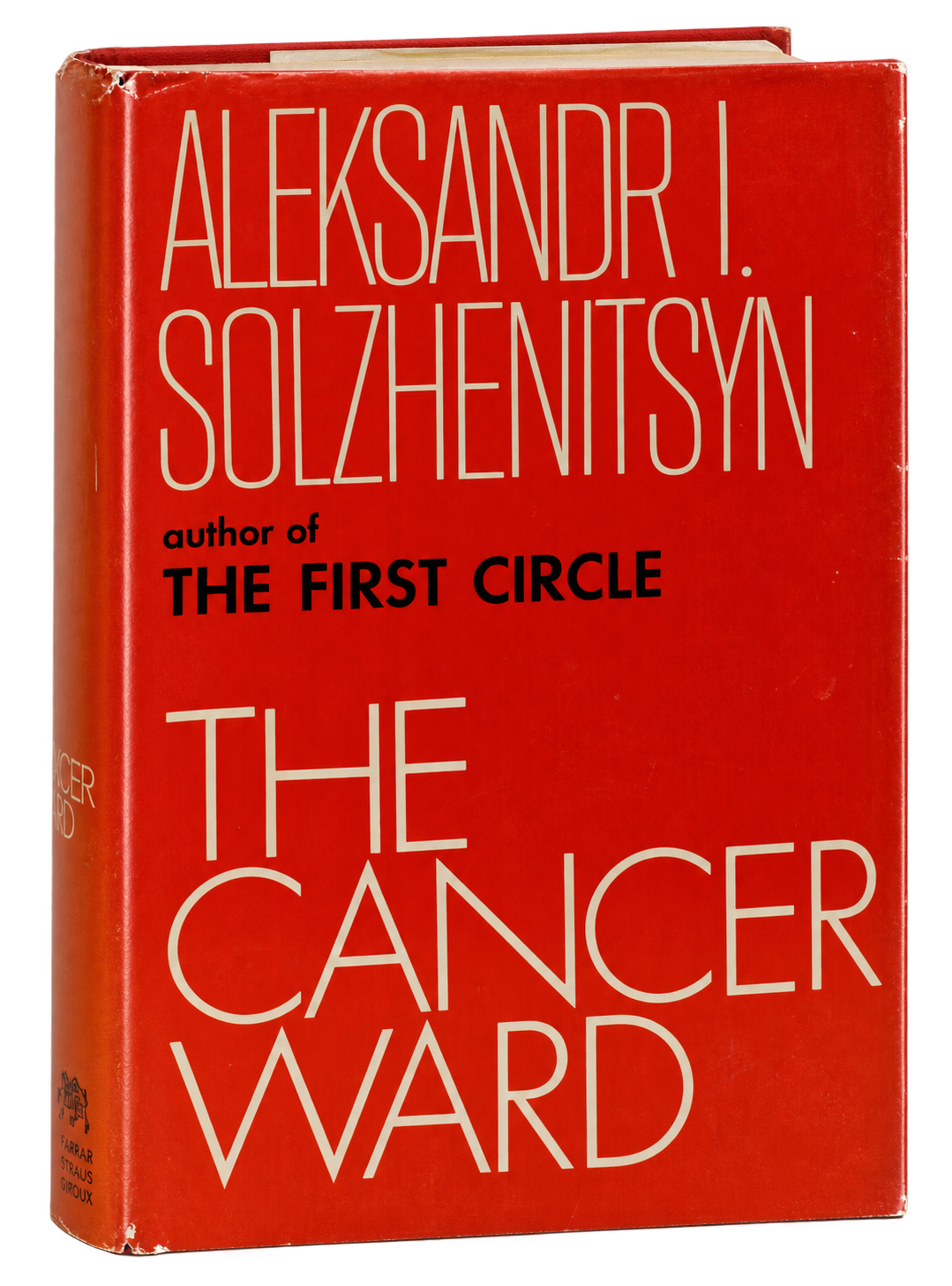
The first American edition, first printing of Alexander Solzhenitsyn’s Cancer Ward, translated from the Russian by Rebecca Frank and published by The Dial Press in 1968. Written after Soviet authorities had again begun closing the space for Solzhenitsyn’s work, the novel transformed a cancer hospital in Soviet Central Asia into a portrait of a society living with the moral aftermath of Stalinism. 616 pp. Original gray publisher’s cloth with black spine lettering and red topstain, retaining the original unclipped dust jacket priced $8.50.
Condition:
Near Fine book in a Very Good+ dust jacket. The binding remains square and tight with an exceptionally clean interior, bright red topstain, and no ownership markings. The original gray cloth shows light scattered spotting. The unclipped jacket remains complete and presents well, with moderate age toning, scattered spotting, light rubbing, and minor edge wear, but no significant tears or paper loss. No restoration or structural defects are observed.
Story Of The Book
The cancer in Cancer Ward is never confined to the human body.
Drawing on his own experiences of imprisonment, exile, and cancer treatment, Solzhenitsyn set the novel in a Soviet hospital shortly after Stalin’s death. Its patients come from across Soviet society: some were damaged by repression, some accommodated themselves to it, and some benefited from it.
The ward becomes a country in miniature. Solzhenitsyn’s question is not simply how people survive a dictatorship. It is what remains inside them after the dictator is gone.
Fear, compromise, guilt, denunciation, and political trauma persist long after Stalin’s death. The illness at the center of the novel becomes a way to examine whether a society shaped by repression can recover simply because the man who embodied the system is no longer alive.
The novel’s publication history sharpened that political meaning. After One Day in the Life of Ivan Denisovich briefly appeared within the Soviet system, Solzhenitsyn was unable to secure domestic publication for Cancer Ward. The manuscript circulated in samizdat before appearing abroad in 1968.
The political opening that had once allowed Solzhenitsyn to speak had closed. The novel survived by leaving the country.
Why It’s In The Collection
Cancer Ward belongs in Consigned to Darkness because censorship is sometimes most revealing when a government has already demonstrated that it is capable of allowing the truth—and then decides it has heard enough.
In 1962, Soviet authorities permitted One Day in the Life of Ivan Denisovich to appear. Only a few years later, Solzhenitsyn could not secure domestic publication for Cancer Ward.
That reversal makes the two books powerful companions. One Day represents an extraordinary opening in Soviet literary control. Cancer Ward documents what happened as that opening closed.
The novel itself also advances Solzhenitsyn’s witness beyond the prison camp. Political repression does not end when prisoners walk through the gates. Its consequences persist in memory, relationships, institutions, habits of fear, and the compromises people made to survive.
This 1968 first American edition preserves the book at the moment Soviet suppression had forced Solzhenitsyn’s work into international circulation. The Rebecca Frank translation was unauthorized, adding another complication to a publication history in which the author had lost control over how a novel he could not publish at home reached readers abroad.
A government had once allowed Solzhenitsyn to describe what Stalinism did to a prisoner. Cancer Ward asked what Stalinism had done to everyone else.
Collection Categories: Witness Literature · Anti-Totalitarianism · Political Imprisonment · Human Rights · Censorship · Free Expression · Political Dissent · Publication-Event Object · Anti-Authoritarianism · Literature
———
Authentication Evidence
Title page identifies Cancer Ward by Alexander Solzhenitsyn, translated from the Russian by Rebecca Frank, and The Dial Press, New York, as publisher.
Copyright page records the 1968 Dial Press publication and explicitly states “First Printing.”
Original gray publisher’s cloth with black spine lettering and red topstain is present.
Original dust jacket is present and remains unclipped at $8.50.
Publisher imprint, binding, jacket typography, and production characteristics correspond to documented copies of the 1968 Dial Press first American edition.
No evidence of book-club manufacture, later printing, rebinding, facsimile jacket, or other bibliographic anomalies is observed.
Taken together, the explicit “First Printing” statement, 1968 Dial Press imprint, Rebecca Frank translation, original publisher’s binding, and original priced dust jacket support identification as an authentic First American Edition · First Printing.