
 Image 1 of 1
Breakfast of Champions — Kurt Vonnegut, Jr.
Full Title: Breakfast of Champions, or Goodbye Blue Monday
Kurt Vonnegut, Jr.
Delacorte Press / Seymour Lawrence · New York · 1973
First Edition · First Printing
The Book:
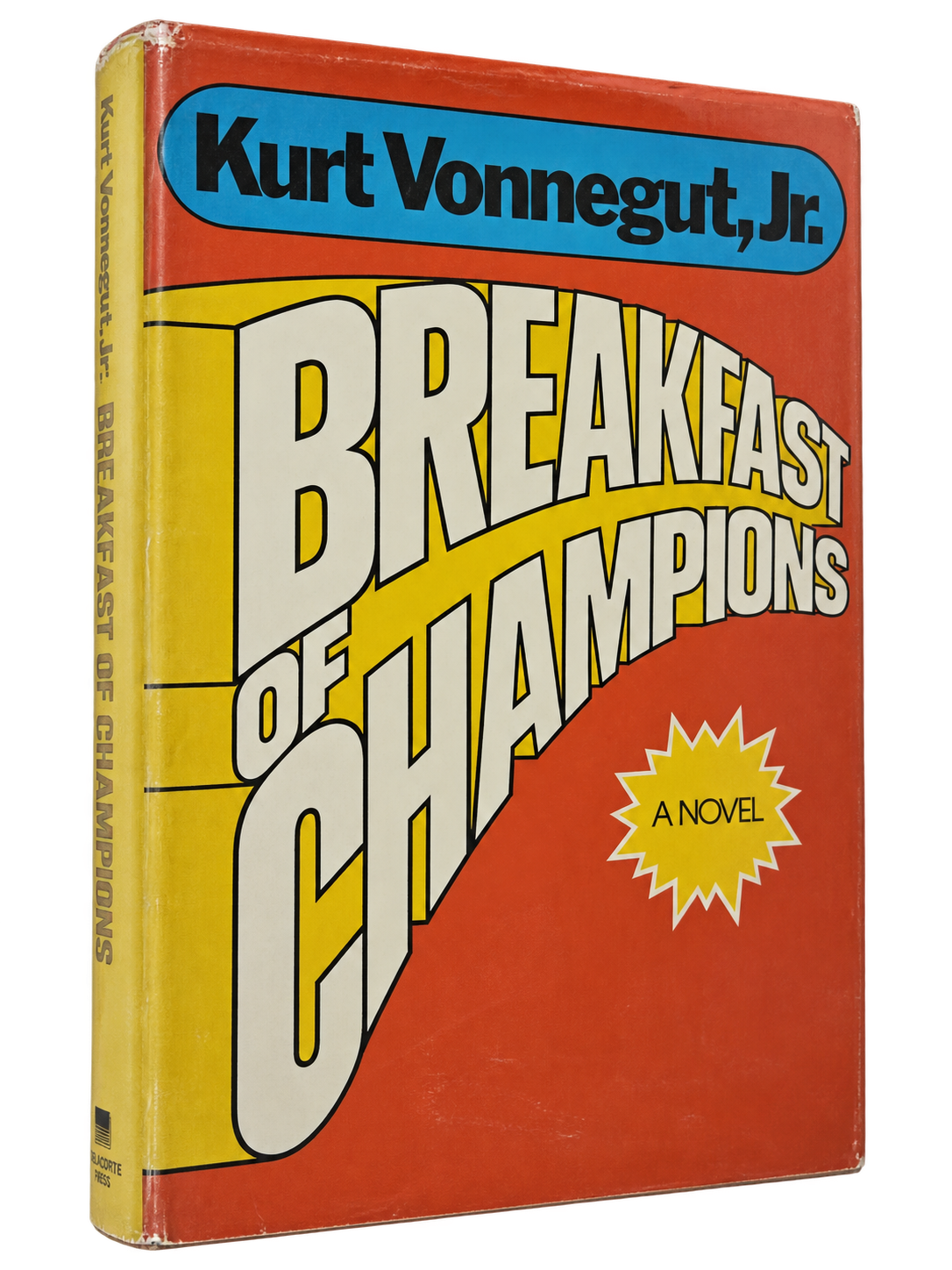
The first edition, first printing of Kurt Vonnegut’s Breakfast of Champions, or Goodbye Blue Monday, published by Delacorte Press / Seymour Lawrence in 1973. Written as Vonnegut turned fifty and dismantling many of the conventions—and even characters—of his earlier fiction, the novel combines satire, metafiction, autobiography, and Vonnegut’s own deliberately crude drawings into a dark inventory of American life. Octavo; [16], 295, [7] pp. This copy retains its original orange cloth, yellow topstain, and original first-state dust jacket, unclipped at $7.95 with the 0573 code. The jacket was designed by Bob Giusti, with Vonnegut’s rear-panel portrait photographed by his wife, Jill Krementz.
Condition:
Very Good+ book in a Good original dust jacket. The orange cloth remains bright and the binding sound, with a clean interior and well-preserved yellow topstain. The original first-state jacket shows substantial wear, including significant chipping at the spine head, edge tears, creasing, and general shelf wear, but remains unclipped with its important first-issue price and code intact.
Story Of The Book
By 1973, Kurt Vonnegut had become one of America’s most famous novelists. Breakfast of Champions is what happened when he turned that fame—and his anger—back on America itself.
Approaching his fiftieth birthday, Vonnegut described the book as an attempt to empty his head of accumulated cultural “junk.” The resulting novel deliberately refuses to behave like a conventional one. Author and characters occupy the same world; familiar figures from earlier books reappear only to be discarded; advertisements, flags, anatomy, corporate logos, crude drawings, and fragments of American history interrupt the narrative as though the country itself has been emptied onto the page.
Beneath the absurdity is a bleak diagnosis of American culture. Through Kilgore Trout, Dwayne Hoover, and Midland City, Vonnegut turns his satire toward consumerism, wealth, environmental destruction, racism, violence, mental illness, free will, and the tendency of institutions and ideas to reduce human beings to things rather than people.
The book was messy, confrontational, enormously popular—and divisive even to its author. Vonnegut later famously graded it a C, yet Breakfast of Champions became one of the works most closely associated with him.
Vonnegut set out to empty his head. What came pouring out was an indictment of the culture that had filled it.
Why It’s In The Collection
Breakfast of Champions belongs in Consigned to Darkness because dissent does not always arrive as manifesto, testimony, or political argument. Sometimes it arrives disguised as a joke.
Vonnegut’s target is not one government or ideology. It is something more diffuse: the systems, assumptions, advertisements, economic arrangements, and inherited stories through which a society teaches people what is normal—and how easily those structures can reduce human beings to consumers, categories, machines, or objects.
The form participates in that rebellion. Vonnegut refuses the authority of conventional storytelling, interrupts his own narrative with crude drawings and commentary, and eventually enters the fictional universe whose inhabitants he controls. The novel becomes an argument not only about authority in American culture, but about the authority of the person writing the book.
This first printing preserves that intervention at its original moment, in the first-state jacket through which readers encountered it in 1973.
Vonnegut did not offer America a better story about itself. He asked why Americans believed the old stories in the first place.
Collection Categories: Literature · Cultural Criticism · Anti-Authoritarianism · Publication-Event Object
———
Authentication Evidence
Title page identifies the work as Breakfast of Champions, or Goodbye Blue Monday by Kurt Vonnegut, Jr.
Title page carries the correct Delacorte Press / Seymour Lawrence publisher identification.
Copyright page explicitly states “First printing—1973,” directly confirming first-printing status.
Original publisher’s orange cloth binding remains present.
Original binding carries Vonnegut’s facsimile signature stamped in gilt on the front board, with gilt and blue spine lettering, consistent with documented first-edition copies.
Original yellow topstain and black endpapers remain present, consistent with documented first-edition copies.
Volume collates to [16], 295, [7] pp., octavo, consistent with specialist bibliographic descriptions of the first edition.
Original dust jacket designed by Bob Giusti remains present.
Rear jacket panel retains the author photograph by Jill Krementz.
Original jacket retains the “Or Goodbye, Blue Monday!” banner associated with the original jacket design.
Original dust jacket is unclipped and retains the $7.95 publisher’s price.
Dust jacket retains the 0573 code, consistent with documented first-state jacket examples.
The combination of “First printing—1973,” $7.95 jacket price, and 0573 jacket code supports identification of the book and jacket as the original first-printing issue.
Documented 1973 Delacorte Book Club editions also exist, making differentiation from the trade issue bibliographically material.
This copy carries the explicit “First printing—1973” statement and the priced $7.95 / 0573 trade dust jacket, distinguishing it from documented book-club issues.
Original illustrations by Vonnegut remain integral to the text.
Publisher imprint, binding, typography, jacket configuration, and production characteristics are internally consistent with documented 1973 first-printing trade copies.
No evidence of book-club manufacture, rebinding, facsimile jacket, or replacement components is observed.
Observable bibliographic evidence supports identification as the 1973 First Edition · First Printing in the original first-state trade dust jacket.