
 Image 1 of 1
Art and Society — Sidney Finkelstein
Sidney Finkelstein
New York: International Publishers, 1947
First Edition · First Printing
The Book:
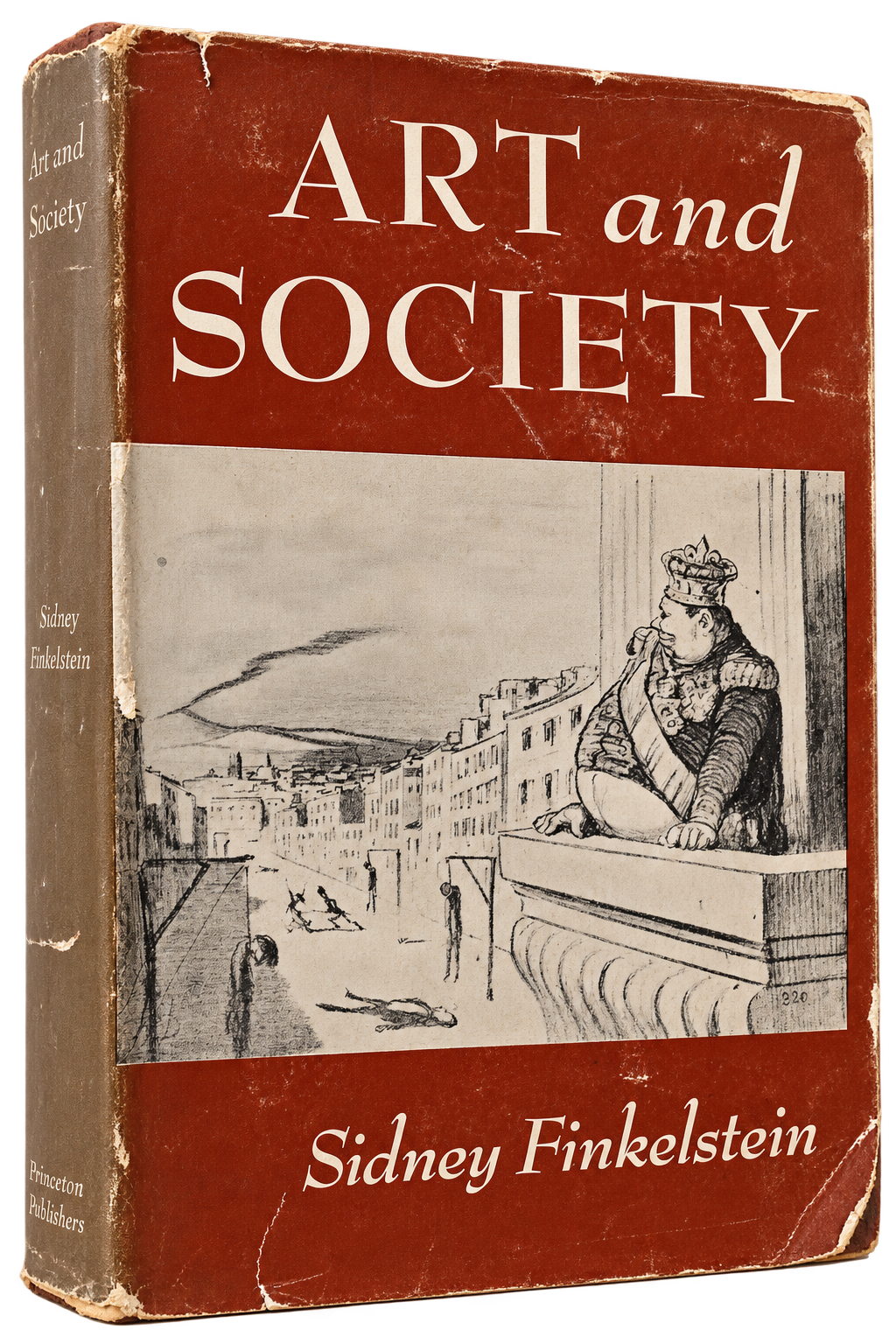
The true first edition, first printing of Sidney Finkelstein’s Art and Society, an early postwar work of Marxist cultural criticism examining the relationship between artistic expression, social organization, and political power. Published by International Publishers in 1947, this copy retains its original brown cloth binding and original first-state dust jacket. The copyright page bears the original 1947 copyright with no indication of a later edition or printing.
Condition:
Very Good in a Good dust jacket. The book retains a sound binding and clean interior with light general shelf wear and an abrasion to the rear board. The original jacket shows moderate edge wear, rubbing, age toning, tape reinforcement, and small losses at the spine ends. Ownership stamps of Philip Sandler and Black and Nobel Books appear on the front endpapers.
Story Of The Book
Who gets to decide whether art is merely beautiful—or whether it has something to say about the society that produced it?
Art and Society appeared in 1947, as the world emerged from fascism and global war into a new struggle over politics, ideology, and culture. Sidney Finkelstein rejected the idea that art could be understood in isolation from that history.
For Finkelstein, paintings, music, literature, and other forms of creative expression did not simply appear from individual genius. Artists lived within societies organized by class, economics, institutions, and political power. Their work inevitably reflected those conditions—and could sometimes challenge them.
That argument placed art inside a much larger twentieth-century debate. Was culture something essentially private and autonomous? Was it shaped by the material conditions of the society around it? Could art reinforce existing structures of power? Could it help people imagine alternatives?
Finkelstein approached those questions from an explicitly Marxist intellectual tradition. That matters. The significance of Art and Society is not that it provides some politically neutral theory of culture. It is that it preserves one side of a consequential argument over who shapes culture, what culture does, and whether artistic expression can ever truly stand outside politics. The inventory identifies the book as an early postwar contribution to precisely this debate over artistic freedom, cultural responsibility, and political power.
Why It’s In The Collection
Art and Society belongs in Consigned to Darkness because control over culture is one of the less obvious ways power operates.
Governments can censor artists. Institutions can determine which voices receive an audience. Political movements can attempt to enlist culture in the service of ideology. Artists, in turn, can reinforce those systems, expose them, reject them, or imagine something beyond them.
Finkelstein’s answer to these questions is ideological and contestable—which makes the book more useful to the collection, not less. Consigned to Darkness is interested not only in books that defended freedom, but in books that reveal how different political traditions understood the relationship between individuals, institutions, culture, and power.
The collection acquired this copy as a true first edition, first printing with its original dust jacket because it preserves the argument in its original postwar context. Rather than treating art as politically neutral, the book participated directly in the broader twentieth-century debate over whether culture reinforces existing systems of power or can become an instrument of intellectual freedom and social transformation.
Power does not only govern what people may say. It also shapes what societies learn to see—and art has always been one place where that power can be contested.
Collection Categories: Free Expression · Cultural Criticism · Political Thought · Marxist Theory · Art and Society
———
Authentication Evidence
• Title page reads International Publishers, New York, consistent with the true first edition published in 1947.
• Copyright page bears the original 1947 copyright with no indication of a later edition, revised edition, or subsequent issue, consistent with the first edition.
• Copyright page contains no later printing statement or indication of a subsequent impression; combined with the 1947 publication and original publisher's binding, this is consistent with the first printing.
• Original International Publishers brown cloth binding matches known first-issue examples.
• Original first-state dust jacket present.
• No evidence of book club manufacture, rebinding, ex-library provenance, or facsimile dust jacket observed.
• The observed bibliographic evidence is consistent with a true first edition, first printing.