
 Image 1 of 1
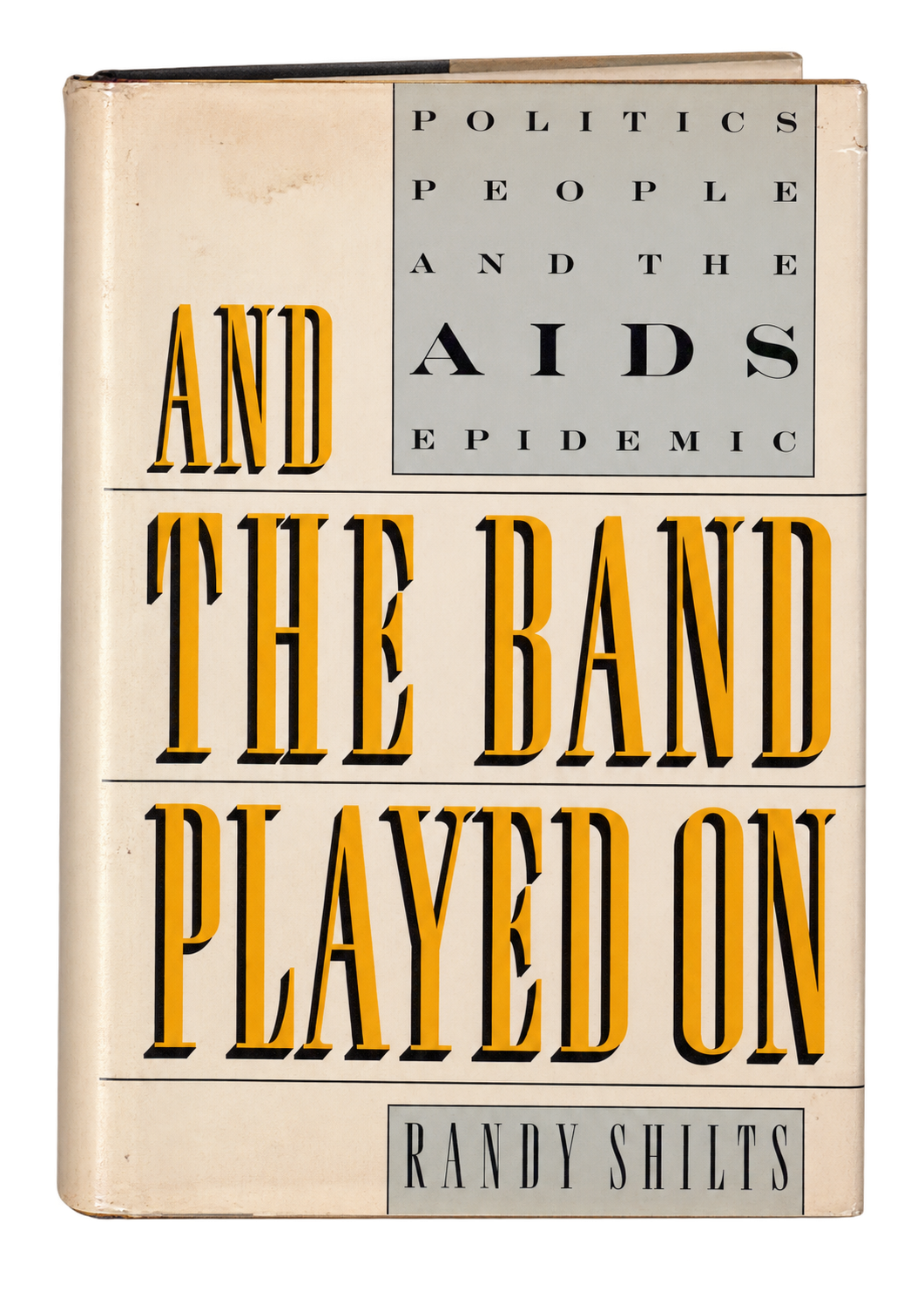
And the Band Played On — Randy Shilts
Full Title:And the Band Played On: Politics, People, and the AIDS Epidemic
Randy Shilts
St. Martin’s Press · New York · 1987
First Edition · First Printing
The Book:
The first edition, first printing of Randy Shilts’s And the Band Played On, published by St. Martin’s Press in 1987 while the AIDS epidemic remained an ongoing national crisis. Drawing on years of reporting, Shilts reconstructed the medical, political, scientific, and human history of the epidemic’s early years and the institutional failures that accompanied it. The complete number line ending in 1 establishes first-printing status; the original unclipped dust jacket retains its $24.95 price. xxiii, 630 pp. Original quarter green cloth over cream paper-covered boards.
Condition:
Very Good+ book in a Very Good+ dust jacket. The binding remains square and sound with a clean text block and bright interior. The green cloth spine shows mild rubbing with partially dulled gilt lettering. Localized adhesive residue and surface disturbance are present on the front free endpaper and facing pastedown from the apparent removal of previously attached material. The original jacket remains bright and complete with light edge wear and minor crumpling at the spine ends. No ownership inscriptions, restoration, or structural defects are observed.
Story Of The Book
The AIDS epidemic was a medical catastrophe. Randy Shilts argued that the scale of the catastrophe was also a failure of institutions.
As a reporter for the San Francisco Chronicle, Shilts had covered AIDS since the earliest years of the crisis. By 1987, tens of thousands of Americans had already been diagnosed, many thousands had died, and entire communities—especially gay men in cities like San Francisco and New York—were living through sustained loss, fear, stigma, and uncertainty.
And the Band Played On attempted to reconstruct how that happened.
Across more than 600 pages, Shilts followed doctors, scientists, activists, patients, politicians, journalists, and government agencies as they confronted—or failed to confront—a disease whose consequences were becoming increasingly impossible to ignore. His reporting exposed bureaucratic delay, political indifference, scientific rivalry, media hesitation, and the stigma surrounding a disease initially associated overwhelmingly with gay men.
But the book’s force comes from never allowing those institutional failures to become abstract. Every delay had a human cost: partners watching partners die, friends becoming caregivers, families facing illness they barely understood, and communities losing people faster than public institutions were willing to respond.
Political decisions and scientific disputes unfold alongside individual lives, giving the book the urgency of reporting rather than retrospective history.
The question running through the book is devastatingly simple: how many people died while institutions with the power to act found reasons not to?
Why It’s In The Collection
And the Band Played On belongs in Consigned to Darkness because silence can become an exercise of power even when no censor orders it.
The institutions Shilts investigated controlled resources that mattered enormously during a public-health emergency: government funding, scientific information, medical authority, political attention, and access to mass media. His reporting documented what could happen when prejudice, bureaucracy, professional rivalry, and political calculation interfered with the willingness to use those resources.
The human stakes were enormous. People were not waiting for an abstract policy dispute to resolve itself. They were getting sick, losing partners and friends, organizing their own care networks, fighting for recognition, and dying while institutions debated jurisdiction, funding, language, and responsibility.
This particular edition is especially important because it is not a later history looking backward at the AIDS crisis. Published in 1987, the book entered the argument while the epidemic was still killing thousands of Americans every year. Its first printing was itself an intervention—an investigation demanding that readers confront what institutions had done, failed to do, and allowed to happen.
The book subsequently became a major reference point in how the early AIDS epidemic was understood, but this copy preserves the moment before that legacy was secure: when Shilts’s investigation first entered public life as an accusation that could no longer easily be ignored.
Collection Categories: Investigative Journalism · Human Rights · LGBTQ+ History · Political History · Free Expression
———
Authentication Evidence
Title page identifies And the Band Played On: Politics, People, and the AIDS Epidemic by Randy Shilts.
Title page identifies St. Martin’s Press, New York, as publisher.
Copyright page records Copyright © 1987 by Randy Shilts.
Copyright page contains the complete number line 10 9 8 7 6 5 4 3 2 1, directly establishing First Printing status.
No later-edition or revised-edition statement appears in the observed publication information.
Independent contemporary publication records identify the St. Martin’s Press hardcover as published in 1987 at 630 pages and $24.95, with a reported 50,000-copy first printing.
ISBN 0-312-00994-1 corresponds to independent bibliographic records of the original 1987 St. Martin’s Press hardcover edition.
Original publisher’s quarter green cloth over cream paper-covered boards is present.
Original unclipped dust jacket is present and retains the printed $24.95 publisher’s price.
Documented first-edition copies independently confirm the quarter-green-cloth/cream-boards binding and $24.95 priced jacket.
No evidence of book-club manufacture, later printing, rebinding, facsimile dust jacket, or restoration is observed.
Taken together, the complete first-printing number line, original 1987 St. Martin’s Press imprint, publisher’s binding, and original priced dust jacket support identification as an authentic 1987 First Edition · First Printing.