
 Image 1 of 1
An Examination of the Age of Reason — Gilbert Wakefield
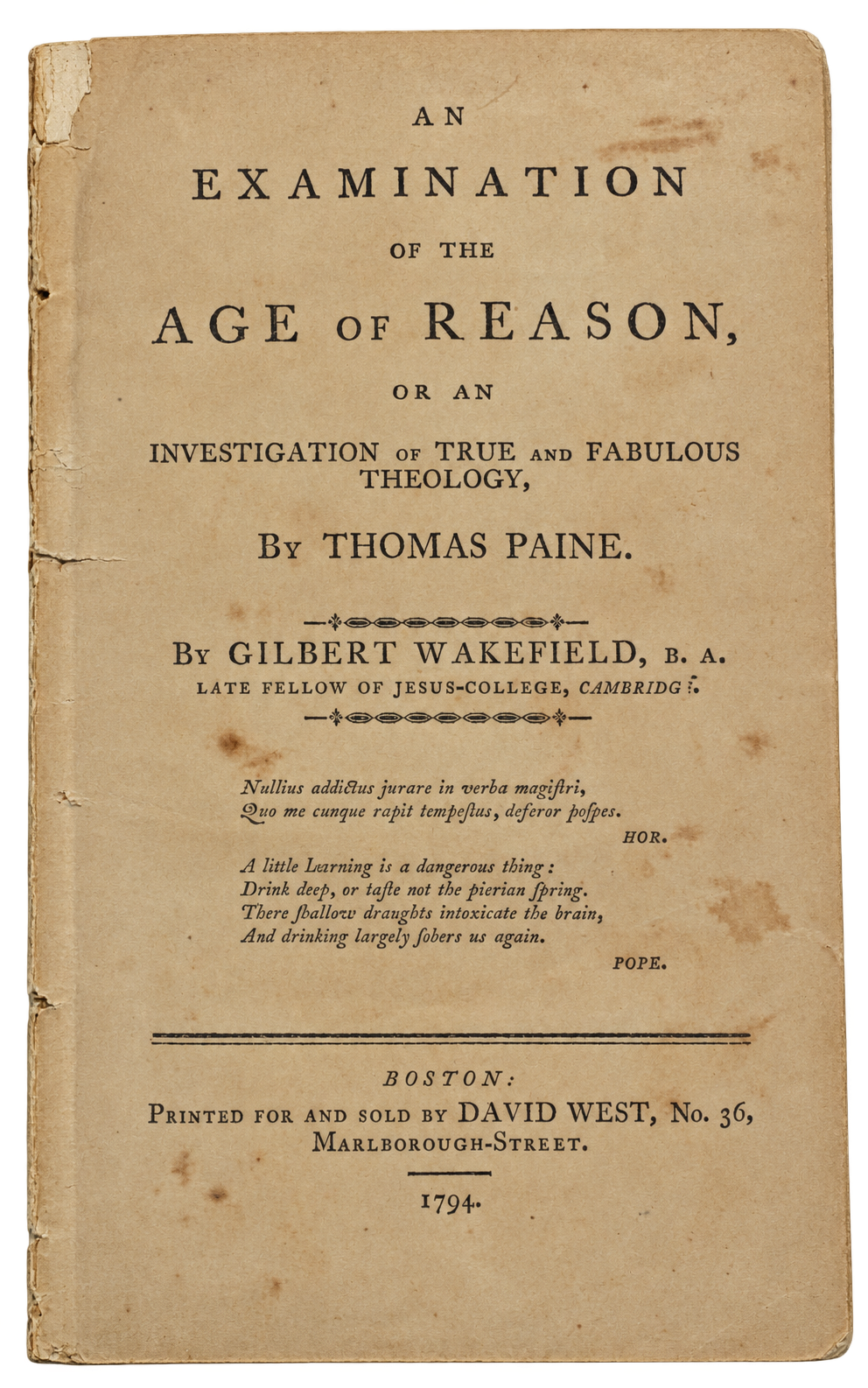
Full Title: An Examination of the Age of Reason, or An Investigation of True and Fabulous Theology, by Thomas Paine
Gilbert Wakefield
Printed for and sold by David West · Boston · 1794
1794 Boston Edition · 1794 Boston Printing · Evans 28016
The Pamphlet:
An original 1794 Boston printing of Gilbert Wakefield’s response to Thomas Paine’s The Age of Reason, printed for and sold by David West at No. 36 Marlborough-Street. Issued in the same year as the London first edition of Wakefield’s response and among four American printings published in 1794, this 36-page pamphlet carried the transatlantic controversy over Paine’s attack on revealed religion directly into the young United States. Preserved disbound from an earlier volume, with its complete title leaf intact. Bibliographically identified as Evans 28016.
Condition:
Good+. Complete 36-page disbound pamphlet with scattered foxing, moderate age toning, light edge wear, and visible evidence of former binding along the irregular spine margin. Title page remains complete and fully legible. No modern rebinding or restoration observed. Preserved in an archival polyester sleeve with acid-free backing board inside a rigid archival protective enclosure.
Story Of The Pamphlet
Thomas Paine challenged revealed religion. Gilbert Wakefield challenged Paine. Neither man was particularly good at accepting what authority told him to believe.
Paine completed the first part of The Age of Reason in revolutionary France while expecting his own arrest. Within hours, he was taken to Luxembourg prison. His attack on revelation, miracles, and institutional religion nevertheless escaped with him: the manuscript had been placed in the hands of Joel Barlow and reached print in 1794.
Wakefield answered that same year. But he was no spokesman for comfortable orthodoxy. A radical Dissenter himself, he admired Paine’s intellect while rejecting his conclusions about scripture, revelation, and resurrection. Their disagreement was therefore something more interesting than believer against unbeliever: two men deeply suspicious of established authority arguing over where reason itself should lead.
Wakefield’s own freedom would eventually collide with the state. In 1799, he was convicted of seditious libel for another political pamphlet and sentenced to two years in Dorchester gaol.
This Boston printing preserves their argument as it reached the young United States in 1794—while Paine himself remained imprisoned in France.
Two dissenters. Two very different heresies. And an argument neither believed authority should be allowed to settle for them.
Why It’s In The Collection
An Examination of the Age of Reason belongs in Consigned to Darkness because free expression becomes most interesting when the people exercising it disagree.
Paine challenged religious authority. Wakefield challenged Paine. Yet Wakefield would himself be imprisoned when his political writing crossed the boundaries the British state was prepared to tolerate.
That history makes this pamphlet unusually revealing. It refuses the easy division between dissident and establishment, radical and censor. The man defending revelation here would later become the prosecuted writer somewhere else.
Published in Boston in 1794, this copy also preserves how quickly that contest crossed the Atlantic. Revolutionary America had not inherited a settled definition of intellectual liberty. It had inherited the opportunity to argue about one.
Paine and Wakefield disagreed about truth. Their lives demonstrated why neither wanted the state deciding it for them.
Collection Categories: Religious Conscience · Free Expression · Political Dissent · Anti-Authoritarianism · Publication-Event Object · Political History
———
Authentication Evidence
Title page identifies Gilbert Wakefield as author and gives the full title An Examination of the Age of Reason, or An Investigation of True and Fabulous Theology, by Thomas Paine.
Title-page imprint reads “Boston: Printed for and sold by David West, No. 36, Marlborough-Street, 1794,” directly establishing the place, publisher/bookseller, and date of this edition.
The imprint distinguishes this copy from the London and other American printings issued in 1794.
Bibliographic identification corresponds to Evans 28016, the 1794 David West Boston printing.
Pamphlet collates to 36 pages, consistent with the bibliographic description of Evans 28016.
Typography, long-s usage, ornamental rules, paper appearance, and visible letterpress impression are consistent with late-eighteenth-century printing.
Irregular former spine margin and surviving sewing/binding evidence are consistent with an original pamphlet formerly bound into a larger volume.
Title leaf remains complete and integral.
No evidence of photographic facsimile reproduction, modern reprint manufacture, supplied title leaf, modern rebinding, or restoration is observed.
The title-page imprint and Evans reference establish this as the 1794 Boston edition and Boston printing.
Multiple American printings appeared in 1794; available evidence does not establish priority among them, and no unsupported claim of “First American Edition” or “First American Printing” is made.
Observable physical and bibliographic evidence supports authentication as the 1794 David West Boston printing, Evans 28016.