
 Image 1 of 1
All Quiet on the Western Front — Erich Maria Remarque
Erich Maria Remarque
Little, Brown, and Company · Boston · 1929
First American Edition · First Printing
The Book:
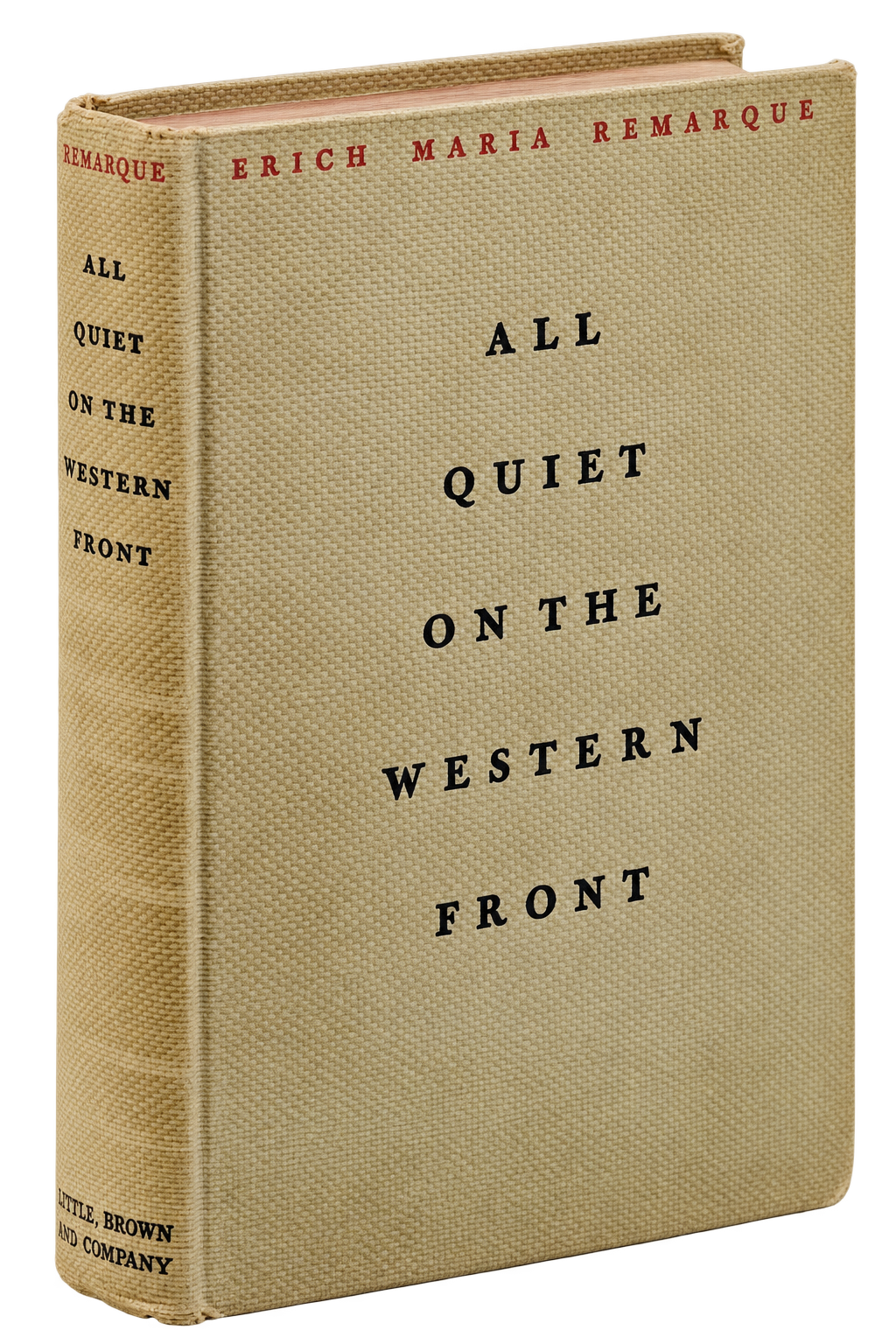
The first American edition, first printing of Erich Maria Remarque’s All Quiet on the Western Front, translated from the German by A. W. Wheen and published by Little, Brown in June 1929. One of the defining literary accounts of the First World War, the novel rejected heroic mythology in favor of the exhaustion, terror, and psychological destruction experienced by ordinary soldiers. This copy retains its original oatmeal publisher’s cloth with black lettering and red author lettering.
Condition:
Near Fine, without dust jacket. The original oatmeal cloth remains exceptionally clean and well preserved, with crisp black lettering, strong red author lettering, sharp corners, and only very minor evidence of handling. The original red topstain remains present. The binding is square and tight and the interior remains bright and clean, with no significant ownership markings, foxing, structural weakness, or restoration observed.
Story Of The Book
Governments had described the First World War in the language of patriotism, sacrifice, and glory. Remarque described what happened to the people asked to fight it.
A German veteran himself, Remarque centered the novel on Paul Bäumer and a generation of young soldiers whose identities are steadily consumed by industrialized warfare. The enemy is not simply the opposing army, but the machinery of nationalism and militarism that turns young men into instruments of political ambition.
The book became an international phenomenon almost immediately—and later a target. After the Nazis came to power, Remarque’s work was denounced as un-German, banned, and burned.
A novel written against the glorification of war had become intolerable to a regime preparing Germany for another one.
Why It’s In The Collection
All Quiet on the Western Front belongs in Consigned to Darkness because it challenged one of the most powerful narratives governments use to justify violence: that war ennobles the people who fight it.
Remarque instead restored individuality, fear, grief, and physical suffering to soldiers otherwise absorbed into patriotic abstraction. The Nazi regime’s later suppression of the novel demonstrated how threatening that testimony could become to an authoritarian state built around militarism and nationalist myth.
This 1929 first American printing preserves the novel at the moment it entered American public life—before its author was driven into exile and before the book itself became an object of Nazi censorship and destruction.
Collection Categories: War & Conflict · Anti-War Literature · Censorship · Anti-Authoritarianism · Free Expression · Exile & Émigré Literature · Literature · Publication-Event Object
———
Authentication Evidence
Correct Little, Brown, and Company title page dated 1929, confirming the first American edition
Copyright page states “Published June, 1929”
Copyright page explicitly states “First Printing,” confirming first printing
Translation credited to A. W. Wheen, consistent with the first American edition
Original oatmeal publisher’s cloth binding present
Original red-and-black lettering to the front board and spine present, consistent with documented first American copies
Original red topstain present and physically confirmed
Collation: [6], 291 pp.
Deckled fore-edge and bottom edge present
Original dust jacket not present
Publisher imprint, typography, binding, and physical construction consistent throughout
No evidence of book-club manufacture, rebinding, later issue, facsimile production, or restoration observed
Observable bibliographic evidence, including the explicit “First Printing” statement, supports identification as the 1929 Little, Brown First American Edition · First Printing.