
 Image 1 of 1
Ai Weiwei on Censorship — Ai Weiwei
Ai Weiwei
Thames & Hudson · New York · 2026
First US Edition · First Printing · Signed
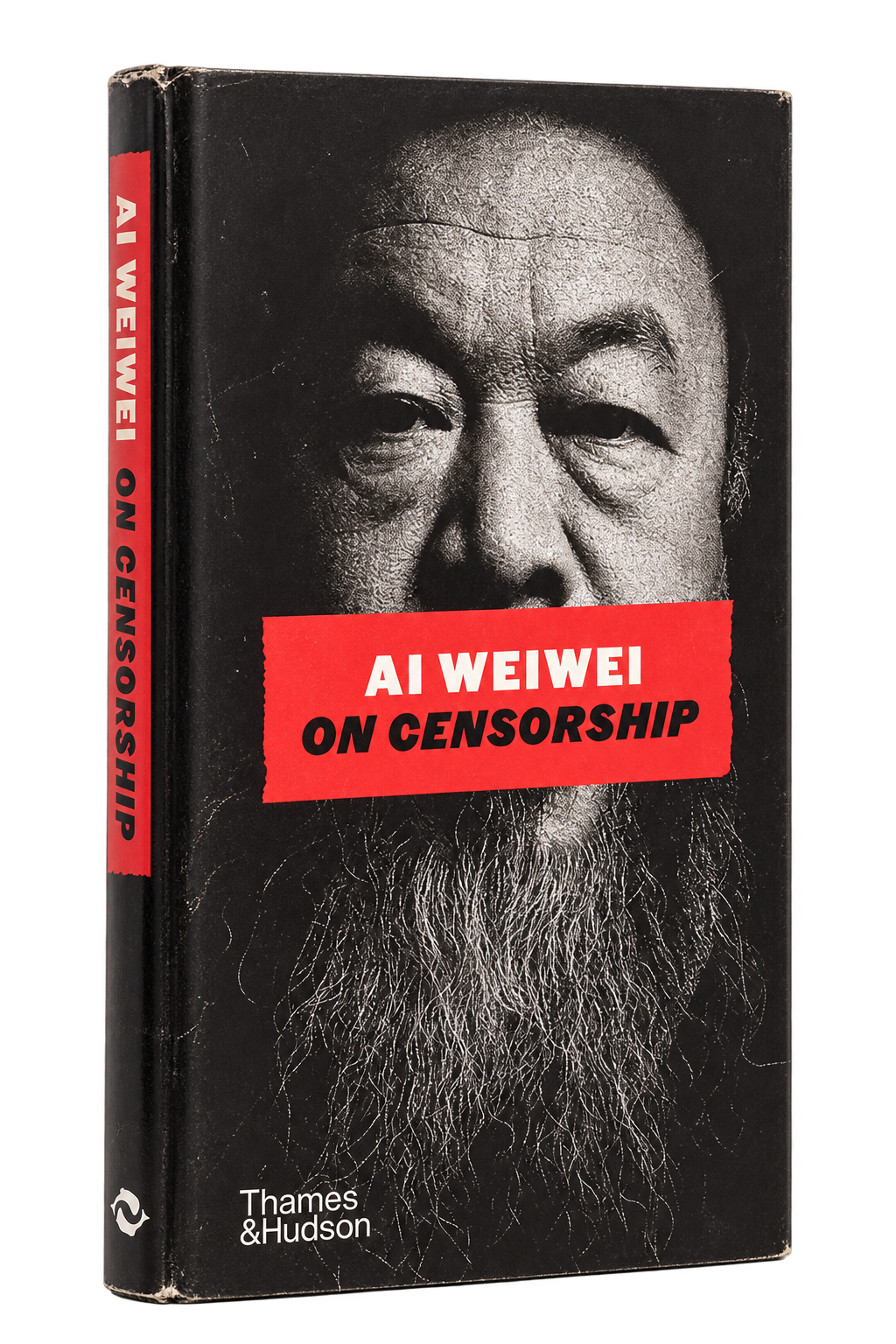
The Book:
The signed First American Edition · First Printing of Ai Weiwei’s Ai Weiwei on Censorship, published by Thames & Hudson in 2026. In this concise 88-page work, illustrated with 10 images, Ai draws upon decades of firsthand experience with state surveillance, detention, censorship, and restrictions on artistic expression to examine how censorship operates through governments, corporations, technology platforms, institutions, social pressure, and self-censorship. Signed by Ai Weiwei in black marker on the front free endpaper. Original black publisher’s boards and original unclipped $15.95 / CAN $21.95 dust jacket retained.
Condition:
Fine book in a Fine original dust jacket. Black publisher’s boards remain exceptionally clean with sharp corners, square binding, bright pages, and no observable wear, ownership markings, foxing, or structural defects. The original unclipped jacket remains in Fine condition and has been protected in an archival polyester cover since acquisition. Signed by Ai Weiwei on the front free endpaper.
Story Of The Book
Ai Weiwei does not approach censorship as an abstraction. He knows what it feels like when power decides that your voice has become dangerous.
For decades, Ai’s art and activism have collided with the Chinese state. His criticism of government secrecy and political authority brought surveillance, restrictions, the destruction of his studio, and detention. In 2011, authorities held him for 81 days while his disappearance became an international symbol of the risks faced by artists who challenge state power.
Ai Weiwei on Censorship turns those experiences outward. Ai argues that censorship is not confined to dictatorships or the obvious banning of a book or silencing of an artist. It can operate through surveillance, corporate power, digital platforms, cultural institutions, social conformity, and ultimately self-censorship—the moment people begin restricting themselves because they have learned what expression may cost them. Thames & Hudson describes the book as addressing censorship within both authoritarian regimes and democratic societies, particularly in an age of big data and mass surveillance.
The book became a Sunday Times bestseller, carrying Ai’s argument beyond the specialist worlds of contemporary art and human-rights advocacy to a broad contemporary readership.
The most effective censor may be the one who no longer has to tell you to be silent.
Why It’s In The Collection
Ai Weiwei on Censorship belongs in Consigned to Darkness because the person describing the machinery of censorship is someone who has lived inside it.
Ai is both observer and participant. His arguments about surveillance, artistic freedom, political control, and self-censorship emerge from a life in which expression repeatedly carried personal consequences. The result is not simply an analysis of censorship, but testimony from one of the world’s most recognizable living dissidents about how power teaches people what they are—and are not—permitted to say.
Its contemporary perspective matters just as much. Many objects in this collection preserve censorship battles after history has rendered its judgment. Ai asks what censorship looks like now, when control can be distributed among governments, corporations, digital platforms, institutions, and individuals who anticipate punishment before anyone explicitly threatens it.
And in this copy, the relationship between author and object is unusually direct. The name signed inside belongs to the person whose confrontation with censorship gives the book its authority.
Collection Categories: Free Expression · Censorship · Anti-Authoritarianism · Human Rights · Political Dissent · Witness Literature · Publication-Event Object · Signed
———
Authentication Evidence
Title page identifies the work as Ai Weiwei on Censorship by Ai Weiwei.
Copyright page explicitly states “First published in the United Kingdom in 2026,” establishing that the work was first issued in the UK.
Copyright page explicitly states “First published in the United States of America in 2026 by Thames & Hudson Inc.,” establishing this copy as the First American Edition.
Independent publisher records date the original UK publication to 29 January 2026; American booksellers record the U.S. publication on 3 March 2026, corroborating the UK-before-U.S. publication sequence stated in the book itself.
No subsequent-printing statement appears in the volume; observed publication evidence supports identification as the First American Edition · First Printing.
Copyright page carries ISBN 978-0-500-03082-0, corresponding to the hardcover issue.
Copyright page identifies the volume as printed and bound in Italy by L.E.G.O. Spa.
Publisher records give a collation of 88 pages with 10 illustrations.
Original black publisher’s boards remain present.
Original illustrated dust jacket remains present.
Original dust jacket is unclipped and retains the $15.95 / CAN $21.95 publisher’s price.
An original handwritten Ai Weiwei signature in black marker appears on the front free endpaper.
The signature is physically applied to this copy and is not printed, reproduced, or part of the publisher’s design.
Publisher imprint, binding, jacket, ISBN, and production characteristics are consistent with the documented 2026 hardcover issue.
No evidence of book-club manufacture, ex-library ownership, remainder marking, rebinding, facsimile jacket, or replacement components is observed.
Observable bibliographic evidence supports identification as the 2026 First American Edition · First Printing, signed by Ai Weiwei.